






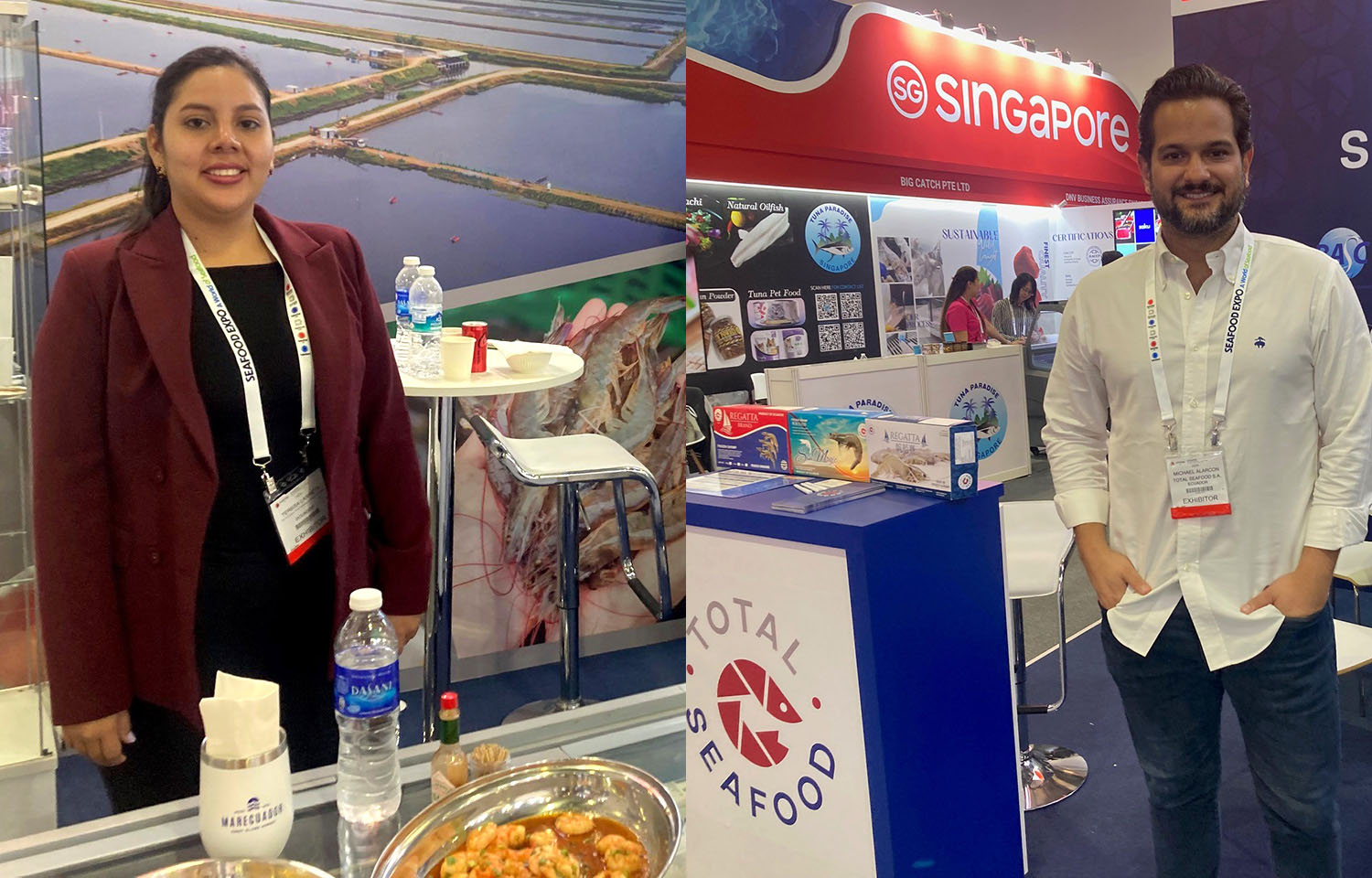
Prices for Ecuadorian shrimp hit some of their lowest levels ever in June on weak demand, according to Total Seafood General Manager Michael Alarcón Arcentales.
Interviewed at the at the 2024 Seafood Expo Asia, which took place from 4 to 6 September in Singapore, Diosmar Sales Executive Teresa Larreta agreed prices were “very, very low” over the summer.
But, both Alarcón Arcentales and Larreta said year-end holiday buying has begun, pushing prices up USD 0.40 (EUR 0.36) per pound.
“We have an upcoming high-demand period over September and October for New Year's in the U.S., Europe, and then China. So, I think prices are on an upward trend,” Alarcón Arcentales told SeafoodSource.
Larreta agreed prices are rising after hitting their rock bottom in June.
“In the last month, it got more steady. We’re starting to see an increase in interest, especially from the Chinese market. They have started to buy for the Mid-Autumn Festival, National Day in October, and New Year is upcoming for them also. So, the price has increased,” Larreta said.
Guayaquil, Ecuador-based Diosmar is a group of companies involved in farming, processing, and exporting shrimp, with around 4,000 hectares of farms producing 120 million pounds of shrimp annually.
Total Seafood exports 160 containers of shrimp monthly, with 60 percent heading to China, 25 percent to the U.S., and 10 percent to Europe.
Between January and July 2024, Ecuador’s shrimp exports to China dropped 23 percent by value and 11 percent by volume year over year, and with Ecuador accounting for 75 percent of China’s shrimp imports, the ebbing demand has taken a toll on Ecuador’s shrimp industry.
“It’s very, very competitive,” Larreta said.
China’s seafood imports had been recovering after Covid-19, but a major decline began in February 2024, partially blamed on a broader downturn in the country’s economy. China's seafood imports dropped 11.7 percent year over year in the first half of 2024 to USD 8.5 billion (EUR 7.6 billion), according to data released by China Customs.
“For us and for all Ecuadorian companies, it makes a big difference what China does,” Larreta said. “Beyond being such an important market itself, it definitely defines the behavior of the prices worldwide.”
Larreta said Diosmar is working to grow its exports 20 percent in the next few years, and the company’s long-term bullish outlook for China is an important factor in that decision. A new free trade deal between the two countries will help, and despite a mixed forecast in the medium term, China’s seafood imports are projected to reach USD 18 billion (EUR 16 billion) again in 2025, approaching the historical highs of 2022 and 2023, They’re set to grow by 5 to 6 percent through 2028, slightly outpacing GDP growth and setting it on track to become the world’s top seafood importer by value, according to a Beijing Haiqiao Marketing report.
Between China’s white-spot controls, its Covid import restrictions, and, more recently, challenges around metabisulfites, selling into China has taken on a higher degree of uncertainty, according to both Larreta and Alarcón Arcentales.
“It is always a challenge, but we have to comply with whatever authority of any market requires. The key thing is that clear rules are set. Once we know how to deal with those rules, we're ready to comply with them,” Alarcón Arcentales said. “There’s always a shakeup in the market when these situations begin because they come all of a sudden and it's not very clear how to follow the rules. But, once everything is cleared up, we can manage it.”
For Total Seafood, the metabisulfite situation has been resolved after implementing a wider set of procedures and parameters for testing of its product.
“We now test three times every batch for every truck that comes into the factory to make sure we are compliant with the amount of [metabisulfite biproduct] SO2 residue. So now that we know how to handle it and what to expect from farmers and how to treat the product in the farm, the process is smoother,” he said. “Every time there's a new challenge from Chinese customs or authorities, the first shake-up is the hardest part, and then you have to learn how to deal with it and it gets better.”
For Diosmar, communication is key to handling clients in China.
“We try to keep fluid communication with our clients. They want the shrimp, and we know they want the shrimp. And of course, they don't want to have troubles or issues because having issues in the port of destination will mean a return. So, we work together to try to solve problems – especially before sending the container,” Larreta said.
Ecuador’s shrimp industry has also faced headwinds in the U.S. market this year, especially after the U.S. Commerce Department imposed antidumping and countervailing duties of up to 13.5 percent on most Ecuadorian shrimp exporters.
“The U.S. has been a challenge this year, not just for exporters but for importers as well. We've worked very hard to get close to our customer base in the U.S., so we've been able to handle the situation the best way possible with them,” Alarcón Arcentales said. “At first, we were a little bit reluctant to sell DDP [duty delivery paid], but then this is what the market required, so now we're doing it. We thought it was going to be a little bit more challenging than it really was. It does have an impact on your cash flow, but other than that, it’s just a regular export.”
Larreta complained about unfairness in the market as Santa Priscila, Ecuador’s largest shrimp exporter, received an exemption from the U.S. government, which ruled it was not engaging in dumping on a level significant enough to qualify for duties.
“So many clients have stopped buying because DDP costs are very high,” she said. “We do not have the advantage of some other companies that may have low DDP.”
Further complicating matters for Total Seafood and Diosmar is a downturn in production in recent months due to a cold snap that has reduced growth, and some farmers deciding to stock lower densities. Lower supply has helped push up prices a bit, according to Alarcón Arcentales, but continued production declines could create conditions for industry consolidation.
“Big farming groups are still expanding production, and the companies that run the traditional big factories, they're also purchasing farms,” he said. “I don't see a big shakeup in the market when there’s still demand for shrimp. But at the end of the day, it’s up to each factory to be competitive, because the prices are dictated by the markets, and each factory must know best how to manage the situation around supply and demand.”
Larreta agreed some Ecuadorian shrimp companies may be forced to close if demand remains low and costs continue to rise.
“Companies without their own farms are especially going to get squeezed between higher prices and higher costs, and probably they won't make it because the domestic market is also having high prices, so when processing plants have to buy from local farmers, they are probably losing money – only the biggest companies can afford to do business in those conditions,” she said. “We expect prices to continue increasing, and hopefully by October, we will have a better scenario. But until that time, there may be some smaller farmers and processing plants that may not last.”
Larreta mentioned an additional factor of concern for Diosmar – a problem with larvae not growing as robustly as expected, along with higher mortalities.
“There is an issue in the larvae; there is not enough survival,” she said. “So, [some companies] probably will have less shrimp production, and that will mean the price will increase in the domestic market. And second, some companies won’t have much shrimp to offer, so probably some companies may close.”
Ecuador Cámara Nacional de Acuacultura Communications Director Shirley Suasnavas said her group, which represents nation’s shrimp industry, hadn’t yet heard of this problem.
“At the moment, we have no reports from producers or, most importantly, from the official Ecuadorian authorities,” she told SeafoodSource via email. “It is likely a specific situation. It is important to remember that during the cold season, shrimp experience stress, which can lead to these health problems.”
Key for Ecuadorian shrimp exporters striving to survive during these difficult times will be diversifying exports, according to both Larreta and Alarcón Arcentales.
“China is a natural market for the industry, but we are always trying to be diversified in other markets as well. So we've been very active in Middle East markets, South Africa, other markets in Asia, Japan, and Malaysia as well,” Alarcón Arcentales said.
For Diosmar, Taiwan and Japan are the primary targets.
“Taiwan is having good prices for live frozen [shrimp]. So right now, we're exporting headless shell-on and life frozen, and we also think those products will do well in Japan, because Vietnam prices are also increasing, and Japan has always been buying from Vietnam, but maybe now they will consider looking at Ecuadorian shrimp,” Larreta said.
