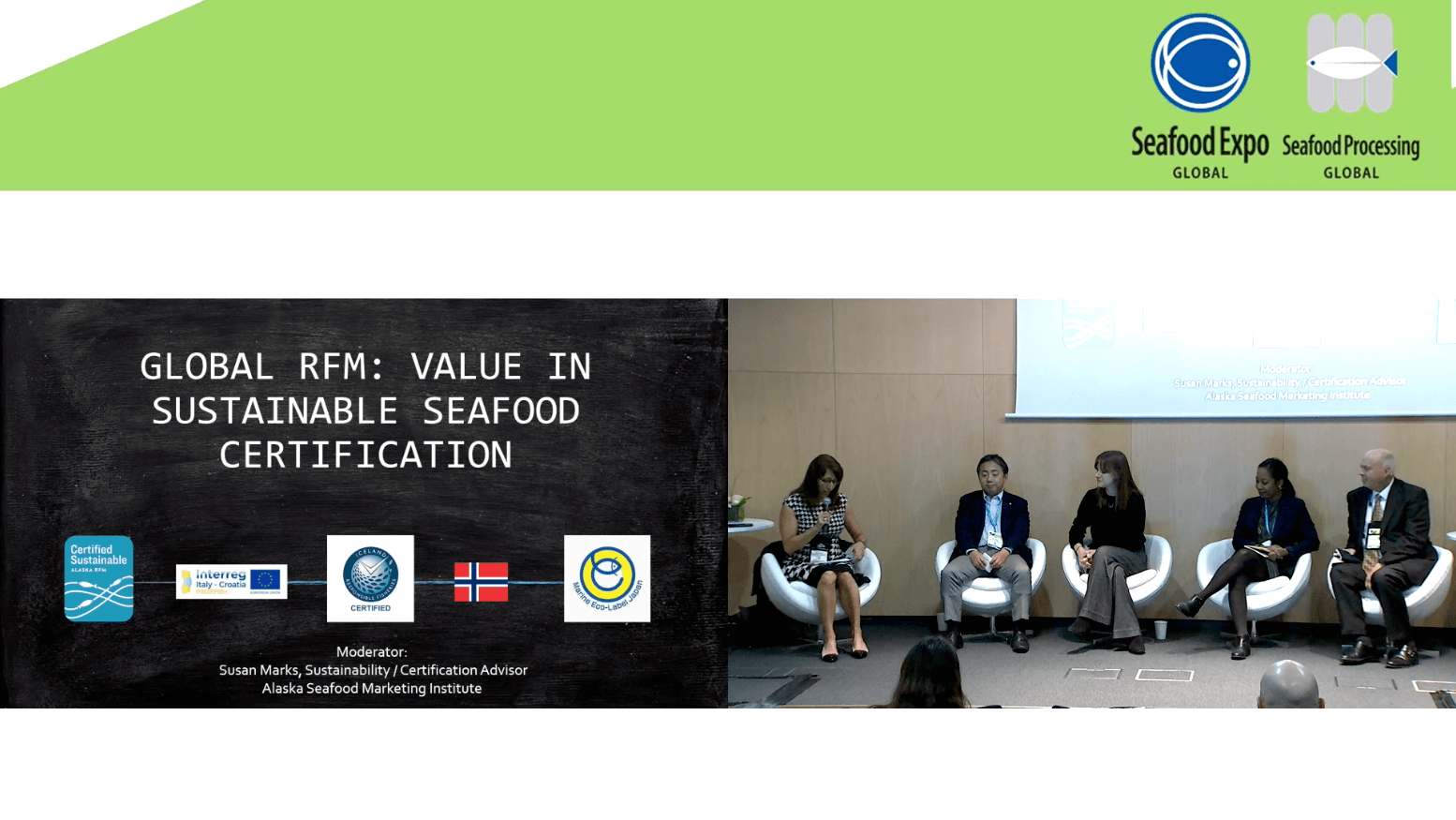
Global RFM: Value in Sustainable Seafood Certification
Speakers: Sévrine Bethy, Food Safety and Responsible Sourcing Manager - Group Supply Management - SODEXO, Hisa Kanno, Secretary General / Technical Manager - Marine Eco-Label Japan Council, Allen Kimball, International Fisheries Operations and Sales Consulting - Trident Seafoods, Giulia Sandalli, Postdoctoral research fellow - Institute for Marine Biological Resources and Biotechnology of the National Research Council (CNR-IRBIM), Sigrid Merino Sardá, Managing Director - Iceland Responsible Fisheries Foundation
The Responsible Fisheries Management (RFM) certification programs offer a way for markets to provide certified, sustainable seafood and highlight the origin without the added expense of logo-licensing fees. Research shows that origin is often a key motivator for seafood purchases and consumers continue to demand more transparency in knowing where their food comes from. (Datassentials; Edelman Trust Barometer 2021) Many certification programs do not include origin on their logos leaving consumers in the dark about where their sustainable seafood comes from. Our goal is to make certified sustainable and traceable wild-caught seafood accessible to all. RFM based programs in Alaska, Iceland, The Gulf States, and Japan have gained momentum in the last few years, with all four achieving recognition to the Global Sustainable Seafood Initiative (GSSI) global benchmark. These programs are accredited and rooted in the Food and Agriculture Organization (FAO) Code of Conduct for Responsible Fisheries and provide a way for well-managed fisheries to be recognized as sustainable. For the supply chain, RFM programs provide a credible and affordable certification choice for customers who want to:
• Demonstrate proof of sustainable seafood sourcing;
• Highlight the origin of their certified sustainable seafood via an ecolabel that is free to use;
• Lessen the cost burden for all participants in the supply chain.
This panel will discuss how the various RFM Programs in North America, Iceland, and Japan are working together towards a future vision for a global RFM program that will eventually represent 6,000,000+ metric tons of certified, sustainable wild-caught seafood and why this appeals to other countries that are interested in offering RFM certification for their fisheries.
We will hear from fisheries in the European Union who are currently considering development of their own RFM program and why they have decided now is the time to explore alternative certification programs. You will learn about the shared Chain of Custody Standard between Alaska and Iceland and how this model is serving as a blueprint for future collaborations between RFM programs that will benefit the marketplace. We will also hear from industry how using the RFM Program adds value and saves money. Finally, we will discuss the difference between the RFM model of certification and other programs that charge a fee to gain market access. How can these programs exist and not charge logo-licensing fees? It is possible and is the foundation these programs are committed to upholding.
Content Access
|
$45.00
|
|
$45.00
|
|
Global RFM: Value in Sustainable Seafood Certification
Speakers: Sévrine Bethy, Food Safety and Responsible Sourcing Manager - Group Supply Management - SODEXO, Hisa Kanno, Secretary General / Technical Manager - Marine Eco-Label Japan Council, Allen Kimball, International Fisheries Operations and Sales Consulting - Trident Seafoods, Giulia Sandalli, Postdoctoral research fellow - Institute for Marine Biological Resources and Biotechnology of the National Research Council (CNR-IRBIM), Sigrid Merino Sardá, Managing Director - Iceland Responsible Fisheries Foundation
The Responsible Fisheries Management (RFM) certification programs offer a way for markets to provide certified, sustainable seafood and highlight the origin without the added expense of logo-licensing fees. Research shows that origin is often a key motivator for seafood purchases and consumers continue to demand more transparency in knowing where their food comes from. (Datassentials; Edelman Trust Barometer 2021) Many certification programs do not include origin on their logos leaving consumers in the dark about where their sustainable seafood comes from. Our goal is to make certified sustainable and traceable wild-caught seafood accessible to all. RFM based programs in Alaska, Iceland, The Gulf States, and Japan have gained momentum in the last few years, with all four achieving recognition to the Global Sustainable Seafood Initiative (GSSI) global benchmark. These programs are accredited and rooted in the Food and Agriculture Organization (FAO) Code of Conduct for Responsible Fisheries and provide a way for well-managed fisheries to be recognized as sustainable. For the supply chain, RFM programs provide a credible and affordable certification choice for customers who want to:
• Demonstrate proof of sustainable seafood sourcing;
• Highlight the origin of their certified sustainable seafood via an ecolabel that is free to use;
• Lessen the cost burden for all participants in the supply chain.
This panel will discuss how the various RFM Programs in North America, Iceland, and Japan are working together towards a future vision for a global RFM program that will eventually represent 6,000,000+ metric tons of certified, sustainable wild-caught seafood and why this appeals to other countries that are interested in offering RFM certification for their fisheries.
We will hear from fisheries in the European Union who are currently considering development of their own RFM program and why they have decided now is the time to explore alternative certification programs. You will learn about the shared Chain of Custody Standard between Alaska and Iceland and how this model is serving as a blueprint for future collaborations between RFM programs that will benefit the marketplace. We will also hear from industry how using the RFM Program adds value and saves money. Finally, we will discuss the difference between the RFM model of certification and other programs that charge a fee to gain market access. How can these programs exist and not charge logo-licensing fees? It is possible and is the foundation these programs are committed to upholding.
Content Access
|
|
|
|
$0.00
|
|
$0.00
|
|
|
|
|
|
|
$40.00
|
|
$40.00
|
|
|
|
|
|
|
$0.00
|
|
$0.00
|
|
|
|
|
|
|
$40.00
|
|
$40.00
|
|
|
|
|
Plenary: 3 Ways To Incorporate a Diversity and Inclusion Program To Benefit Your Business
Speaker: Tony Byers, PhD, Former Director, Global Diversity & Inclusion, Starbucks
A properly managed diversity and inclusion program can increase engagement, creativity and business performance. By also learning to leverage diversity and inclusion through best practices, organizations can turn D&I into a powerful business advantage that stimulates innovation and drives marketplace growth.
In this plenary presentation, Dr. Tony Byers shows you how to leverage talent to make business stronger, improve processes and how to find and retain top talent.
Content Access
|
$45.00
|
|
$45.00
|
|
Plenary: 3 Ways To Incorporate a Diversity and Inclusion Program To Benefit Your Business
Speaker: Tony Byers, PhD, Former Director, Global Diversity & Inclusion, Starbucks
A properly managed diversity and inclusion program can increase engagement, creativity and business performance. By also learning to leverage diversity and inclusion through best practices, organizations can turn D&I into a powerful business advantage that stimulates innovation and drives marketplace growth.
In this plenary presentation, Dr. Tony Byers shows you how to leverage talent to make business stronger, improve processes and how to find and retain top talent.
Content Access
|
|
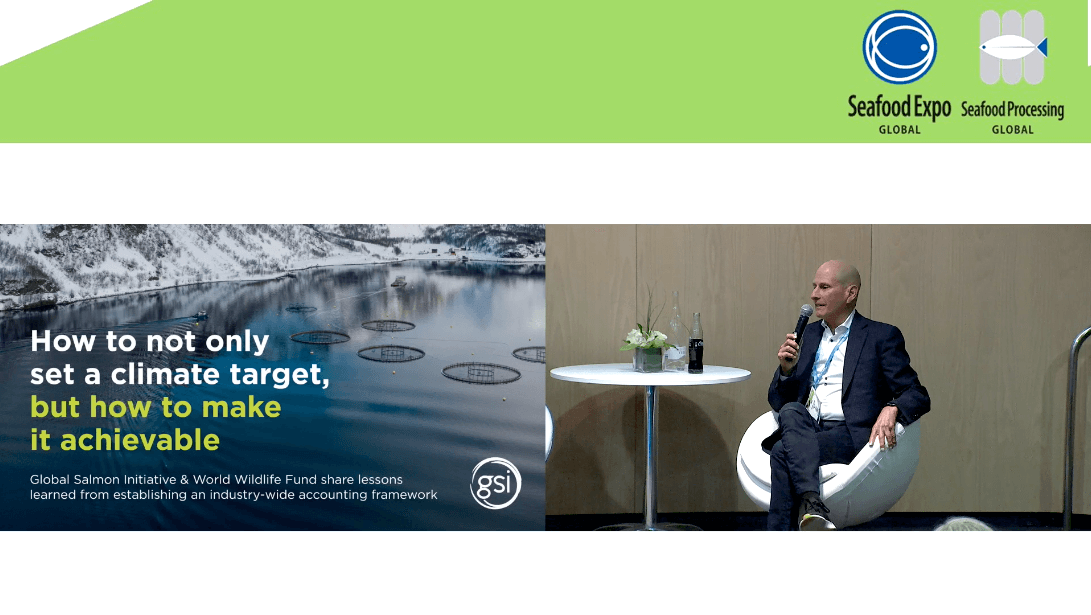
How to Not Only Set a Climate Target, but Actually Make it Achievable. Lessons from Salmon Aquaculture.
Speakers:
Avrim Lazar
Carlos Diaz
Kristina Furnes
Emily Moberg
Sophie Ryan
The race to zero is on, and we know it needs to be done. But the question is how do we get there? Aquaculture already has a low carbon footprint, but improvements still need to be made to ensure we maintain our position as a climate-friendly option. The changes required are across the supply chain, and affect the whole industry, no matter of location. Recognizing that collective efforts could help accelerate change, over the last year the Global Salmon Initiative has been working in partnership with the World Wildlife Fund to establish an accounting framework for greenhouse gas emissions for the farmed salmon sector, from feed to consumer. Prioritizing stakeholder collaboration and shared learning, this project has developed a cohesive accounting framework with ambitious mitigation goals in mind. In this session we will share how the framework was developed, its uses for both farmed salmon and the wider aquaculture industry, and the many opportunities collaboration offers in scaling mitigation efforts from on the ground experience.
Content Access
|
$45.00
|
|
$45.00
|
|
How to Not Only Set a Climate Target, but Actually Make it Achievable. Lessons from Salmon Aquaculture.
Speakers:
Avrim Lazar
Carlos Diaz
Kristina Furnes
Emily Moberg
Sophie Ryan
The race to zero is on, and we know it needs to be done. But the question is how do we get there? Aquaculture already has a low carbon footprint, but improvements still need to be made to ensure we maintain our position as a climate-friendly option. The changes required are across the supply chain, and affect the whole industry, no matter of location. Recognizing that collective efforts could help accelerate change, over the last year the Global Salmon Initiative has been working in partnership with the World Wildlife Fund to establish an accounting framework for greenhouse gas emissions for the farmed salmon sector, from feed to consumer. Prioritizing stakeholder collaboration and shared learning, this project has developed a cohesive accounting framework with ambitious mitigation goals in mind. In this session we will share how the framework was developed, its uses for both farmed salmon and the wider aquaculture industry, and the many opportunities collaboration offers in scaling mitigation efforts from on the ground experience.
Content Access
|
|
|
|
$0.00
|
|
$0.00
|
|
|
|
|
Guide to Global Consumer Trends
Today’s seafood business landscape is bright. Consumers everywhere are finding value in seafood and are flocking to both retailers and restaurants in search of high-quality proteins.
Download
|
$0.00
|
|
$0.00
|
|
Guide to Global Consumer Trends
Today’s seafood business landscape is bright. Consumers everywhere are finding value in seafood and are flocking to both retailers and restaurants in search of high-quality proteins.
Download
|
|
|
|
$0.00
|
|
$0.00
|
|
|
|
|
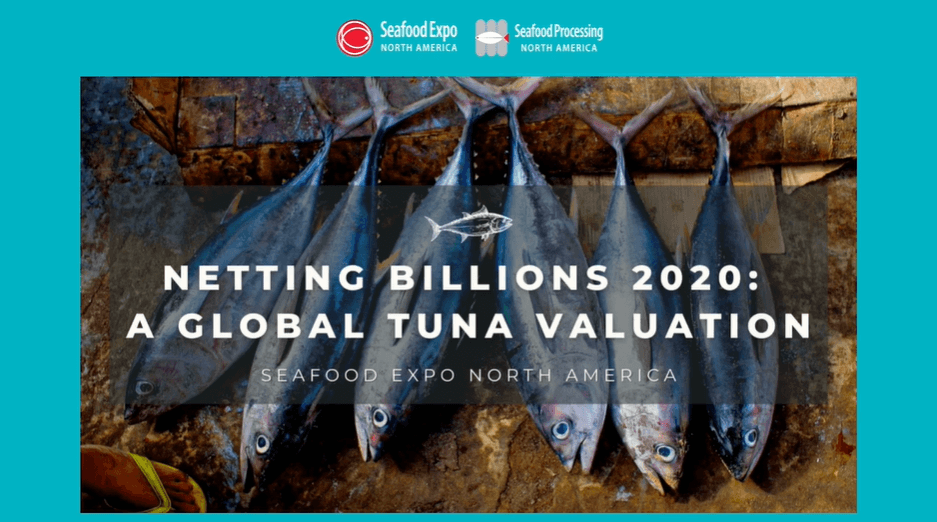
Netting Billions 2020: A Global Tuna Valuation
Moderator: Grantly Galland, The Pew Charitable Trusts
Speakers: Hugo Byrnes, Ahold Delhaize
Greg Hammann, Marine Instruments
Raiana McKinney, The Pew Charitable Trusts,
Tom Pickerell, Global Tuna Alliance
In 2018, commercial tuna fishing was worth more than US$40 billion to the world economy, more than the GDP of at least 100 nations. From canned tuna to top-shelf bluefin sashimi, these fisheries generate significant revenue and support an enormous industry from the fishers all the way to the consumers. Due to the ongoing global pandemic, demand for non-perishable protein sources, such as canned tuna, has skyrocketed. It is easy to see just how vital the tuna industry is for not just the blue economy—but for food security around the world.
But while vessels are catching more tuna than ever before to meet this demand, the value at the dock and at the final point of sale has decreased since 2012. When factoring in the costs associated with higher catch, profits may have even declined substantially. The message is clear: catching more fish is not always better for the bottom-line. Sustainably managing tuna fisheries and allowing overfished stocks to recover will maximize their value, reduce the cost of fishing, and sustain marine ecosystems and the industries and people who rely on tuna fishing. Better management of tuna fisheries is not simply a conservation issue but also an economic one.
Yet, more often than not, the long-term sustainability of these fisheries takes a back seat to the short-term political or monetary gains that often drive management decisions. Adopting forward thinking harvest strategies, coupled with stronger consequences for noncompliance and well-developed electronic monitoring of fishing activity would all help restore tunas to healthy population sizes, preserve their value, and ensure that these valuable fisheries are being governed effectively.
This session would start with an overview presentation on recent research to estimate the global monetary value of commercial tuna fisheries. Beyond the economics, the presentation will cover the tuna fisheries management process and discuss ways governments and industry can improve management of fish stocks globally by:
1. Modernizing management through harvest strategies,
2. Improving oversight and accurate reporting of fishing activities, and
3. Ensuring consequences for noncompliance with fisheries rules.
Following this presentation, the Global Tuna Alliance will moderate a panel discussion.
Content Access
|
$45.00
|
|
$45.00
|
|
Netting Billions 2020: A Global Tuna Valuation
Moderator: Grantly Galland, The Pew Charitable Trusts
Speakers: Hugo Byrnes, Ahold Delhaize
Greg Hammann, Marine Instruments
Raiana McKinney, The Pew Charitable Trusts,
Tom Pickerell, Global Tuna Alliance
In 2018, commercial tuna fishing was worth more than US$40 billion to the world economy, more than the GDP of at least 100 nations. From canned tuna to top-shelf bluefin sashimi, these fisheries generate significant revenue and support an enormous industry from the fishers all the way to the consumers. Due to the ongoing global pandemic, demand for non-perishable protein sources, such as canned tuna, has skyrocketed. It is easy to see just how vital the tuna industry is for not just the blue economy—but for food security around the world.
But while vessels are catching more tuna than ever before to meet this demand, the value at the dock and at the final point of sale has decreased since 2012. When factoring in the costs associated with higher catch, profits may have even declined substantially. The message is clear: catching more fish is not always better for the bottom-line. Sustainably managing tuna fisheries and allowing overfished stocks to recover will maximize their value, reduce the cost of fishing, and sustain marine ecosystems and the industries and people who rely on tuna fishing. Better management of tuna fisheries is not simply a conservation issue but also an economic one.
Yet, more often than not, the long-term sustainability of these fisheries takes a back seat to the short-term political or monetary gains that often drive management decisions. Adopting forward thinking harvest strategies, coupled with stronger consequences for noncompliance and well-developed electronic monitoring of fishing activity would all help restore tunas to healthy population sizes, preserve their value, and ensure that these valuable fisheries are being governed effectively.
This session would start with an overview presentation on recent research to estimate the global monetary value of commercial tuna fisheries. Beyond the economics, the presentation will cover the tuna fisheries management process and discuss ways governments and industry can improve management of fish stocks globally by:
1. Modernizing management through harvest strategies,
2. Improving oversight and accurate reporting of fishing activities, and
3. Ensuring consequences for noncompliance with fisheries rules.
Following this presentation, the Global Tuna Alliance will moderate a panel discussion.
Content Access
|
|
|
|
$0.00
|
|
$0.00
|
|
|
|
|
|
|
$0.00
|
|
$0.00
|
|
|
|
|
How is Artificial Intelligence Going to Disrupt the Seafood Industry?
Moderator: Eric Enno Tamm, ThisFish
Speakers: Mark Hager, New England Marine Monitoring
Artificial intelligence (AI) is already part of our daily lives. Google Maps, Amazon recommendations, Facebook ads—all these technologies are powered by some kind of AI. So, how is AI going to disrupt the seafood industry? Because of the natural variability of fish, it is often difficult for fish farmers, fishermen and seafood processors to predict quality and production outcomes, such as yields, since there are so many variables. As it turns out, that's a perfect problem for artificial intelligence which is set to disrupt the seafood industry. In this session, you'll learn about what is AI and how it is used, what are its current applications in the seafood industry and what is cutting-edge research currently being conducted in the industry.
Content Access
|
$45.00
|
|
$45.00
|
|
How is Artificial Intelligence Going to Disrupt the Seafood Industry?
Moderator: Eric Enno Tamm, ThisFish
Speakers: Mark Hager, New England Marine Monitoring
Artificial intelligence (AI) is already part of our daily lives. Google Maps, Amazon recommendations, Facebook ads—all these technologies are powered by some kind of AI. So, how is AI going to disrupt the seafood industry? Because of the natural variability of fish, it is often difficult for fish farmers, fishermen and seafood processors to predict quality and production outcomes, such as yields, since there are so many variables. As it turns out, that's a perfect problem for artificial intelligence which is set to disrupt the seafood industry. In this session, you'll learn about what is AI and how it is used, what are its current applications in the seafood industry and what is cutting-edge research currently being conducted in the industry.
Content Access
|
|
Chefs' opinions on seafood country origins sustainability and labeling
James Griffin, an associate professor of culinary studies at Johnson & Wales University, will share findings from a recent national study on seafood sustainability in commercial foodservice. The study investigated where chefs get their information on sustainability, as well as their opinions of countries of origin and labeling. Griffin’s research suggests that chefs rely more than ever on vendors or suppliers to assure the seafood they purchase is sustainable, in part due to the complexity of seafood sustainability across multiple species and the lack of a consistent definition for what sustainability means when it comes to seafood.
Basic Product
|
$40.00
|
|
$40.00
|
|
Chefs' opinions on seafood country origins sustainability and labeling
James Griffin, an associate professor of culinary studies at Johnson & Wales University, will share findings from a recent national study on seafood sustainability in commercial foodservice. The study investigated where chefs get their information on sustainability, as well as their opinions of countries of origin and labeling. Griffin’s research suggests that chefs rely more than ever on vendors or suppliers to assure the seafood they purchase is sustainable, in part due to the complexity of seafood sustainability across multiple species and the lack of a consistent definition for what sustainability means when it comes to seafood.
Basic Product
|
|
|
Product Total
|
$345.00 |
|
|
Grand Total
|
$345.00 |
|