Combatting IUU Fishing: The Case of High Seas Squid
Moderator: Braddock Spear, SFP
Speakers: Sam Grimley, Sea Pact
Sarah Hussey, SeaFarms LTD
To combat each of the components of IUU fishing (illegal, unreported, and unregulated), different actions and multiple players are required. Governments need adopt laws, adhere to international agreements, set regulations, and enforce. Companies trading in seafood need to maintain ethical standards, support government actions to combat IUU, conduct due diligence of sources and suppliers, and impose consequences in response to illegal or unreported fishing activity. The high seas squid fisheries in the waters off the coast of South America presents a case study where governments and seafood companies are taking steps to stop IUU fishing. Our panel will provide three different industry perspectives on these issues in the fisheries and actions that have been, are being, and can be taken.
Content Access
|
$45.00
|
|
$45.00
|
|
Combatting IUU Fishing: The Case of High Seas Squid
Moderator: Braddock Spear, SFP
Speakers: Sam Grimley, Sea Pact
Sarah Hussey, SeaFarms LTD
To combat each of the components of IUU fishing (illegal, unreported, and unregulated), different actions and multiple players are required. Governments need adopt laws, adhere to international agreements, set regulations, and enforce. Companies trading in seafood need to maintain ethical standards, support government actions to combat IUU, conduct due diligence of sources and suppliers, and impose consequences in response to illegal or unreported fishing activity. The high seas squid fisheries in the waters off the coast of South America presents a case study where governments and seafood companies are taking steps to stop IUU fishing. Our panel will provide three different industry perspectives on these issues in the fisheries and actions that have been, are being, and can be taken.
Content Access
|
|
|
|
$0.00
|
|
$0.00
|
|
|
|
|
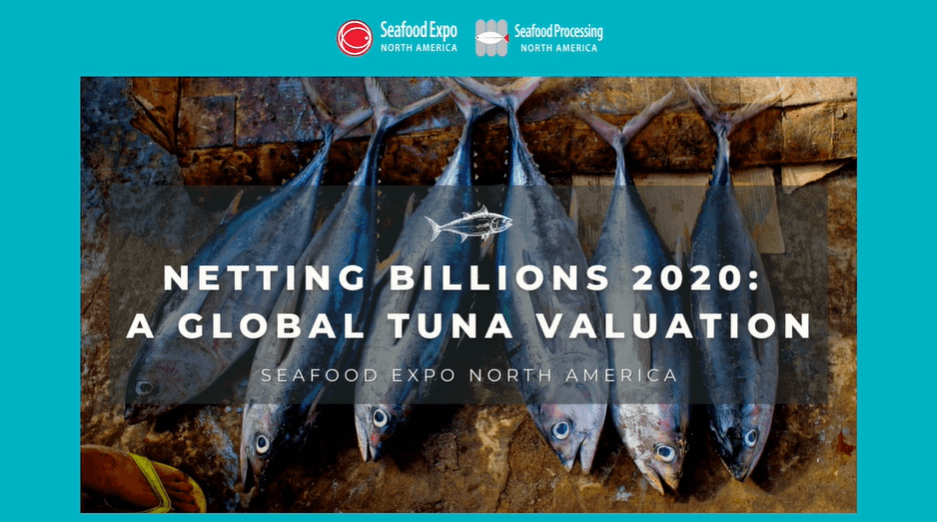
Netting Billions 2020: A Global Tuna Valuation
Moderator: Grantly Galland, The Pew Charitable Trusts
Speakers: Hugo Byrnes, Ahold Delhaize
Greg Hammann, Marine Instruments
Raiana McKinney, The Pew Charitable Trusts,
Tom Pickerell, Global Tuna Alliance
In 2018, commercial tuna fishing was worth more than US$40 billion to the world economy, more than the GDP of at least 100 nations. From canned tuna to top-shelf bluefin sashimi, these fisheries generate significant revenue and support an enormous industry from the fishers all the way to the consumers. Due to the ongoing global pandemic, demand for non-perishable protein sources, such as canned tuna, has skyrocketed. It is easy to see just how vital the tuna industry is for not just the blue economy—but for food security around the world.
But while vessels are catching more tuna than ever before to meet this demand, the value at the dock and at the final point of sale has decreased since 2012. When factoring in the costs associated with higher catch, profits may have even declined substantially. The message is clear: catching more fish is not always better for the bottom-line. Sustainably managing tuna fisheries and allowing overfished stocks to recover will maximize their value, reduce the cost of fishing, and sustain marine ecosystems and the industries and people who rely on tuna fishing. Better management of tuna fisheries is not simply a conservation issue but also an economic one.
Yet, more often than not, the long-term sustainability of these fisheries takes a back seat to the short-term political or monetary gains that often drive management decisions. Adopting forward thinking harvest strategies, coupled with stronger consequences for noncompliance and well-developed electronic monitoring of fishing activity would all help restore tunas to healthy population sizes, preserve their value, and ensure that these valuable fisheries are being governed effectively.
This session would start with an overview presentation on recent research to estimate the global monetary value of commercial tuna fisheries. Beyond the economics, the presentation will cover the tuna fisheries management process and discuss ways governments and industry can improve management of fish stocks globally by:
1. Modernizing management through harvest strategies,
2. Improving oversight and accurate reporting of fishing activities, and
3. Ensuring consequences for noncompliance with fisheries rules.
Following this presentation, the Global Tuna Alliance will moderate a panel discussion.
Content Access
|
$45.00
|
|
$45.00
|
|
Netting Billions 2020: A Global Tuna Valuation
Moderator: Grantly Galland, The Pew Charitable Trusts
Speakers: Hugo Byrnes, Ahold Delhaize
Greg Hammann, Marine Instruments
Raiana McKinney, The Pew Charitable Trusts,
Tom Pickerell, Global Tuna Alliance
In 2018, commercial tuna fishing was worth more than US$40 billion to the world economy, more than the GDP of at least 100 nations. From canned tuna to top-shelf bluefin sashimi, these fisheries generate significant revenue and support an enormous industry from the fishers all the way to the consumers. Due to the ongoing global pandemic, demand for non-perishable protein sources, such as canned tuna, has skyrocketed. It is easy to see just how vital the tuna industry is for not just the blue economy—but for food security around the world.
But while vessels are catching more tuna than ever before to meet this demand, the value at the dock and at the final point of sale has decreased since 2012. When factoring in the costs associated with higher catch, profits may have even declined substantially. The message is clear: catching more fish is not always better for the bottom-line. Sustainably managing tuna fisheries and allowing overfished stocks to recover will maximize their value, reduce the cost of fishing, and sustain marine ecosystems and the industries and people who rely on tuna fishing. Better management of tuna fisheries is not simply a conservation issue but also an economic one.
Yet, more often than not, the long-term sustainability of these fisheries takes a back seat to the short-term political or monetary gains that often drive management decisions. Adopting forward thinking harvest strategies, coupled with stronger consequences for noncompliance and well-developed electronic monitoring of fishing activity would all help restore tunas to healthy population sizes, preserve their value, and ensure that these valuable fisheries are being governed effectively.
This session would start with an overview presentation on recent research to estimate the global monetary value of commercial tuna fisheries. Beyond the economics, the presentation will cover the tuna fisheries management process and discuss ways governments and industry can improve management of fish stocks globally by:
1. Modernizing management through harvest strategies,
2. Improving oversight and accurate reporting of fishing activities, and
3. Ensuring consequences for noncompliance with fisheries rules.
Following this presentation, the Global Tuna Alliance will moderate a panel discussion.
Content Access
|
|
How is Artificial Intelligence Going to Disrupt the Seafood Industry?
Moderator: Eric Enno Tamm, ThisFish
Speakers: Mark Hager, New England Marine Monitoring
Artificial intelligence (AI) is already part of our daily lives. Google Maps, Amazon recommendations, Facebook ads—all these technologies are powered by some kind of AI. So, how is AI going to disrupt the seafood industry? Because of the natural variability of fish, it is often difficult for fish farmers, fishermen and seafood processors to predict quality and production outcomes, such as yields, since there are so many variables. As it turns out, that's a perfect problem for artificial intelligence which is set to disrupt the seafood industry. In this session, you'll learn about what is AI and how it is used, what are its current applications in the seafood industry and what is cutting-edge research currently being conducted in the industry.
Content Access
|
$45.00
|
|
$45.00
|
|
How is Artificial Intelligence Going to Disrupt the Seafood Industry?
Moderator: Eric Enno Tamm, ThisFish
Speakers: Mark Hager, New England Marine Monitoring
Artificial intelligence (AI) is already part of our daily lives. Google Maps, Amazon recommendations, Facebook ads—all these technologies are powered by some kind of AI. So, how is AI going to disrupt the seafood industry? Because of the natural variability of fish, it is often difficult for fish farmers, fishermen and seafood processors to predict quality and production outcomes, such as yields, since there are so many variables. As it turns out, that's a perfect problem for artificial intelligence which is set to disrupt the seafood industry. In this session, you'll learn about what is AI and how it is used, what are its current applications in the seafood industry and what is cutting-edge research currently being conducted in the industry.
Content Access
|
|
|
Product Total
|
$135.00 |
|
|
Grand Total
|
$135.00 |
|