






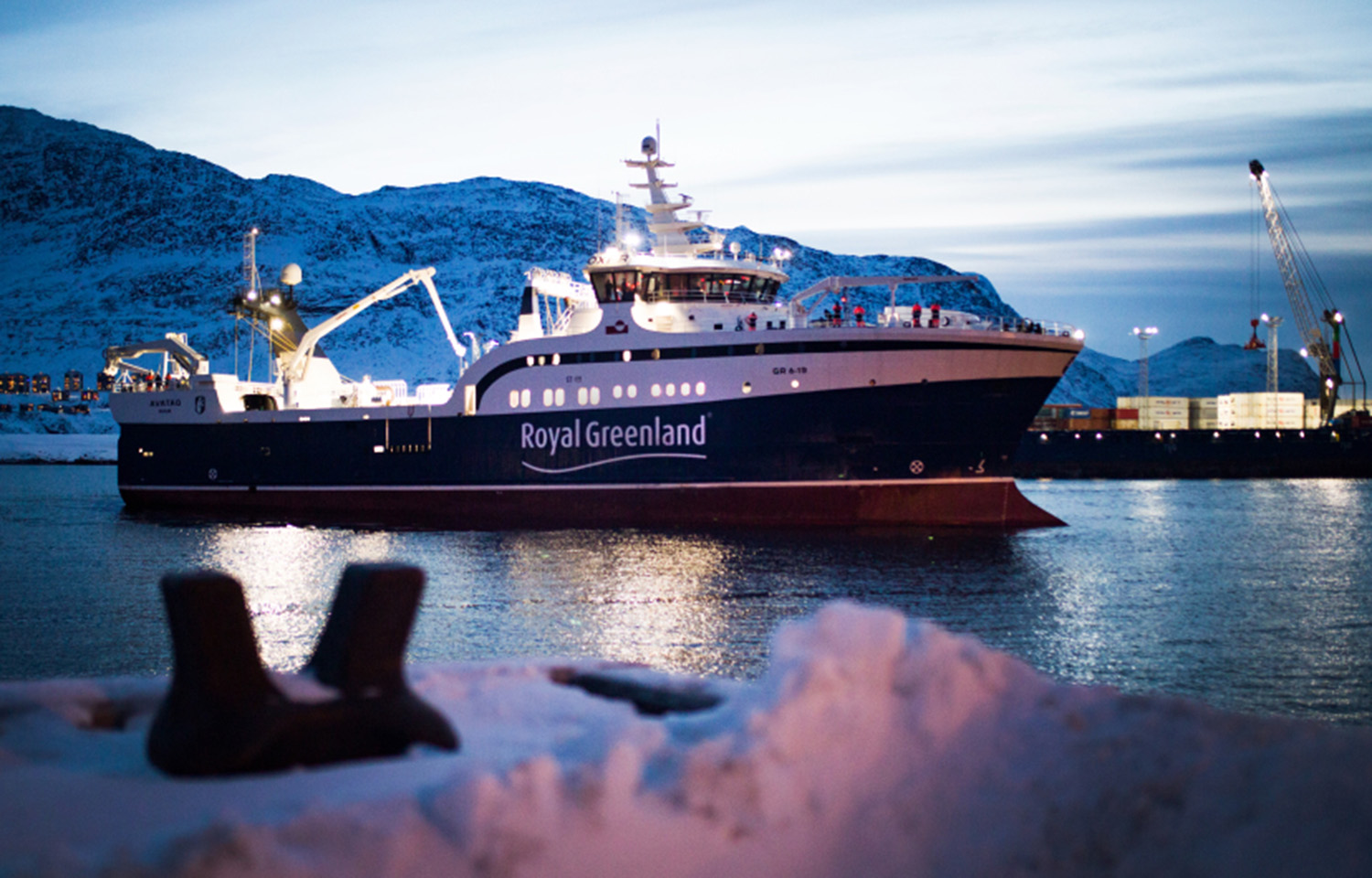
Royal Greenland posted a DKK 255 million (USD 36.8 million, EUR 34.2 million) pre-tax loss in 2023, which it blamed on a global market decline and economic uncertainty, combined with higher costs.
Royal Greenland Chair Maliina Abelsen called the year “undoubtedly … one of the most challenging in our long history,” even as the company managed to maintain its net revenue at DKK 5.798 billion (USD 837 million, EUR 777 million), nearly even with its 2022 result of DKK 5.757 billion (USD 831 million, EUR 772 million).
“Our journey through 2023 has been characterized by global upheavals that have tested our resilience and adaptability,” Abelsen said. “The ongoing geopolitical turmoil, escalated by conflict and war, has sent tremors through the world economy, which for us has meant navigating the waters of inflation and rising production costs. These challenges have affected every facet of our business – from capture to end customer – and have required extraordinary efforts from our entire team.”
Royal Greenland CEO Susanne Arfelt Rajamand listed a slew of challenges the company battled in 2023, including a market slowdown in Europe and the U.S., a flood of Russian cod and snow crab dragging down global prices, fluctuations between flat and declining sales prices, increasing costs, and a decline in the company’s business in Chile after it lost approval to export to China.
“It has been a demanding year, but it is in adversity that we test our resilience and ability to adapt. We have introduced additional cost controls across the business and improved our operational efficiency, which should help soften some of the economic blows we are facing,” Royal Greenland CEO Susanne Arfelt Rajamand said in a statement.
In response to the turmoil, the Nuuk, Greenland firm, which is owned by Greenland’s government, implemented cost-saving measures, including the decision to permanently close its processing facility in Matane, Quebec, Canada, which was destroyed in a fire in March 2024.
“We are in the process of a turnaround where we are analyzing several activities and initiatives to drive costs out of the company,” Arfelt Rajamand said. The strategy will deliver savings of at least DKK 100 million [USD 14.4 million, EUR 13.4 million] annually when fully implemented.”
The company’s sales in Europe, which accounted for 26 percent of its total sales, fell 5 percent to DKK 1.5 billion (USD 217 million, EUR 201 million), with the decline led by drops in sales of cod and shell-on prawns.
“The decline in cod can partly be attributed to restraint among industrial buyers and competition from imported Russian cod at low prices,” the company said. “In the U.K., Royal Greenland's sales continue to be hampered by the challenges created by Brexit.”
Royal Greenland’s sales to Scandinavia, which made up 19 percent of its total sales, declined to DKK 1.1 billion (USD 159 million, EUR 148 million). The company said it had held its ground in Denmark and Norway but lost out in other markets.
The firm had better fortune in Asia, where it achieved record revenue of DKK 2 billion (USD 289 million, EUR 268 million), with Greenland halibut and shell-on prawns accounting for 75 percent of its sales, which were 35 percent of the company’s total sales. Its own-brand consumer-packaged products in China sold well in supermarkets and via e-commerce, creating DKK 90 million (USD 13 million, EUR 12.1 million) in revenue. A recession in Japan and currency devaluation of the yen has hurt demand there, however.
Royal Greenland's DKK 1 billion (USD 144.4 million, EUR 134.1 million) in North American sales amounted to 17 percent of its total sales.
“After a turbulent 2022, where snow crab sales experienced a significant decline, efforts in 2023 [in North America] have been concentrated on rebuilding solid and stable sales, with a particular focus on snow crab,” it said. “In 2023, Royal Greenland has expanded sales in foodservice and retail, which has increased our resilience.”
Royal Greenland's remaining sales – in Australia, Chile, and to business partners in the Middle East – were stable.
“Despite a difficult market environment, Royal Greenland has maintained its market position in key product categories such as prawn and snow crab, and we have good expectations for improved sales in the coming periods,” Arfelt Rajamand said. “We have also intensified sales in stable and growing markets such as China and are working to optimize our product offerings to fit the current market conditions.”
At home in Greenland, the company broke ground on a new processing facility in Tasiilaq, in southeast Greenland, which will become its 38th processing facility. In exchange for building the factory, Royal Greenland will receive a 5,500-metric-ton cod quota boost.
“We are delighted to have received the final go-ahead in 2023 for the construction of a new, modern factory in Tasiilaq,” Abelsen said. “This project is not only a symbol of our commitment to Greenland's economic development, but also a step toward creating development on the east coast for the benefit of citizens in and around Tasiilaq.”
Abelsen said the company was also benefitting from long-term strategic investments in its trawler fleet, which she said “have proven to be a catalyst for growth.”
“These investments have ensured robust earnings in this part of our business and confirm our belief that a focused and well-considered approach to renewal and innovation is the key to success,” she said.
In December 2023, Royal Greenland sold its stake in a joint venture in Russia to its partner, Agama, Arfelt Rajamand confirmed to SeafoodSource at the 2024 Seafood Expo Global. The JV included the production of up to 9,000 MT of seafood products at a facility near Moscow and up to 6,000 MT at a second plant near Murmansk, as well as a retail sales network. The decision was necessitated by the government of Greenland requiring all national companies to cease trading in Russia in response to its invasion of Ukraine. The joint venture posted sales of RUB 453 million (USD 5 million, EUR 4.6 million) in 2022, according to Kommersant.
"There was a stand that we could not be in Russia, and therefore we had to terminate," Arfelt Rajamond said. "It was a business that we had look forward to growing; we saw a lot of opportunities there. It was tough, but we had to walk the talk."
In 2022, Royal Greenland posted a profit of DKK 235 million (then USD 35 million, EUR 31 million) and revenue of DKK 5.8 billion (then USD 866 million, EUR 788 million), and in 2021, it recorded a profit of DKK 326 million (then USD 44.4 million, EUR 43.8 million) in 2021 on revenue of DKK 5.64 billion (then USD 769 million, EUR 758 million).
In order to return to profitability, the company needs to make big changes, Abelsen said.
“We are now at a crossroads where we must look forward and prepare for the new reality that awaits,” Abelsen said. “This requires bold decisions, including making massive changes to our organization. We are faced with streamlining the business and cutting to the bone to ensure we remain agile, efficient, and competitive in a rapidly changing market.”
