



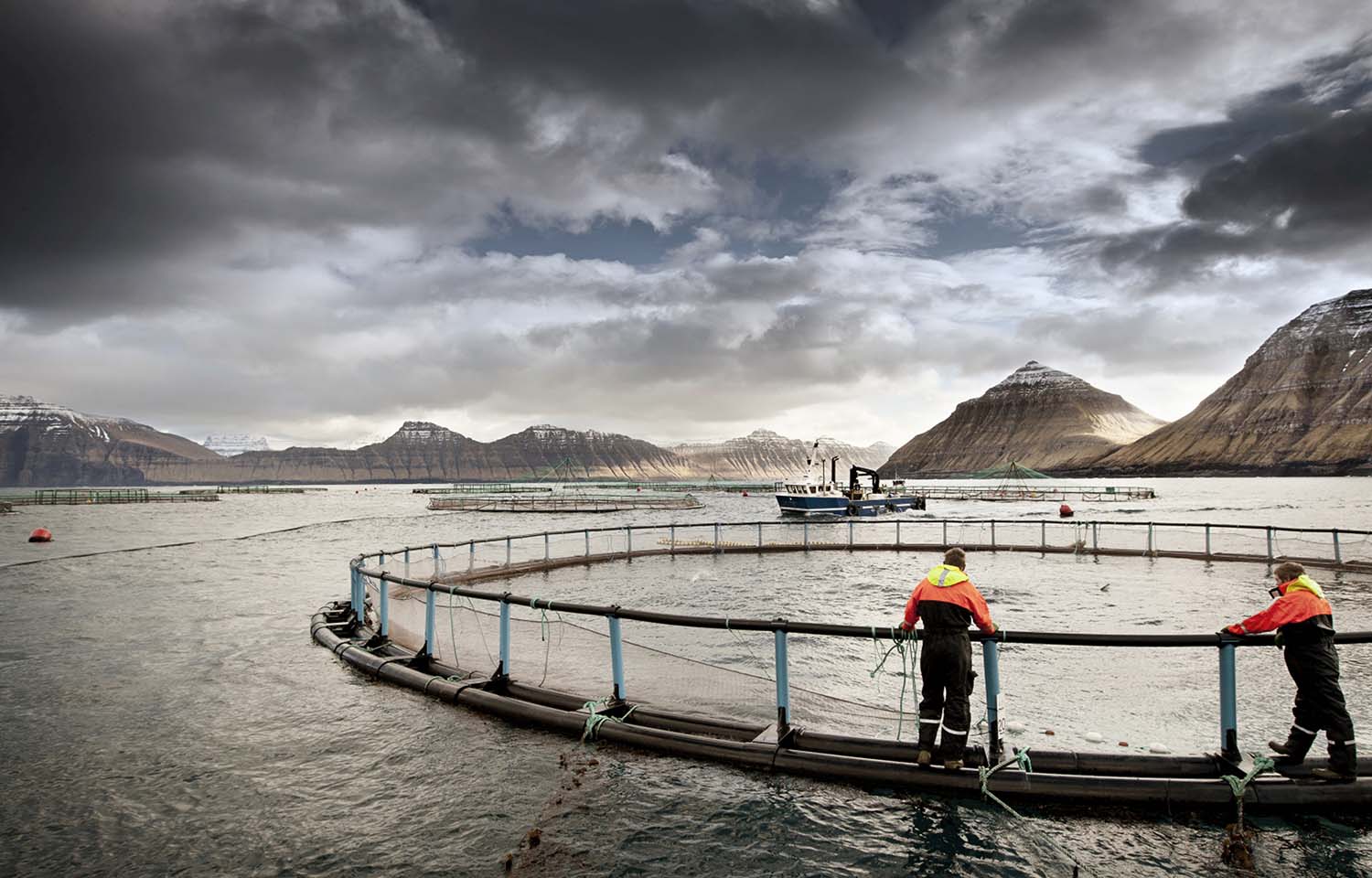
Good biological performance in the Faroe Islands and improved performance in Scotland helped the Bakkafrost Group post Q1 2024 revenues of DKK 2.6 billion (USD 375.4 million, EUR 348.6 million), increase of roughly 8 percent year over year.
The salmon-farming company’s operational earnings before interest and taxes (EBIT) for the period totaled DKK 710 million (USD 102.5 million, EUR 95.2 million), and it turned a profit of DKK 401 million (USD 57.9 million, EUR 53.8 million). In the corresponding period of 2023, these totals were DKK 565 million (USD 81.6 million, EUR 75.8 million) and DKK 467 million (USD 67.4 million, EUR 62.6 million), respectively.
Delivering the Q1 results on 6 May 2024, Bakkafrost CFO Høgni Dahl Jakobsen said that measured in operational EBIT, this quarter was the best one in the group’s history.
By segment, Bakkafrost’s Farming Faroe Islands (FO) delivered quarterly revenues of almost DKK 1.6 billion (USD 231.1 million, EUR 214.5 million) and an operational EBIT of DKK 671 million (USD 96.9 million, EUR 90 million), compared to DKK 1.3 billion (USD 187.7 million, EUR 174.3 million) and DKK 410 million (USD 59.2 million, EUR 55 million) in Q1 2023, respectively. It harvested 14,294 MT of salmon in the quarter, compared to 11,005 MT in Q1 2023.
Farming Scotland’s (SCT) revenues for the period fell by DKK 96 million (USD 13.9 million, EUR 12.9 million) year over year to DKK 612 million (USD 88.4 million, EUR 82.1 million), and its operational EBIT fell DKK 116 million (USD 16.8 million, EUR 15.6 million) to DKK 39 million (USD 5.6 million, EUR 5.2 million). This segment’s operations harvested 1,263 MT of fish, marking a drop from the 9,093 MT it harvested in Q1 2023.
Jakobsen highlighted the first-quarter average price for 4- to 5-kilogram superior Atlantic salmon amounted to NOK 108.97 (USD 10.04, EUR 9.32) per kilogram – a 4 percent increase on the corresponding period of 2023. Compared to the fourth quarter of last year, the price was 31 percent higher.
“The market was, in general, affected by a shortage of large, superior fish, as we also saw the price difference between small and large fish increasing through the quarter,” Jakobsen said.
Bakkafrost sales to the European market increased by 4 percent in the quarter, despite the lower European harvest.
“Demand in Europe has been good, and the biological challenges in Norway have increased the availability of [bringing] fillets to the market,” Jakobsen said.
According to Jakobsen, the Faroes was the only salmon-producing region in the world to show any increased harvest weights in Q1 – increasing 12 percent to an average 5.27 kilograms.
Bakkafrost CEO Regin Jacobsen said Scotland has continued to face some issues, but biology in Q1 was good at most sites, except for one with fish previously weakened by a jellyfish encounter. Jacobsen also pointed to some start-up issues in parts of Scotland’s new Applecross facility. This, he said, will impact the pace of the company’s overall smolt release this year and its average weights.
“As we continue to follow our de-risking strategy in Scotland, we plan to harvest around three quarters of the 2024 volume in H1,” he said, adding that the outlook for the salmon market is “tight and supportive for continued strong salmon prices in Q2, especially large salmon of superior quality, which both the Faroe Islands and Scotland are able to provide.”
In Q1 2024, Bakkafrost also started construction of a new hatchery in Skálavík, Faroe IsIands, which will further increase production capacity by around 7 million smolt. Once Skálavík is complete in about three years, the annual smolt production capacity in the Faroe Islands will be 24 million smolts, as targeted in the company’s 2024-28 investment program.
After Q1’s results, Bakkafrost’s harvest guidance for 2024 remains unchanged at 91,000 MT gutted weight, with 66,000 MT projected to come from the Faroe Islands and 25,000 MT from Scotland.
“However, there are some twists in the breakdowns between quarters,” Jacobsen said.
He confirmed the second-quarter harvest in the Faroes is expected to drop from 16,500 MT to 12,500 MT because of the larger harvest in the first quarter, while Scotland is expected to increase from 11,000 MT to 12,000 MT in the second quarter – mainly due to projected better biology.
Bakkafrost’s long-term goal, announced at its Capital Markets Day last year, is to build up its growth capacity to 200,000 MT and its actual production to 165,000 MT by 2028.
“Our focus is to grow sustainably with a high focus on utilizing our competitive advantage in the value chain and to especially differentiate ourselves in the marketplace – focusing on the world’s best salmon,” Jacobsen said.
