






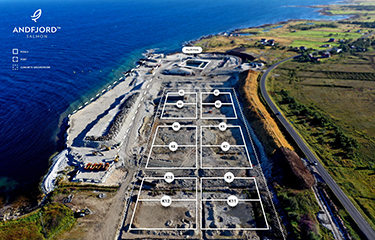
After recording a first harvest of 646 metric tons (MT) from the pilot pool at its Kvalnes site, Norwegian land-based salmon producer Andfjord Salmon AS is forging ahead with expansion plans that will increase its production capacity in the near future.
The planned expansion will increase production at Kvalnes on the island of Andøya to 8,000 MT of head-on gutted (HOG) fish by 2025, gradually growing to 40,000 MT HOG by 2030.
Andfjord Salmon’s flow-through, salmon-rearing system aims to capitalize on Andøya’s close proximity to the oxygen-rich Gulf Stream. Through the company’s patented technology, it has introduced a laminar water-flow process, whereby water is pushed into the square-shaped pool and a parallel current moves it from one side to the other. Not only does this establish an even distribution of water in the system, the company said, it also eliminates turbulence.
Delivering Andfjord Salmon’s Q2 2023 results, CEO Martin Rasmussen explained that the innovative fish-farming concept combines the advantages of closed-pool, land-based production with the benefits of sea-based net-pen farming. The oxygen-rich seawater that the facility uses, the company claims, is an ideal temperature for rearing salmon and comes from depths of around 40 meters, where threats like sea lice and algae are little cause for concern.
“From a biological perspective, the first production cycle was a success,” Rasmussen said, pointing to a survival rate of 97.8 percent after 12 months in the pool and a post-harvest survival rate of 97.5 percent. Meanwhile, the growth of the fish exceeded expectations by 40 percent, Rasmussen noted, compared to original estimates the company based on conventional farming benchmarks.
“We sold the salmon from the first harvest to strategically selected seafood [processors and] distributors in several European countries, and their feedback was very positive, particularly regarding the yield and the color of the fish,” Rasmussen said.
He added that the "main goal for the first batch of fish was not to reach the highest average price but to reach the right buyers," and after having done so, Andfjord is "more confident that we will be able to achieve a premium price on our product in the future.”
Having delivered proof of concept and with expansion plans underway, the next smolt release – around 800,000 fish – is likely to occur in mid-2025, with a production cycle lasting 12 to 14 months.
In June this year, the company secured NOK 825 million (USD 77.1 million, EUR 71.8 million) of funding commitments from three banks for the next build-out phase at Kvalnes, Rasmussen confirmed. These funds will help introduce a shared infrastructure, including new waterways and a harbor for the entire site.
“Our banks and our shareholders firmly have faith in our concept and vision,” Rasmussen said.
According to its H1 2023 report, the company’s total sales income will not be visible until the third quarter due to the first harvest concluding in July.
However, Andfjord Salmon CFO Bjarne Martinsen confirmed that total sales income from the first production cycle amounted to NOK 37.1 million (USD 3.5 million, EUR 3.2 million), with NOK 9.6 million (USD 897,060, EUR 835,160) accounted for in H1 2023.
The company sustained operating losses of NOK 32.3 million (USD 3 million, EUR 2.8 million) in H1, compared to a loss of NOK 20.6 million (USD 1.9 million, EUR 1.8 million) in the same period a year ago. This, the company stated, was mainly due to increased depreciation and amortization expenses, as well as other operating expenses.
Martinsen added that by the end of the second quarter, the company had invested more than NOK 40 million (USD 3.7 million, EUR 3.5 million) in the next stage of construction, on top of the investments made in the first stage.
In addition to the NOK 825 million worth of bank loans, Andfjord has secured a further NOK 615 million (USD 57.5 million, EUR 53.5 million) through private placement.
With these funds available, Martinsen said the company has identified steps that will allow the Kvalnes build-out plan to reach annual production of 40,000 MT HOG.
Phase one – getting the facility up to 8,000 MT by 2025 – will include four new pools, together with waterways, rock pools, a shared port area, and new technical infrastructure. The total budget for this stage is NOK 1.65 billion (USD 154.2 million, EUR 143.5 million).
“A strong start has been made, and we expect good progress over the coming months,” Martinsen said. “After this first step, the infrastructure will be ready, and we will be able to build four new pools each year and reach capacity of 19,000 MT [in] 2027. Production at Kvalnes will then increase gradually, and we will reach the full potential of 40,000 MT in 2030.”
North of the Kvalnes location, Andfjord Salmon also has the sites of Breivik and Fiskenes, which, in the longer term, should deliver a combined 50,000 MT. Preparatory work on these sites is already underway, with construction slated for 2026 into the following year.
“Having three locations so close together will allow us to extract significant operational synergies between the sites. However, Kvalnes is our main focus in the coming years,” Rasmussen said.
Image courtesy of Andfjord Salmon
