






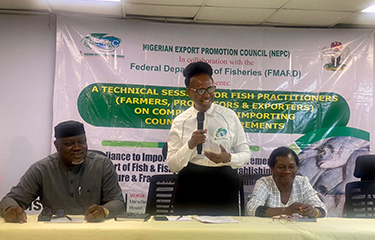
In response to a regression of aquaculture production levels over the past seven years, Nigeria is teaming up with development partners to implement a catfish farming project aiming to reverse the downward trend.
Aquaculture production in the West African nation hit an all-time high of about 316,000 metric tons (MT) in 2015 but gradually declined to 290,000 MT in 2019 before spiraling to 261,700 MT in 2020, according to the Food and Agriculture Organization (FAO). Experts have attributed these falling aquaculture output figures to increased production costs and a decline in domestic seafood demand due to persistently high inflation levels and devaluation of the local currency.
The high costs of production – especially in regard to accessing affordable, high-quality fish feed – have forced many Nigerian fish farmers to switch to inferior feed over the past decade, resulting in decreased harvest sizes and overall output.
These factors have led the Nigerian government and partners such as the FAO; the E.U.; the Organization of African, Caribbean, and Pacific States (OACPS); and the German Federal Ministry for Economic Cooperation and Development (BMZ) to collaborate on a catfish-farming project titled FISH4ACP, with the objective of strengthening Nigeria’s aquaculture sector – Africa’s second-biggest aquaculture producer after Egypt.
“FISH4ACP aims to stimulate Nigeria’s catfish sector by improving access to key export markets, enhancing productivity, and supporting domestic production of high-quality fish seed and feed,” the FAO said. “Increasing competitiveness through marketing and product diversification is high on the agenda, while special attention will also be given to the environmental sustainability of farming practices.”
Among several objectives, the partners, together with Nigeria’s Federal Ministry of Agriculture and Food Security, aim to grant Nigerian fish farmers access to affordable, high-quality feed through a credit scheme under which repayment is due only after farmers harvest and sell their products.
“Nigeria wants to become more self-sufficient in fish production, as demand for fish significantly exceeds domestic production,” FAO said. “It prioritizes aquaculture, because of its potential to create jobs and business opportunities, in particular for women and youth.”
The FISH4ACP project will also support fish processors in embracing innovative fish smoking kilns that use less wood, reducing health risks for the country’s processors.
FISH4ACP joins other Nigerian catfish projects that have sought to stimulate the sector, such as the Catfish Sustainability Project launched by Nutreco and Skretting in 2016, the initial goals of which included increasing sustainable catfish production through farmer training sessions.
“The project aims to improve the performance of small-scale catfish farmers, helping them increase productivity and income generation, promoting best management practices to ensure environmental sustainability, and facilitating an organized catfish farmer structure to engage stakeholders in catfish production,” Nutreco said at the project’s launch.
About 800 catfish farmers in the Nigerian states of Oyo and Ogun subscribed to the project by December 2021, with Nutreco claiming that around 80 percent of the trained catfish farmers adopted at least two of the innovations that were part of the best management practices they learned under the project’s curriculum between 2016 and 2021.
“We have also seen an average profit jump per farmer from 11 percent to 39 percent, catfish survival rates increasing from 69 percent to 95 percent, and a doubling of average harvest weight from 600 grams to 1.2 kilograms,” Nutreco said.
By increasing domestic aquaculture production through FISH4ACP and the Catfish Sustainability Project, among other projects, Nigeria expects to reduce spending on seafood imports; data from the Nigerian National Bureau of Statistics shows that the country spent NGN 122.5 billion (USD 143.7 million, EUR 133.5 million) on fish and seafood imports in 2021.
Additionally, the Nigerian government said these projects are important from a food security standpoint. Projections show that if the country’s 2017 baseline per capita fish and seafood consumption of 9.12 kilograms stays the same, Nigeria would require 2.4 million MT of seafood to supply protein for the nation’s anticipated population of nearly 263 million people by 2030.
Photo courtesy of Nigerian Export Promotion Council
