




Indonesia has set a target of producing 2 million metric tons (MT) of shrimp by 2024, but some sector experts are skeptical about the feasibility of the goal.
Indonesia was the third largest-aquaculture producer in the world by volume in 2020, after China and India, with much of that production being shrimp. With 18,000 islands and islets, the Indonesian archipelago possesses the third-most coastlines of all countries.
Indonesia has become a major player in aquaculture even though it has only thus far used 7.38 percent of its potential area for aquaculture production, according to a 2016 Ipsos report.
Indonesia earned approximately USD 6.2 billion (EUR 5.8 billion) from its exports of fishery and marine products in 2022 and is aiming to reach USD 7.6 billion (EUR 7.1 billion) in sales in 2023. Shrimp accounted for USD 2.2 billion (EUR 2 billion) in 2021, making the species Indonesia’s most-valuable seafood export.
Between January and November 2022, Indonesia exported USD 5.71 billion (EUR 5.33 billion) worth of seafood. Its biggest markets were the U.S at USD 2.15 billion (EUR 2 billion) in sales, China at USD 1.02 billion (EUR 951.5 million), Japan at USD 678 million (EUR 632.5 million), the ASEAN bloc at USD 651 million (EUR 607.4 million), and the European Union at USD 357 million (EUR 333 million), according to the Jakarta Globe.
“Indonesia has the puzzle pieces to become a global leader in aquaculture and seafood production,” Guntur Mallarangeng, the co-founder and CEO of shrimp farm management company Delos, told CNBC. “Once we figure out how to put them together, we should be able to become a seafood powerhouse in the global market.”
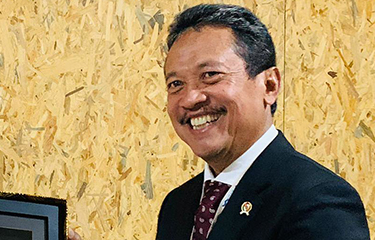
In December 2022, Indonesia Maritime Affairs and Fisheries Minister Sakti Wahyu Trenggono told local lawmakers he was confident Indonesia will achieve the 2024 shrimp-production goal. Indonesia has 247,000 hectares dedicated to shrimp ponds, with average productivity currently sitting at 0.6 MT per hectare per year. The Indonesian government is planning to develop 1,000 new hectares of modernized shrimp-farming ponds, Trenggono said, and it plans to boost production by converting traditional ponds into semi-intensive or intensive ponds, which has potential to increase output by between 15 and 20 MT per hectare, according to Antara News.
Trenggono said a major impediment to achieving the goal will be the difficulty of acquiring land the expansion. Already, some of the land purchased by the state to contribute to the project has been found to be prone to flooding.
In 2020, shrimp analysts and company executives had said they did not believe Indonesia’s ambitious growth targets in the shrimp sector will come true. As of February 2023, most of them had not changed their minds.
Patrik Henriksson, a researcher at Stockholm University and the Malaysia-based nonprofit research organization Worldfish, who has conducted several studies on Indonesian seafood sector, told SeafoodSource there's no chance Indonesia meets its goal.
“[The government] is hanging on to their old target even if they will never achieve it,” he said. “Even if they increase the farm area and productivity, they would need immense amounts of lands, farmers, shrimp fry, and feed, that are not readily available.”
While domestic consumption totals and informal exports to China could account for some of the markets Indonesia is relying on for growth, feed sales data and estimates from local industry indicate that the total production of vannamei in Indonesia totaled between 400,000 and 450,000 MT last year.
Shrimp Insights Founder Willem van der Pijl said, of that total, Indonesia exported between 210,000 and 220,000 MT of vannamei in 2022, on par with Thailand but was much lower than the shrimp exports of Ecuador, India, and Vietnam.
“Unfortunately, the data in the figure above suggests that the Indonesian government is not succeeding in its ambition to drastically grow farmed shrimp production and exports,” van der Pijl said.
Photo courtesy of U.S. Department of State
