

The fourth quarter of 2023 closed out a solid year’s performance for Frøya, Norway-headquartered SalMar, but the period also ended with several of the salmon producer’s facilities in central and northern Norway suffering from string jellyfish attacks.
With the attacks continuing to cause serious impacts to fish welfare into the new year, the company has culled substantial volumes at multiple locations and harvested much of its fish earlier than planned to avoid further issues.
This has resulted in a 20,000-metric-ton (MT) reduction to SalMar’s 2024 guided harvest volume. Its volume guidance in its other locations remains unchanged at 7,000 MT for SalMar Aker Ocean, 15,000 MT in Iceland, and 37,000 MT in Scotland.
Presenting the company’s Q4 and full-year 2023 report on 15 February, SalMar CEO Frode Arntsen said jellyfish swarms are one of the “severe risk factors” in fish farming, but that it’s rare for them to cause as much harm as they have.
“It has been over 20 years since SalMar experienced a similar jellyfish attack in Norway," he said. "Unfortunately, those who were involved 20 years ago say that the issue doesn’t resolve immediately. It takes some time through the winter, possibly until May, before the jellyfish disappear."
Complicating matters for SalMar, the jellyfish attacks occurred during a period of harsh weather conditions.
“It’s impossible to be out on the farming sites when the wind is at its peak … but something happens in SalMar when such events occur; we feel the responsibility for the job, for the fish, for the environment, for our people, and we feel the urge for improvement,” he said. “All of this together unleashes the extra SalMar power. With tasks solved, improvements begin immediately. The situation [has begun to] look better at several of our locations, and we continue to monitor the situation closely to try to avoid further incidents.”
Regarding SalMar’s financial results, 2023 was a “strong year” thanks in part to the successful integration of its NTS, NRS, and SalmoNor mergers and acquisitions, which took place between the end of 2022 and into 2023, Arntsen said.
Alongside a record high harvest volume of 254,100 MT – an increase of 31 percent year over year – its operational earnings before interest and taxes (EBIT) amounted to almost NOK 8.1 billion (USD 765.7 million, EUR 713.1 million), compared with 2022’s NOK 4.5 billion (USD 425.4 million, EUR 396.2 million).
Due to the positive results and the company’s strong overall financial position, SalMar’s board of directors proposed a dividend of NOK 35 (USD 3.31, EUR 3.08) per share for FY 2023.
In Q4 2023, SalMar’s Icelandic Salmon business – the country’s largest producer and processor of farmed salmon – harvested a record 17,900 MT (gutted weight) of fish in 2024 and generated operating income of NOK 605 million (USD 57.2 million, EUR 53.3 million), up from the NOK 539 million (USD 51 million, EUR 47.5 million) the segment posted in the same period of 2022.
Iceland also experienced biological challenges, however, encountering sea lice problems at the start of the quarter that resulted in Q4 operational EBIT per kilogram of NOK 3.60 (USD 0.34, EUR 0.32), in comparison to NOK 16.40 (USD 1.55, EUR 1.44) in Q4 2022.
SalMar reported Icelandic Salmon expects lower harvest volumes in Q1 2024 compared to Q1 2023 and for costs to remain high due to the biological challenges. Its volume guidance for 2024 remained unchanged at 15,000 MT.
SalMar was not the only company that faced sea lice issues in Iceland. Mowi subsidiary Arctic Fish, acquired in 2022, was confronted with intense sea lice issues in November 2023.
Also in Q4 2023, Arnarlax, a wholly owned subsidiary of Icelandic Salmon, entered into a sustainable linked credit facility worth EUR 100 million (USD 107.4 million) with a three-year tenor. The facility encompasses a term loan facility, a revolving facility, and an overdraft facility, along with added flexibility of two one-year extension options.
Meanwhile, SalMar Aker Ocean had two semi-offshore projects come into operation in Q4 2023, with Arctic Offshore Farming also harvesting its first batch of 2,300 MT in the period. SalMar Aker Ocean acquired Arctic Offshore Farming from SalMar in December 2023.
Looking ahead, Arntsen said SalMar sees potential for improvement and growth in all parts of its business. The company also maintains that its current operational structure has the potential for further growth and for achieving its longer-term volume ambition of reaching 362,000 MT through organic growth.
“Our job is to succeed at every step, and the volume will come in a few years,” he said. “The end of 2023 was a minor hiccup, but it does not alter our growth potential. There is a strong market out there for our salmon.”
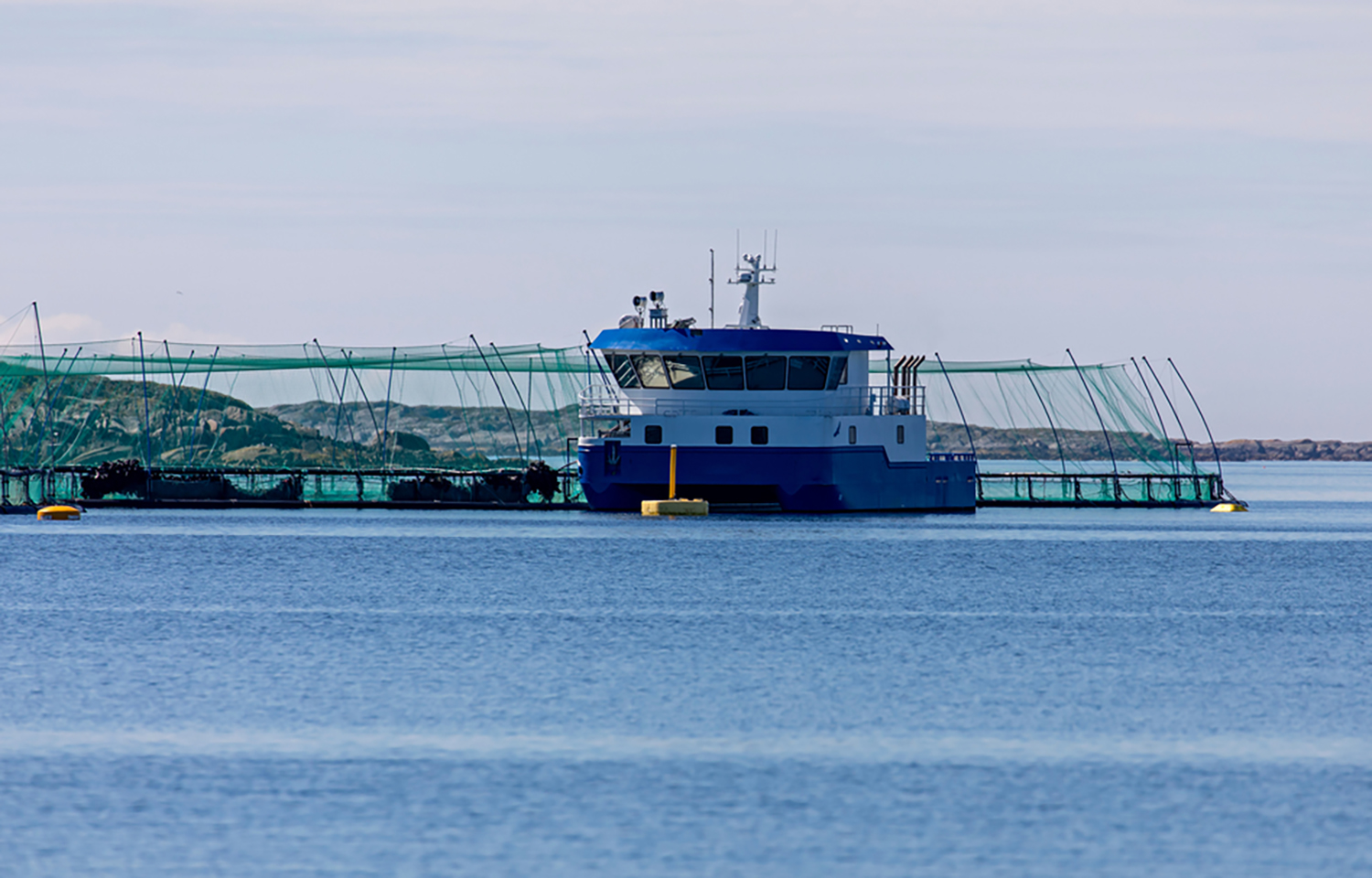
Photo courtesy of Haavard Dyroe/Shutterstock
