






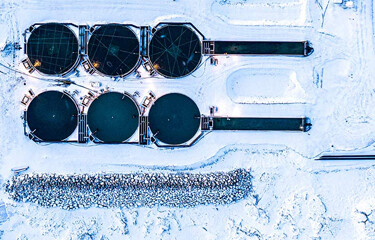
Grindavík, Iceland-based land-based Arctic char farmer Matorka has experienced its best year to date in 2023 across several categories – from producing to processing to sales – and next year’s performance is likely to break records again despite several hundred earthquakes having affected company facilities recently, according to CEO Christo du Plessis.
Matorka’s land-based facilities, as well as the nearby town of Grindavík in southwest Iceland, were shaken by several hundred seismic events between late October and a peak earthquake on 10 November, du Plessis said. Those earthquakes were then followed up with a volcanic eruption on 18 December.
He told SeafoodSource that the area around the fishing town of Grindavík, where Matorka’s farm and processing facility are located, began experiencing seismic activity on 25 October. Then, early on 11 November – the day following the biggest earthquake – subsidence, when the ground sinks due to either human or natural causes, occurred in the town, causing several cracks to appear on critical infrastructure.
In past years, Matorka endured regular earthquakes without problems, but this year – for the first time in its history – it suffered structural damage to its facilities.
“The geological events that happened around Grindavík in the past few weeks were a once-in-2,000-year event and something completely new,” du Plessis said. “The situation is stable at present, but the town remains evacuated with no plans for residents to be allowed back before 2024.”
On Matorka’s farm, the ground dropped by up to 30 centimeters in places, and this damaged six of its 18 grow-out tanks to varying degrees.
“We suffered no damage to our juvenile fish facility, and also, our hatchery remains unscathed … it was actually the subsidence and not the earthquakes that did the damage,” du Plessis said. “Our rented processing facility and head office building also suffered what appears to be structural damage, including cracks in the floor which render it unsuitable for seafood processing.”
After the quake, Matorka's management team had to get police approval to enter the company's facilities. Once they were able to enter the farm, they stabilized the facility’s life-support systems and restarted some of the borehole pumps supplying water to the tanks.
“We lost one tank of harvest-sized fish, which was very unfortunate, but managed to save the rest of the fish that would most likely have been lost without intervention,” du Plessis said. “We also lost the electricity feed on [11 November], but our backup diesel generators kicked in. We could run the whole operation on these generators, but we had to return to the farm every eight hours to refuel and had to do so for three days until the grid power was restored.”
A full production team was allowed back on Matorka’s farm after four days. At this point, the company turned its attention to processing. It quickly found a third-party alternative to take over the work previously done at its damaged Grindavík facility.
“We started harvesting on [17 November] and working nights to process,” du Plessis said. “We also started the search for a vacant facility in the area and signed a lease for a plant on 22 November. We immediately started relocating our processing equipment from Grindavík to Hafnarfjörður, some 40 kilometers away.”
On 1 December, the Icelandic Food Safety Authority audited and approved Matorka’s operations, and the company immediately proceeded to process a small harvest.
“We ramped up volumes every day thereafter and were back at [our] normal run rate by Friday 5 December,” du Plessis said.
Because Matorka lost a full tank of harvest-sized fish and a few weeks’ worth of harvests, 2023 overall production was lower than anticipated, du Plessis said. However, he said the market damage was limited, as the company was able to sell again within one week of the sustaining damage to its facilities. It has been supplying its customers ever since, albeit at slightly lower volumes.
“We will still end the year with record growth and sales of Arctic char for which we are very grateful, and this is a testament to a fantastic team effort from all staff over many months,” du Plessis said.
Alongside domestic sales, the company’s main markets are Canada, the United States, and Western Europe.
“Demand has been strong, and the brand refresh we undertook in Q1 2023, as well as our almost unbeatable sustainability credentials, have really created interest in our products,” du Plessis said.
Looking ahead to 2024, he said Matorka has realigned its production pipeline to work with the reduced tank capacity on its grow-out farm. The company is also confident that insurance pay-outs for the damage to its infrastructure will allow it to restore its former capacity and ramp up production to 3,000 metric tons (MT) annually for 2025 and beyond.
“For 2024, we have all the fish in the tanks to produce more than 2,200 MT of the world’s finest Arctic char,” he said.
On 18 December, after weeks of further earthquake activity, a volcano erupted northeast of Grindavík, spewing lava as much as 100 meters into the air from a 4-kilometer-long fissure. In a LinkedIn update, the company said it suffered no damage from the eruption, which was more than 7 kilometers away from its farm.
Photo courtesy of Matorka
