


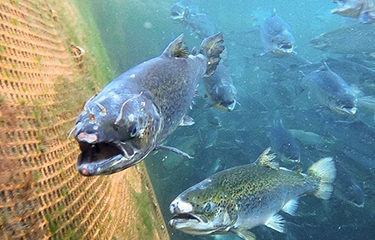
Scotland’s salmon-farming industry is defending itself against criticism from several Scottish chefs and NGOs concerned about fish welfare and environmental issues.
National trade and marketing body for the Scottish seafood industry Seafood Scotland, however, is defending the sector, pointing to a government report showing a decline in antibiotic usage among the country’s salmon farms.
Recent criticism of Scotland’s salmon-farming sector has come from several directions, including Lloyd Morse, co-owner and head chef of The Palmerston in Edinburgh, Scotland.
“Open net farms are plagued by parasitic sea lice, which disperse from the farms and can infect and kill migrating wild salmon and trout,” he said.
Morse called on fellow chefs and restaurateurs to join him in refusing to serve farmed salmon.
“We champion our suppliers who grow vegetables and raise animals in a wholesome and sustainable manner. I believe that farmed salmon is neither wholesome nor sustainable,” Morse told SeafoodSource. “I can't speak for other restaurants, but personally, I am not going to use factory-farmed, diseased fish.”
Scrutiny of the Scottish farmed salmon sector is also coming from U.K.-based NGO WildFish, which recently alleged that certification schemes, such as the Aquaculture Stewardship Council (ASC), Soil Association Organic, and the U.K. Royal Society for the Prevention of Cruelty to Animals (RSPCA) Assured credential – the latter of which is a U.K. certification that ensures farmed animal welfare – are misleading consumers as to the sustainability of certified farmed salmon they’re purchasing. To prove its claims, the NGO has presented undercover video footage of farmed salmon giant Mowi’s operations showing damaged and diseased fish.
Wildfish’s report, “Responsibly farmed? Investigating the certification of Scottish farmed salmon,” found “numerous examples of how certification of Scottish salmon requires lower environmental and welfare standards than could reasonably be expected by consumers,” it said.
Salmon originating from farms reporting mortality rates as high as 74 percent can place an RSPCA Assured “high welfare” label on their products in supermarkets across the U.K., according to WildFish.
The report documents examples of farms breaching certification standards while retaining their certifications, citing four Scottish salmon farms that surpassed ASC sea lice limits earlier this year that didn’t lose their certified status.
This is not the first time Mowi has been under fire from NGO investigations. WildFish and other NGOs made similar claims in July 2021, citing another batch of undercover footage at Mowi’s farm in Scotland. Mowi defended its animal welfare measures, and the RSPCA farm-animal welfare program – RSPCA Assured – determined in August 2021 there was no credible evidence of animal welfare violations.
Now, the salmon-farming giant has decided to battle WildFish’s claims even more aggressively than it did two years ago.
“If WildFish – a sport-angling association – were truly interested in addressing animal welfare and wild salmon survival, it would take a deep look into the impacts of its own practices instead of deflecting attention elsewhere,” Mowi Scotland Communications Director Ian Roberts told SeafoodSource. “Salmon on farms are cared for daily by dedicated fish health teams and licensed veterinarians.”
While WildFish-contracted activists “may take photos of a rare fish doing poorly within a population of thousands, these images do not represent the health status of the populations on the farm, which are inspected by third-party animal welfare experts,” Roberts said.
Mowi obtained high scores in Compassion in World Farming’s new Salmon Welfare Scorecard, which reports the performance of eight major salmon producers using 13 key welfare parameters. Mowi and Cermaq earned a “green” rating in the “key welfare indicator” section and for their policies on humane slaughter.
The U.K. government also published a report showing a significant fall in antibiotic use among farmed salmon operations, further bolstering Mowi’s defense.
The vast majority of Scottish farmed salmon – more than 90 percent – received no antibiotic treatments whatsoever, Salmon Scotland Head of Communications Andrew Watson told SeafoodSource. Farms only use antibiotics under veterinary prescription, and no trace of antibiotics makes its way into the food chain, according to Watson.
“If a tiny handful of restaurants want to take one of the world’s most popular dishes off their menu to try to make a name for themselves that’s entirely their business, but with 2.6 million meals of Scottish salmon eaten every day, it won’t make the slightest difference to the continuing success of our sector," Watson said.
Salmon Scotland CEO Donna Fordyce said her organization "respects the desire of individuals to find out more about what they eat – or serve – and how it is sourced.
"We always encourage people to ensure any questions they have regarding farmed salmon are answered from reliably sourced facts,” Fordyce told SeafoodSource.
Photo courtesy of Wildfish/Corin Smith
