






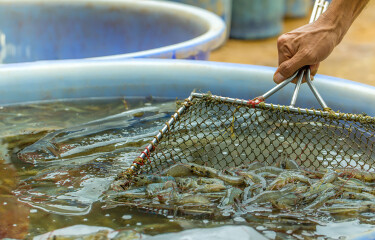
Farmed salmon and fishmeal production is likely to stabilize worldwide in 2024 thanks to manageable increases in supply and slightly lower prices in both sectors, but it’s a very different story for farmed shrimp, with heavy oversupply, extremely low prices, and weaker than expected Chinese demand taking their toll going into the year, according to the latest industry report from Rabobank.
Compiled by Rabobank Senior Global Seafood Specialist Gorjan Nikolik, “Global Aquaculture Update 1H 2024" states that in 2023, shrimp farmers faced one of the most challenging years in more than a decade. Weak shrimp demand in Western markets, combined with persistently strong supply from Ecuador, created price levels that dropped even lower than the lowest point of the Covid-19 pandemic, while costs remained elevated due to high feed prices.
Those effects have continued into the new year, with the low prices and weak demand making it hard to predict when the market might stabilize. Indeed, the report suggests the current low prices could become “the new normal.”
Specifically, Rabobank’s report found that China imported record volumes of shrimp in 2023 as pandemic lockdowns lifted, but while the country’s demand rebounded, overall recovery was slower than expected.
A lot of the additional volume China absorbed stemmed from Ecuadorian shrimp production growth, with the South American country’s exports breaking new records, including a 14.1 percent year-over-year increase in volume for the year to November 2023.
“It is hard to see a repeat of the same shrimp-buying frenzy in China in 1H 2024,” the report stated, adding that an increase in domestic supply could also dampen China’s demand for imports.
For the year to October 2023, China’s shrimp imports were down 6.9 percent in value but up 21.4 percent in volume. Meanwhile, U.S. import value and volume fell 20 percent and 9 percent, respectively, over the same period.
Rabobank’s analysis states that global shrimp supply in the first six months of 2024 should be negative, which should help to even out prices, but warned that continued supply growth in Ecuador may derail a price recovery.
It’s possible that Ecuadorian producers will contract the country’s supply, but Nikolik told SeafoodSource that it’s not easy for producers to make quick adjustments that align to shifting market needs.
Instead of Ecuador, the expectation is the bulk of shrimp supply contraction will come from Asia, continuing on trends from the year before. Vietnam and Indonesia experienced a sharp contraction in shrimp production in the second half of 2023, and Rabobank expects more of the same in the first half of this year. A “mild” supply drop is expected from India’s shrimp farmers in the period.
As for farmed salmon, Rabobank forecasted it will again be the most profitable of all aquaculture industries in the first half of 2024, with high prices and marginally lower feed and biological costs supporting strong performance. Biological challenges remain the main risk, the report said.
Relative to the first half of 2023, salmon supply will likely be boosted by better biological conditions in Norway, Canada, the U.K., the Faroe Islands, and Iceland, but Chile remains “a risk factor,” Nikolik said.
Part of the predicted lower supply in Chile is due to company-by-company legislation, mainly regarding corrections implemented for those that exceeded their concessions’ legal production limits, while further biological challenges such as algal blooms resulting from El Niño could also affect production.
The likely outcome is a “very tight market” in the Americas, Nikolik said.
“The Chilean [salmon] shortfall is unlikely to be covered by Canadian or even European supply in H1 2024. Of course, it is harder to predict if enough European supply will be exported to the U.S., as that trade not only depends on European supply but also on factors such as relative prices, supply contracts, and even relationships,” he said.
Alongside “persistently good demand,” according to the report, salmon is still price competitive compared to other proteins, and the first half of 2024 should bring only slightly lower prices than those recorded in the corresponding period of last year.
Overall, Rabobank predicts 1.9 percent growth in the global supply of Atlantic salmon, compared with declines of 1.2 percent and 1.4 percent in 2022 and 2023, respectively.
Elsewhere, after a severe shortage in 2023, fishmeal supply is expected to improve as El Niño conditions weaken during the first half of this year, helping to facilitate improved fishing in Peru and normalize prices, the report suggests.
Simultaneously, Rabobank said improved fishmeal supply should also normalize prices for terrestrial commodity alternatives such as soybean meal, which had been easing in price throughout last year.
Last year’s shortages saw fishmeal prices rise by around USD 200 to EUR 300 (EUR 184 to EUR 276) per metric ton (MT). Provided there’s a solid total allowable catch (TAC) implemented for anchovy fishing – ideally above 2 million MT – prices could reverse back to pre-El Niño levels, Nikolik said.
Photo courtesy of Phensri Ngamsommitr/Shutterstock
