






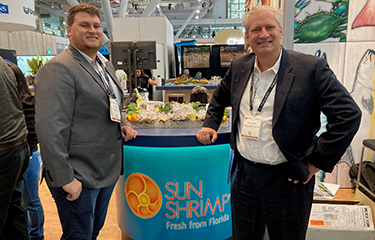
Robin Pearl, the president and CEO of Saint James City, Florida, U.S.A.-based shrimp farm and genetics firm American Penaeid and the Sun Shrimp brand has become one of the world’s foremost experts on shrimp farming.
His original fascination with aquaculture has its roots in his childhood, and wanting his children to also experience the joy of catching pond-stocked trout.
“Growing up in Europe, we used to do that all the time. What I wanted to do was build a place in South Florida where people could take their kids to catch a fish, clean it, and take it home so mommy could cook it,” he told SeafoodSource. “But I very quickly learned that trout was not a good species for Florida’s heat.”
Through his research on trout farming, Pearl first encountered the idea of shrimp aquaculture. Looking for an entrepreneurial project, in 1999, he co-founded OceanBoy Farms in South Florida, raising salt-water shrimp in low-salinity ponds. The company had initial success, growing over a million pounds of shrimp in its first year, and was able to raise over USD 65 million (EUR 60.4 million) for expansion. But, with all the money raised, Pearl lost control of the company and was kicked out of its management in 2003.
“They were looking to flip it to Wall Street and it was just not what I wanted to do,” he said. “I thought I was a wealthy man because I had my founder shares, but five years after my departure, that company went bankrupt. I lost my whole investment. I call it my USD 65 million education.”
The experience left Pearl dissatisfied. In 2013, he co-founded Sun Shrimp on 75 acres on Pine Island, in Southwest Florida, complete with an on-site genetics laboratory, a hatchery, 24 grow-out greenhouses, a packing plant, a lab, and other support facilities. The farm currently has a food-production capacity of 350 to 400 metric tons, but Pearl admits his passion is for shrimp genetics. American Penaeid sells shrimp seed and broodstock grown with what it calls “industry-leading genetics,” and has dedicated 150 tanks to genetics experimentation.
“When we first started, we had a talented team, we have good equipment, but our shrimp died. We spent a lot of time and money with consultants and technicians, and they all concluded that they were dying of vibrio. We spent two years trying to solve this problem. We tried everything and nothing worked until we looked at genetics,” he said. “We had shrimp that were growing fast and dying, and then we brought in shrimp that lived but weren’t growing. While the surviving shrimp were not the solution either, it at least confirmed that genetics were our main problem, and thus the solution. After a lot of trials, we ended up solving the genetic issue, and in the process, this led us to become one of the largest shrimp-genetics companies in the world.”
Pearl said he used an Ecuadorian model of mixing various vannamei shrimp in a pond and studying which ones performed the best using genotyping to find the best-surviving families.
“Everybody likes to blame disease when their shrimp die. But I blamed it on the fact that for many years, the industry went after the fastest-growing shrimp, and those shrimp are weaker or less capable of fending off disease. We've learned that, over time, that doesn't work,” he said. “Instead, we focused on survival first, growth second. For example, we found that if you have a tank with a 25-gram shrimp average, and you have one 35-gram shrimp in that pond, that large shrimp would traditionally be chosen by genetics companies, but experience has shown that you are better off selecting a 29-gram shrimp that comes from a very high-surviving family [identified] using genotyping analysis. Yes, it is not the fastest-growing shrimp, but it has exceptionally good survival and because it is still much larger than the average, we are increasing growth rates while selecting for survival first.”
Five years into the new approach, American Penaeid has improved its commercial growth levels to reach an average of 2.3 grams per week, which Pearl said is still lower than traditional fast growth lines that are hitting three or four grams per week, but he said aren’t able to survive and produce a profitable crop for farms facing environmental and disease challenges.
“We're now in our fifth year of this project, and looking back after genotyping over 2.5 million shrimp, it was an enormous investment into genetics and research,” he said. “We did it because … no one else was doing anything at a scale or intensity than we were. It was extremely disappointing. Everybody in the world was having these diseases or survival problems, but if you’re a struggling shrimp farmer, you're not really admitting that to anybody, so nobody really knew the extent of the problem. Once we started getting traction with the survival-first approach, we realized this could be impactful for a lot of people – certainly for ourselves, but also for customers around the world. We all want fast growth, but it does no one any good to grow shrimp that do not make it to harvest.”
American Penaeid has the goal of attaining 90 percent survival to harvest for all its shrimp, according to Pearl. He said his views on shrimp disease and mortality might be controversial, but that his results speak for themselves.
“I’ve made every single type of mistake. I have learned what to do, and more importantly, what not to do,” Pearl said. “My answer to that original problem today is that vibrio is a result, not a cause – there is always going to be something that kills shrimp when they are stressed in commercial farming environments. Now we no longer fight vibrio and we stopped with all the all the probiotics and all the essential oils and everything else we were using to fight vibrio.”
Pearl has also settled on other solutions he feels are optimal for shrimp aquaculture, including a custom biofloc solution he and his team developed called Hydro-Life.
“There’s minimal water use, no chemicals, no probiotics, and the product taste and color are just incredible,” Pearl said.
Pearl and American Penaeid also developed a concrete proprietary gullwing aquaculture tank (GAT) design. He said the system allows for greater autonomous functioning, quicker turnarounds between harvests, and greater automation of water-quality controls, feeding, and harvesting. And they’re designed to withstand hurricanes, which are common in Florida.
“It's all doing industrial-scale farming where there’s a minimum of effort and maximum return in putting the shrimp in, leaving them alone, harvesting them every 90 days, and then turning that tank around within 24 hours,” he said. “And as a bonus, we got hit by a direct hurricane last year and these GAT tanks did fine, so this is a now proven scalable solution.”
Pearl is now actively fundraising for a proposed expansion to the company’s farm that will include a scaling up of production to 3,000 MT of premium-grade shrimp annually. Pearl said his goal is to begin construction soon and have it completed by the end of 2024. A previous expansion effort failed due to supply chain and labor shortage complications from the Covid pandemic, but Pearl said the additional time allowed him to firm up his vision for the future of American Penaeid and its dual goals of being the best at both shrimp farming and genetics.
“We’ve decided to keep the original facility dedicated to genetics while dedicating our expansion footprint toward increasing our food-production capacity,” he said.
Pearl acknowledged it may be impossible for him to raise shrimp as cheaply as can be done overseas. But he said locally raised shrimp with sustainability bona fides have a huge market potential in the U.S.
“I cannot match Ecuadorian, Vietnamese, Indian, or Indonesian shrimp on price. It's just not possible. But we have the advantage of being able to offer fresh, American-grown shrimp every single day of the year, and many people are willing to pay a premium price for that. Everybody wants fresh because it’s synonymous with better quality. So, we're going after that part of the market.”
Pearl lamented the current size and state of the domestic cultured shrimp industry in the U.S., saying its lack of robustness means start-ups that enter the industry are on their own.
“My goal is and has always been to raise shrimp in America, by Americans, for Americans. But the reason shrimp farming in America has been difficult is because there's not a lot of support. There's not like a hundred hatcheries you can go to when your genetics are no good or have post-larvae shrimp when you need them,” he said. “Realistically, you need to be able to be self-sufficient. You need to be vertically integrated, from genetics to processing, sales, and marketing. And so, it gets expensive to do all of that, so in my opinion, shrimp farming will not be a mom-and-pop business in the U.S. It can only work at scale.”
However, Pearl is optimistic the U.S. shrimp industry will become a bigger player soon.
“I get very frustrated when I hear people say America can never grow its own shrimp,” he said. “Long-term, American consumers are going to move away from overseas shrimp, and there are a million reasons for them to do so, from increasing our self-reliance and food security to cutting down on carbon emissions to traceability to eliminating antibiotics and other contaminants that are still prevalent in imported shrimp.”
Pearl said he’s crunched the numbers and found he could replace all shrimp imports to the U.S. by building and operating 45,000 GAT shrimp tanks, and that it can be done at a cost of USD 14 billion (EUR 13 billion), needing under 10,000 hectares of land.
“We have proven the genetics, husbandry, and technology in place today. All we have to do is scale it up. I’m not saying we’ll get there in the next couple of years, but when you look at that investment and compare it to other American food industries, it’s not that much for a country like America. I realize it’s ambitious, it’s crazy to think we could feasibly eliminate all imports,” he said. “I think my takeaway is this: Never underestimate American farmers.”
Photo by Cliff White/SeafoodSource
