






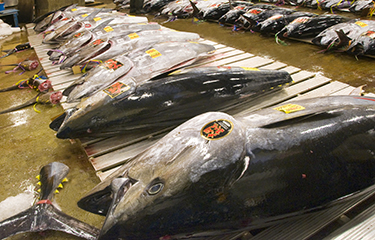
An underreporting scandal is tarnishing the reputation of Japan’s most highly-regarded regional bluefin tuna brand, and prompting a call for improved traceability.
Two fishery company presidents were arrested on 7 February, 2023, in the port town of Oma in Aomori Prefecture for allegedly failing to report catches of bluefin tuna to the prefectural government.
Tadaaki Nitta and Kazumi Sasaki, the presidents of Uochu and Saihoku Suisan, respectively, were accused of failing to report about 18 metric tons (MT) of Pacific bluefin tuna caught off the coast of the prefecture and other areas to the prefectural government from July to September 2021. The police are also investigating about 20 fishermen who were accused of selling the tuna to the two on suspicion of the same charge.
Catches landed in Oma are normally reported to the prefecture by the Oma Fisheries Cooperative. However, the two men are suspected to have bought fish directly from fishermen without going through the cooperative. Tuna weighing over 30 kilograms can receive the Oma tuna mark on the cheek. The stickers have a serial number indicating which boat caught the tuna, when the tuna was caught, and the method used to catch it. Since the tuna in this incident did not go through the Oma fishery cooperative, they likely did not bear this mark.
The arrest caused the town of Oma to cancel shipments of its return gifts for the furusato nozei hometown tax payment, since the two companies had been entrusted with supplying the tuna for it. The Hometown Tax Donation Program, or furusato nozei in Japanese, allows taxpayers to donate money to local governments in areas where they do not live and in turn receive credit toward their residence tax. In return, they can receive a thank-you gift, which is supposed to be an item made locally.
Though the current arrest was based on underreporting of 18 MT of bluefin tuna, the police said they believe the two men failed to report nearly 100 MT of catch to the prefecture in the 2021 fiscal year. The amount of the underreporting would equal about one-seventh of the quota allocated to the prefecture, and would take the prefecture’s catch over its quota limit.
Oma tuna is most conspicuous at the year's first tuna auction, which takes place annually to great fanfare at Tokyo’s Toyosu Wholesale Market. Every year, a fish from Oma is chosen as the biggest and best and auctioned off for an outrageous sum in a competitive battle for PR exposure.
The president of the Shizuoka-based company that bought the tuna in question said he bought the tuna based on the certificate of origin, and that it trusted the shipping source, according to Higashi-Oku Nippo news report. While he apologized for the incident, he added Japan does not have a robust catch reporting and traceability system, a sufficient audit system, that could catch and prevent such issues.
In December 2021, Oma fishermen who had sold to dealers other than the fishery cooperative had been questioned by the Aomori Prefectural Fisheries Promotion Division and the Japan Fishery Agency about their catch reporting, and some admitted to underreporting their catch, according to Diamond. The time of this questioning correspond with the July to September transactions that are the subject of the investigation.
While members of the fishing cooperative were involved, the cooperative organization itself was not implicated. However, it is facing another issue that casts a shadow on its validity as a regional brand: accepting tuna caught in an area of the Tsugaru Strait outside the declared geographical boundaries of the brand. The cooperative has turned a blind eye to this, saying that it accepts the origin claims of the fishermen. Fishing has been poor recently within the cooperative's area, with more fish now found in the open Pacific.
Tokyo-based Seafood Legacy, a consultancy that promotes sustainable fishing, has responded to the arrests with a call for wider traceability requirements for seafood caught in Japan. Seafood Legacy CEO Wakao Hanaoka said Japan’s Fishery Distribution Optimization Law, which came into effect in December 2022, aims to prevent entry to the domestic market of imported marine products caught through illegal, unreported, and unregulated (IUU) fishing.
However, for domestic marine products, the law only prohibits the distribution of catch by poachers without a license, and does not address illegal fishing and unreported fishing by fishermen with permits.
“As someone who was partly involved in the formulation of both laws, including serving as an expert committee member at a related panel of experts, I regret the current situation and keenly feel the need for the government to immediately come up with measures to establish a robust catch reporting and traceability system that ensures objectivity, including rewinding the screws on the roadmap of the new Fisheries Act and revising the Fishery Distribution Optimization Act,” Hanaoka said.
The incident also weakens Japan’s position in regional fishery management organizations (RFMOs), where it has been requesting an increase in annual catches based on data indicating a recovery of the stock.
“If such a thing becomes rampant in the future, it will cause a loss of international credibility," Japan Minister of Agriculture, Forestry, and Fisheries Tetsuro Nomura said at a news conference. "We must seriously discuss and consider what kind of management and prevention can be done to prevent recurrence before such a situation occurs."
Photo courtesy of KPG-Payless/Shutterstock
