






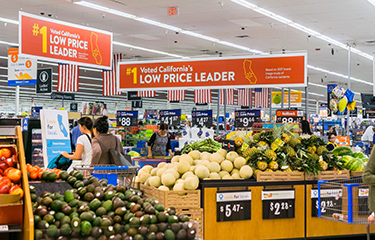
U.S. grocery prices are not rising at the level they were last year, when food price inflation hit record highs, but Americans continue to be concerned the overall economy and their personal finances.
Walmart’s longstanding focus on value, however, has helped it – along with other value-driven grocery chains – thrive within the current high inflationary environment, in which consumers are growing more cost-conscious, Insider Intelligence Senior Analyst Zak Stambor told SeafoodSource.
“Walmart grocery and wellness sales help insulate it from consumers’ pullback in discretionary spending,” Stambor said. “[Rising grocery prices] have driven younger and higher-income consumers to give Walmart a try, which has helped it grow its dominant share of the U.S. grocery market.”
Bentonville, Arkansas, U.S.A.-headquartered Walmart’s strong e-commerce growth shows it is “winning over shoppers who are looking for convenience with its range of pickup and delivery options,” Stambor said.
Overall e-commerce grocery sales fell 1.1 percent in the company’s second fiscal quarter compared to the same period a year ago, but pickup and delivery orders increased.
“The combined effect of price inflation and the expiration of Covid financial support has triggered a flight-to-value as purchasing power remains under pressure,” David Bishop, a partner at retail data site Brick Meets Click, said in a press release. “This means it’s vital for grocers to offer customers more ways to save money while also providing the experience that online shoppers expect, as cost considerations will weigh more heavily than convenience for cash-strapped households in the second half of this year.”
Walmart recently reported an overall global consolidated revenue hike of 5.7 percent to USD 161.6 billion (EUR 150 billion) in its fiscal second quarter and a 6.4 percent hike in Walmart's U.S. comparable sales. Its e-commerce sales surged 24 percent in the quarter.
The grocery business is a central cog in Walmart’s offerings, helping it steadily grow membership in its Walmart+ program and providing more digital advertising space to bolster its retail media business, Stambor said.
The chain accounted for nearly 36 percent of all U.S. online grocery sales in the second quarter of this year, up more than 5 percent from the prior year and its highest share of nationwide online sales to date, according to a new Brick Meets Click report.
Walmart is not only capitalizing on actual food inflation with its focus on value, but the chain is also benefiting from perceived inflationary trends.
Americans are not yet feeling relief from the declining food-at-home inflation rate and believe it is 15 points higher than the actual 7.1 percent annual rate as measured by the U.S. Bureau of Labor Statistics, according to the most recent dunnhumby Consumer Trends Tracker (CTT) released in late August.
The report also found that 36 percent of U.S. families have skipped meals due to financial reasons in the last year and that 62 percent of Americans would have a hard time paying an unexpected expense of USD 400 (EUR 370).
“Over this year-long study, we have seen a very troubling trend of nearly one-third of all Americans, and nearly 40 percent of younger Americans, skipping meals due to financial concerns. Wave after wave, our research has also shown that 18- to 44-year-olds are at the epicenter of a food and financial insecurity crisis that shows no signs of abating,” dunnhumby President of Americas Matt O’Grady said.
U.S. shoppers have steadily sought out omnichannel resources over the last year to optimize their grocery shopping and save money, dunnhumby noted, which further explains Walmart’s e-commerce growth. A little more than a quarter of consumers (28 percent) now order groceries online for delivery at least some of the time, a 9 percent increase year over year.
“Those checking prices online before or during a shop has also increased by 9 percent year over year, up to 40 percent,” dunnhumby said.
More consumers are looking for deals, and 40 percent said they are shopping at different stores to find the best value – a 9 percent spike since last year. Consumers are most willing to shop around for non-alcoholic beverages (60 percent), packaged foods (55 percent), and frozen food (54 percent).
Seafood demand has not caught up with deflationary trends, though, 210 Analytics Principal Anne-Marie Roerink told SeafoodSource, resulting in fresh seafood sales dropping 4.8 percent in value to USD 483 million (EUR 450.4 million) in July, with a 3.3 percent decline in pounds sold. Frozen seafood sales also decreased 4.2 percent in value, totaling USD 500 million (EUR 466.3 million).
Following recent trends, seafood inflation was lower than overall food and beverage inflation – which rose 5.2 percent – in July, according to Circana and 210 Analytics data. Total fresh seafood prices deflated 2 percent, led by a 7.6 percent drop in shellfish prices. Frozen seafood prices also dipped 4.3 percent, while shelf-stable seafood inflation rose at a slight 0.6 percent rate.
Photo courtesy of Brick Meets Click
