


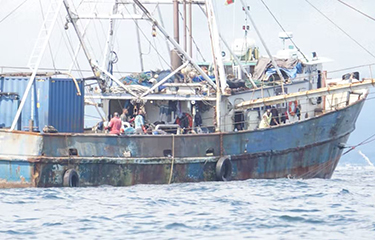
Cameroon is now looking to ship its seafood elsewhere after the European Commission issued a “red card,” effectively banning Cameroonian seafood exports.
On 5 January, 2023, the E.C. identified Cameroon as a noncooperating country in the fight against illegal fishing for continuing to “register fishing vessels under its flag without demonstrating its ability to effectively control and monitor their fishing activities, particularly when operating outside its territorial waters.”
The ban came nearly a year after the E.C. issued a yellow card to Cameroon – an official warning to the Cameroonian government of its failure to effectively tackle IUU fishing.
“Cameroon has not ensured sufficient cooperation with the [E.C.] in the fight against IUU fishing and did not provide adequate and timely replies to queries from the commission,” the E.C. said in a statement. “[The red card] is based on the failure of Cameroonian authorities to ensure adequate control over the national fishing fleet and to take necessary corrective measures for the cessation and prevention of IUU fishing activities. Cameroon has continued registering fishing vessels that operate outside its waters, including an IUU fishing vessel, while there is a lack of monitoring of their activities.”
Cameroon becomes the second country in Africa given a red card after Comoros, while Ghana, Liberia, and Sierra Leone received yellow cards in June 2021, May 2017, and April 2016, respectively. Togo and Guinea had their red cards removed in October 2016 and October 2014, respectively.
“The decision by the European Commission to impose a red card on Cameroon is regrettable, but absolutely the right one given the circumstances,” Environmental Justice Foundation CEO and Founder Steve Trent said in a statement.
Trent said Cameroon is losing out economically despite a significant number of large foreign trawlers flying the country’s flag. FAO data shows 15 percent decline in the value of Cameroon’s overall fish and seafood exports between 2016 and 2020, from USD 4.99 million (EUR 4.57 million) to USD 4.27 million (EUR 3.91 million).
The vessels “have little to no Cameroonian ownership, do not land fish at the country’s ports, and do not appear to employ Cameroonian fishers," Trent said.
"Cameroon’s government has taken action in recent years to improve transparency and tackle illegal fishing. I have seen this firsthand, as EJF works in partnership with the Cameroonian authorities to improve fisheries governance and ensure a more sustainable ocean," Trent said. "However, the danger of becoming a safe haven for illegal fishers risks undermining the progress made. Cameroon can and should use the momentum of this red card to drive ambitious, lasting reform, making sure that only legal, ethical, and sustainable fishing takes place under its flag.”
In July 2022, the European Commission said there were at least 14 vessels engaged in illegal and unregulated fishing registered in Cameroon despite their ownership or management being traced to Belgium, Malta, Latvia, and Cyprus.
The E.U. issued numerous warnings to Cameroon questioning the safety of its seafood exports products and the legality of the fishing taking place in the country’s exclusive economic zone. In 2004 the E.U. temporarily suspended its imports of Cameroonian seafood after finding hygienic issues with shrimp sourced from the West African nation. It issued a subsequent seafood-import ban in 2009. Prior to those bans, France, Spain, Belgium, Holland, and Greece were all major markets for Cameroon’s seafood exports.
The E.U.’s red card comes as Cameroon has already been exploring other export-market options, including other African countries and Asia. As it has dealt with European pressure, Cameroon has sought out and signed seafood-export deals with other countries, including Malaysia. Shrimp remains Cameroon’s main seafood export with the country’s annual production estimated at 5,200 MT. In 2021, Cameroon exported an estimated 590 metric tons (MT) of shrimp to neighboring countries and 290 (MT) to Asia, according to FAO (FAOSTAT) statistics.
The E.C. red card comes even as the E.U. and the German government have been financing an initiative to support an improvement and expansion of Cameroon’s shrimp sector. The FISH4ACP is being implemented by the FAO “to increase the productivity and competitiveness of Cameroon’s shrimp sector by promoting a sustainable and responsibly managed shrimp fishery that stimulates economic growth and brings social benefits for all involved in the value chain.”
The initiative entails improving stock management and monitoring of fishing activities to enable better management of Cameroon’s shrimp fishery and lessen its impact on the environment, according to the FAO.
Photo courtesy of Oceans 5
