





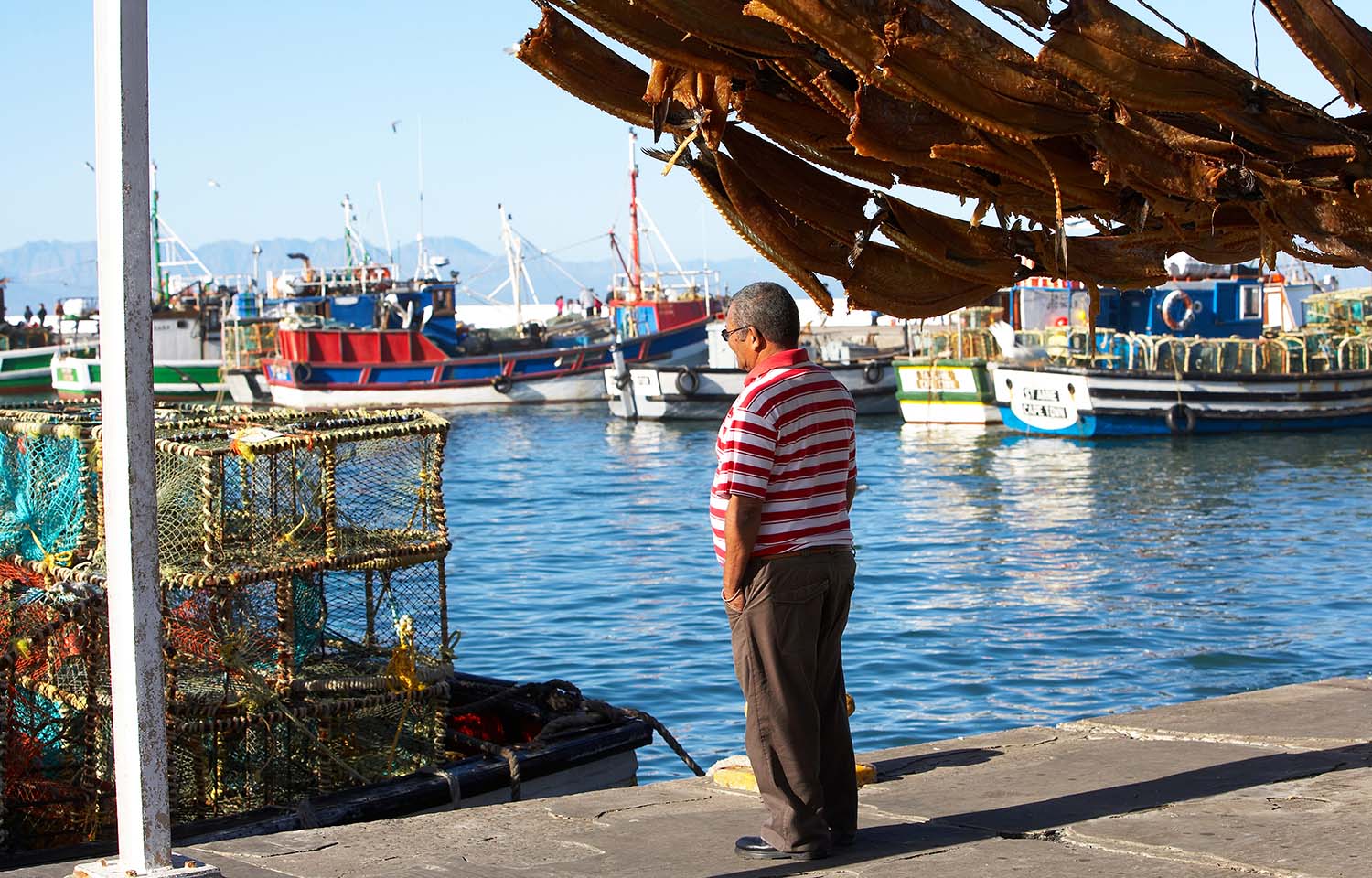
A group of small-scale fishers in South Africa have accused the country’s Department of Forestry, Fisheries, and the Environment (DFFE) of corruption and discrimination through the deployment of its fishing rights allocation (FRA) system, claiming that they have been cast aside in attaining rights while those with upper-class connections in the country receive more favorable treatment.
The group, interviewed where they work in Cape Town’s Kalk Bay Harbor by local newspaper the Daily Maverick, mainly comprise Black and Indian fishers claiming the coastal communities where they live and make a living are often denied the permits needed to fish, sometimes leading to the collapse of generations-old fishing businesses.
They alleged the discrimination goes back to in 2005, when many were dispossessed of their fishing permits upon the introduction of the country’s new fisheries policy, which contained no quota provision for small-scale fishers.
Furthermore, they claim the process of applying for the FRA is shrouded in corruption and appears designed to lock out small-scale fishers. They criticized the system’s online application process as convoluted and frequently changing.
“The allocations are such a corrupt system. You have to tell your story to a quota board, but it’s no use because people with influence can buy quotas,” Tony Trimmel, a local fisher of Filipino descent, told the Daily Maverick. “People connected to politicians are the first recipients. You’re never going to be able to prove it, but everybody in the industry knows it, and the online license application system is a nightmare and stacked against us.”
In response, the South Africa DFFE denied all corruption and discrimination claims. It said its FRA system stems from the country’s Marine Living Resources Act (MLRA) of 1998, which requires the department to issue fishing rights to qualified applicants without discrimination.
DFFE Chief Director for Communication and Advocacy Peter Mbelengwa said the MLRA has been fundamental to granting fishing rights “since the promulgation of this act up until today.”
“The fishing rights system has not changed, and the MLRA makes provisions for three categories of fishing sectors: namely commercial, small-scale, and recreational,” he told SeafoodSource.
Mbelengwa said the DFFE has provided various avenues to enable engagement with small-scale fishers, should they encounter issues with the FRA process.
“The structure meets from time to time to provide advice to the minister for fisheries on matters relating to the fishing sector," he said.
Nevertheless, Mbelengwa acknowledged some incidents of corruption in the allocation of fishing rights have occured, but said the government has been combating corruption through existing legal frameworks and has pursuing charges against some of the department’s fisheries control officers (FCOs). He cited a case of seven FCOs convicted of engaging in suspect quota allocations in September 2023.
But Masifundise, a Cape Town-based NGO that works closely with small-scale fisheries across South Africa, said DFFE's problems are unlikely to disappear anytime soon. It expressed concern about mounting complaints of corruption in the FRA process.
“There is no doubt corruption is rife in the Fisheries Department when it comes to the allocation of fishing rights," it said.
Masifundise Director Naseegh Jaffer said a major problem with the FRA system is a lack of “clear criteria to identify who small-scale fishers are.”
“The manner the quotas are allocated is, at times, abused,” he said.
Broadly, Jaffer said the FRA system only recognizes small-scale fishers organized into a group, and that individual fishers, such as the ones in Kalk Bay, are encountering issues when applying for small-scale fishing quotas.
“The claims by the Kalk Bay guys may not be the whole truth because there is a lot of information they have not disclosed, especially about an order issued by the court regarding small-scale fishers policies in 2010,” Jaffer said.
That issuance involved a South African court ordering the DFFE to develop a policy conferring the right to catch different species of fish near the shore to small-scale fishing groups engaged in fishing to meet food and basic livelihoods and those directly involved in the processing or marketing of fish.
“I will not entirely dispute with those interviewed for the report that they are artisanal fishers, but I dispute that they are fully small-scale fishers as provided for by the policy because of the nature of the vessel they use, which takes between eight and 10 people," Jaffer said. "They have some characteristics of small-scale fishers but won’t fit into the DFFE classification of small-scale fishers."
The DFFE recently announced the completion of issuing 15-year fishing rights to small-scale fishers in the Western Cape, marking the “final province where these rights have been granted for the first time in South Africa’s history,” according to South Africa Fisheries Minister Barbara Creecy.
Creecy admitted there is much more that needs to be done to support the small-scale fishing sector’s growth and development.
“We are very committed to this process," she said.
Creecy said the DFFE is still in the process of developing an aid plan to grant quota for fisheries that are sustainable and financially viable to the small-scale fishing sector.
Photo courtesy of the John Martin Media/Shutterstock
