


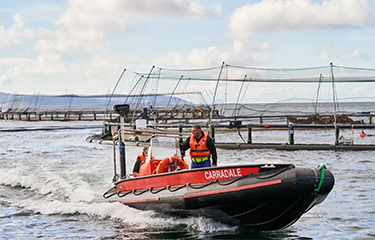
Mowi Scotland has received council approval for its proposed salmon farm on the Scottish west coast, which it said will create 10 permanent jobs and bolster investment in the local community near Kintyre’s Kilbrannan Sound.
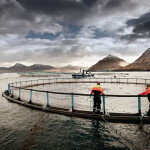
The new farm – North Kilbrannan – will include 12 120-meter compact circular cages, as well as a 400-metric-ton (MT) feed barge, and hold a maximum 2,475 MT of Atlantic salmon.
Mowi Scotland Director of Communications Ian Roberts told SeafoodSource that the company aims to build and stock the farm by late spring 2024, with its first salmon expected to be available in the market by 2025.
“This new site complements nearby farming operations, and the added economic activity will help facilitate substantial investment and upgrades to Carradale Harbor for both commercial use and the benefit of the community,” Roberts said. Those upgrades include the construction of a purpose-built shore base, storage facilities, and a new pontoon.
The unanimous approval the farm received from the Argyll and Bute Council – one of 32 unitary council areas in Scotland – follows five years of work by Mowi Scotland, in collaboration with teams of marine biologists, oceanographers, and data analysts, responding to local concerns and outlining the plan’s economic and sustainability benefits.
Besides those efforts, the council highlighted Mowi’s recent recognition as the world’s leading sustainable protein producer for the fifth year in a row by the Coller FAIRR Protein Producer Index as a major reason why the farm received unanimous approval.
Mowi Scotland, which is the country’s largest salmon producer, also recently collected its first eggs from specially selected Mowi broodstock that will eventually make their way to the company’s new broodstock and egg facility in Ardessie.
The egg collection is an early stage of the company’s made-in-Scotland broodstock program, which has entailed the next generation of the company’s salmon being taken from Mowi’s nucleus breeding program in Ireland in 2021 and raised at seawater farms in Scotland. After a few weeks held in freshwater this autumn, Mowi’s breeding experts began checking the salmon for spawn readiness; conducting DNA analysis to search for high growth potential, disease resistance, and flesh pigment quality; and ranking male fish according to their breeding index.
For several years, Mowi has been reliant on external egg supply due to an export ban implemented by the Scottish government on Norwegian salmon ova. The Ardessie facility aims to solve that issue and will produce up to 50 million eggs to supply Mowi’s production hatcheries.
“Once the Ardessie broodstock site is complete, we will be able to produce all the eggs required for Mowi Scotland production with some additional capacity to sell to third parties,” Roberts said. “The proposed recirculating aquaculture system design allows temperature and light regime manipulation of each tank individually so we can adjust these parameters to induce early and late spawning, thus providing eggs throughout an extended season to match smolt production requirements.”
More plans are also in the works for Mowi Scotland, as it has stated it wants to grow post-smolt salmon at its farms in Loch Etive and began initiating a community engagement process for these efforts in September.
“Our community events earlier in the year were well received with good engagement regarding our post-smolt plans for Loch Etive,” Roberts said. “We are looking forward to holding more events in January 2024 and continuing to work with the local community to make improvements for both our operations and the local environment.”
Mowi production experts found Loch Etive to be the most suitable location out of a number of options for post-smolt operations due to its comparably lower costs and carbon footprint. The plan for the site is to employ six-month growth cycles that enable farms to synchronize fallow periods, or temporary periods of ceased production, throughout the entire loch system.
According to the company, those half-year breaks in production combined with the loch’s naturally brackish waters will help maintain a low sea lice population. Also, with less standing biomass on site, the company can use less feed and, therefore, will generate less organic waste, aiding in seabed recovery.
Photo courtesy of Mowi Scotland
