





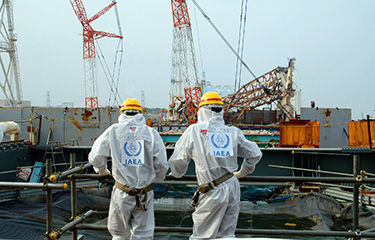
Tokyo Electric Power Company Holdings (TEPCO), the operator of the earthquake-damaged Fukushima Daiichi Nuclear Power Station, has announced it plans to move ahead with a controversial release of contaminated water on Thursday, 24 August.
A fight over the release of the water has stretched over years, with some countries, including China and Russia, promising import restrictions on fish from Japan if the release is conducted.
In response to concerns about contamination of local fishery products as a result of the release, TEPCO issued a report, released in English on 26 July, providing an update on its efforts to prevent fish containing high cesium concentrations from escaping Fukushima's port. TEPCO released a Japanese-only version on 5 July, the same day the company revealed an analysis of a black rockfish sampled from the port area of the Fukushima Daiichi Nuclear Power Station found its flesh contained 180 times the legal amount of cesium-137.
The fish, sampled from the Unit 1-4 intake open channel on 18 May, was tested for both radioactive isotopes cesium-134 and -137, and the value for the latter reached 18,000 becquerels per kilogram. Japan's current limit for radioactive cesium in food is 100 becquerels per kilogram.
The reason for the high level of radioactive material, according to TEPCO, is that contaminated water flowed into the Fukushima Daiichi nuclear power station port immediately after the accident, and rainwater from the areas around reactors one, two, and three continues to flow into the inner breakwater where the rockfish was caught in May. As a result of the flows, the sediment on the seabed inside the inner breakwater also contains a high concentration of cesium.
When a black rockfish exceeding radioactivity standards was caught off the port of Soma in January 2022, the high concentration led authorities to believe it escaped from the nuclear plant’s port. Shipments of black rockfish from Fukushima prefecture were suspended, and sampling of all species of fish near the plant was increased, confirming other cases of high radioactivity.
“Following increased efforts to catch the fish in the port implemented in February 2022 and onward, the number of specimens caught and analyzed has increased significantly from 88 in FY2021 to 415 in FY2022,” the TEPCO report said. “The number of specimens analyzed with cesium concentrations exceeding 100 Bq/L has also increased accordingly.”
Since then, TEPCO has been installing additional nets around the port area, especially along the east seawall, where the most cases of high readings were recorded. It also plans to take three other measures for reducing the number of fish with high concentrations of cesium.
First, TEPCO will remove rubble and install paving to reduce the cesium concentration of seawater in the intake open channel for Units 1-4 to less than one becquerel per liter. To deal with sand deposits, a silt fence will be installed at a discharge outlet, and sediment deposition will be sampled.
Second, TEPCO will use gill nets to catch fish and prevent them from leaving the area. In addition, the existing net installed to prevent fish from leaving at the east seawall will be replaced with nets made of strong and corrosion-resistant polyester monofilament nets and steel pipe piles. The new net will be extended to surround the intake open channels. The work was to begin in July and finish by the end of 2023.
Third, the cesium concentration of seawater in the port and the status of the fish will continue to be monitored.
The containment of fish contaminated with cesium, and limiting the amount of exposure fish in the port undergo, is a separate issue from releasing stored cooling water containing tritium into the sea.
In response to that announcement, Hong Kong, the second-largest market for fisheries exports from Japan, has already vowed to place an indefinite ban on all seafood imports from 10 Japanese prefectures, the South China Morning Post reported. Hong Kong also said it plans to publish the test results of other food from the country daily, and Secretary for Environment and Ecology Tse Chin-wan told the media that preventative measures would be necessary because Tokyo had failed to answer how it would reduce risks.
“This is a precautionary measure. We are taking a more conservative and safer approach [by] including coastal and nearby prefectures [in the ban],” Tse said.
The ban will apply to the prefectures of Tokyo, Fukushima, Chiba, Tochigi, Ibaraki, Gunma, Miyagi, Niigata, Nagano, and Saitama, and covers all fresh, frozen, chilled, dried, or processed seafood.
Even if the tritium does not pose a danger to human health, as promised by Japan’s Nuclear Regulation Authority and the International Atomic Energy Agency (IAEA), the big question is how consumers and fish dealers will respond to the latest release.
“If they ban imports that come via Tokyo, I think all sushi restaurants in Hong Kong will be in trouble,” restaurant owner Halry Yu told Reuters.
Fisheries cooperatives in the prefectures near the release area have also been steadfast in opposition to the plan, but have accepted the inevitable while demanding that the government live up to its promise to offer aid in case of lost income. The government created a fund to buy and freeze seafood products and to expand sales channels if domestic or export demand for seafood drops sharply because of the release. The government also instructed TEPCO to plan to compensate fishers for losses caused by reputational harm.
Japan Prime Minister Fumio Kishida said on 21 August the government will offer its support to fishing communities as TEPCO continues its decades-long process of cleaning up radioactive wastewater and material.
The wastewater release will be a setback to the local seafood industry, which had been seeing signs of recovery. After the disaster, fishing for flounder – a signature product of the Joban (Northeast Honshu) region – was mostly halted, and the catch fell from about 260 metric tons (MT) to nearly zero. The price of flounder also fell from a pre-disaster 2011 price that was about the same as the national average, to just 23 percent of the national average as big discounts were demanded by buyers who were unsure of consumer demand.
However, test fishing has gradually increased, reaching 4.5 MT in 2020. Large and steady volumes are important, as mass retailers will decline to handle products with low and variable catches, even though the quality of fish from the area is highly evaluated, the report said.
By 2020, flounder from Fukushima prefecture had also recovered its favorable reputation and was selling at 95 percent of the average pre-disaster price, according to a report from the Fukushima Reconstruction Promotion Group of the Ministry of Economy, Trade and Industry.
Japanese consumers were also becoming less afraid of radiation in seafood from the region. A report from Japan's Consumer Affairs Agency polled consumers in January 2023 and found the concern over the origin of Japanese seafood in relation to the Fukushima disaster was the lowest since the meltdown occurred.
To further calm fears on the wastewater release issue, TEPCO has been operating controlled tritium-exposure experiments on flounder, abalone, and seaweed in ALPS-treated water (1,250 becquerels per liter) and in regular seawater as a control. They found that there were no abnormalities or significant differences in mortality.
When moved into the tritium containing water, the organisms' concentration of tritium rose to match that of the surrounding water. However, the levels did not exceed that of the water, showing that tritium was not bio-accumulating. When researchers returned the organisms to normal seawater, the tritium levels quickly decreased.
Photo courtesy of Gregg Webb/IAEA
