






The recent expansion of the U.S. ban on Russian seafood has deepened a divide that has split the U.S. industry into opposing camps: those who support the prohibition and those who oppose it.
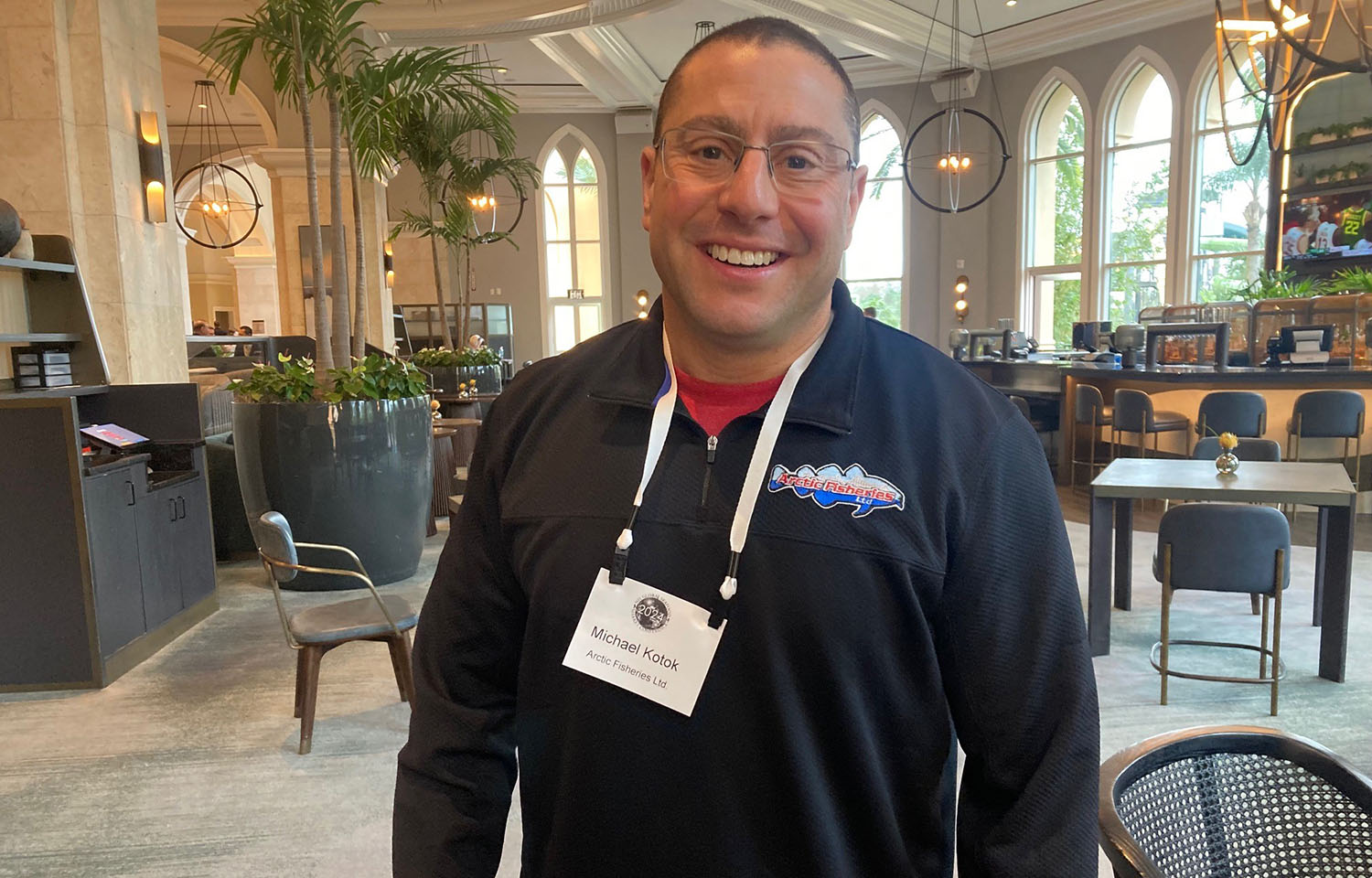
The tensions, which have spilled over via proxies onto the floor of the U.S. Senate and divided the U.S. industry's largest trade group – the National Fisheries Institute (NFI) – are the byproduct of an important and rigorous debate, according to Arctic Fisheries President Michael Kotok, but one that is in danger of crossing over into physical confrontation.
In an interview with SeafoodSource at the 2024 Global Seafood Market Conference, hosted by NFI from 23 to 25 January in Orlando, Florida, U.S.A., Kotok claimed he has received multiple physical threats since proclaiming his opposition to the U.S. ban.
“I've been threatened. I've had two physical threats,” he said.
Kotok said one threat had come from an individual who works in the seafood industry with whom he is familiar. He declined to name that person or reveal the issuer of the second threat, whom Kotok said he didn’t know personally.
Kotok is the head of Arctic Fisheries, a Buffalo, New York, U.S.A.-based importer now in its fourth generation of family ownership. He said the company, which is an importer of cod, haddock, pollock, king crab, snow crab, and other species, has a “punk rock” mentality to it, with posters of Joe Strummer, the lead singer of The Clash, hanging on the wall in Kotok’s office.
“We’re not afraid to call out the ruling class, and it’s a part of our culture to point out where we think things are wrong,” Kotok said.
When it comes to working in the seafood industry, misinformation is Kotok’s biggest pet peeve.
“It's very easy to be deceptive and sort of dance in the gray areas,” he said. “We prefer to let people know the truth, even if that means we lose the sale.”
Kotok said he felt compelled to call out what he considered a strategic blunder by the United States in implementing its ban on Russian seafood.
“I don't think it does any damage to Russia. I do believe that commerce keeps our world safe. I just look at the direction that the U.S. and Russia and U.S. and China potentially want to go, and I don't think the solution is there,” he said. “That’s not a commentary on any administration or anyone in politics; I just think we really want the Russians to actually be relying on us, not want to make them [become] self-sufficient, which is what we're doing. I want to punish Putin just as much as the next guy, but I don't think stopping USD 1,500 [EUR 1,386] pollock blocks from entering the U.S. is something the Kremlin is sweating.”
Arctic Fisheries imports fish from Iceland, Norway, Canada, China, and Vietnam and recently ceased importing from Russia, which accounted for about 20 to 25 percent of the company’s business by both volume and value, as a result of the ban.
“There's not much else we can do besides switch to Norwegian raw material and Chinese production, but so is everyone else,” Kotok said. “Prices have already shot up because of this artificial bump from Russian to Norwegian sourcing. Even the Russian prices have shot up, and now you’ve got all the plants hustling to get as much of that Norwegian stuff processed and shipped here, as well as some of the Russian stuff that's that can still get in in time. I think it's a little bit artificial, but it's certainly going to be damaging to the consumer.”
In a 22 December LinkedIn post, Kotok said “a certain large Alaskan seafood company [whose] financial difficulties and restructuring came to light in parallel with this effort” to widen the ban stood to gain the most from the move, calling it a “bailout.”
Trident Seafoods recently announced plans to sell off a significant portion of its assets in Alaska and to trim its workforce by 10 percent amid a crisis in Alaska’s seafood industry.
“They've duped the government by masquerading their monopolistic behavior as patriotism,” Kotok said. “This amendment grants a small contingent of Alaskan producers monopolistic power at the expense of the entire industry and its connections: port workers, warehouse workers, manufacturers, truckers, distributors, restaurants, and consumers.”
In October 2023, Trident CEO Joe Bundrant issued a call for the U.S. government to take further action to ensure the ban on Russian seafood was implemented effectively. His position has been championed by U.S. Senator Dan Sullivan (R-Alaska), who Kotok accused of “parroting – unchecked – [Trident’s] narrative.”
Kotok said all the ban accomplished was to empower and strengthen Russia.
“We've already seen Russia begin to build out Murmansk as a fully functional port. Previously, Russian vessels were heavily reliant upon Norwegian ports for things like offloads, sales and logistics, warehousing, provisions, fuel, staffing, repairs, equipment, and more. They needed Norway [and] the West. That is no more,” he said. “Our sanctions are creating a self-reliant Russia that is getting stronger. Economically, this does zero to the Russian war machine. Their products are still flowing to places all over the world. This amendment does not even give a single papercut to Putin. These are commodities traded all over the world, and that continues. We are just a small, skipable cog.”
Additionally, the ban is making fewer seafood products available to U.S. consumers and driving up their prices, according to Kotok.
“It's hurting consumer preference. Certain politicians who say Americans should eat American fish; we don't even produce enough, and we don't produce the variety,” he told SeafoodSource. “I don't think we can have everyone eating tilapia. People prefer choices, and that's the wonderful thing about seafood.”
Kotok acknowledged an effort from the industry, led by NFI, to get the ban reversed or overturned will likely not be successful.
“You look around [at GSMC], and everyone's still saying, ‘Let’s fight this,’” he said. “The ship has sailed. Now, it's how do you navigate this situation? What do you do for the consumer? There's still not many answers.”
Even with the ban, Kotok is optimistic about U.S. seafood sales in 2024.
“I feel like seafood is a leading indicator. Seafood generically began going [south] right after Ukraine was invaded by Putin. I think people began to reassess at that time, and we all looked at our supply chains and at this huge bottleneck that was out there on the water. I think that's when we realized we did actually have enough inventory, but we didn't realize that initially. So, seafood went through its price declines,” he said. “Every species has been oversold – prices got too low or lower than what reality was or should have been, and now we're seeing every species is starting to get their footing. Now, we're seeing things turn around, and we're starting to see some demand. The last six or seven weeks … we are seeing a comeback. It won't be strong like it was. There has been demand disruption. We have to work as an industry to get that back. Increasingly, in my opinion, it comes down to how consumers view the value, and as an industry, we have to fight for those dollars.”
Photo by Cliff White/SeafoodSource
