



U.S. sanctions are forcing Russian crab suppliers to find new markets, and Japan has become a new destination for deeply discounted king crab, snow crab, and horsehair crab.
The U.S., which was formerly the biggest purchaser of crab from Russia, introduced an embargo on imports of Russian seafood in March 2022 as part of sanctions related to the Russian invasion of Ukraine. The country recently expanded that ban to include products that stem from Russia but were processed by third-party nations.
Japan similarly introduced sanctions at the time of Russia’s invasion by removing the country’s “most favored nation” status in April 2022, but this move did not ban imports like U.S. sanctions did; it only slightly raised tariff rates.
As a result of Russia’s stripped status, Japan’s customs duties on Russian-origin crab rose from 4 percent to 6 percent, and the duty on salmon and trout jumped from 3.5 percent to 5 percent.
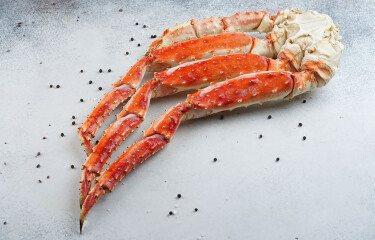
Nevertheless, Russian crab shipments to Japan have continued and specifically comprise three types of the crustacean: king crab, snow crab, and horsehair crab.
Japan Customs data for 2023 through October showed that the country imported nearly 2.5 million kilograms of king crab valued at JPY 8.3 billion (USD 57 million, EUR 52.8 million). All but 9 percent of that volume, or 2.45 million kilograms, came from Russia, with the rest coming from Norway.
The average value per kilogram of Russian king crab exported to Japan was JPY 3,325 (USD 22.59, EUR 20.78), marking a 59 percent year-over-year price drop for the 10-month period. Import volume of the product, meanwhile, increased by over 78 percent year over year.
The pattern of lower prices and an increase in imports from Russia also held true for snow crab, but this did not strongly affect domestically caught products, with Japan’s domestic snow crab continuing to demand premium prices thanks to several factors, including higher quality, even amid a glut of frozen products.
Russian-sourced snow crab accounted for 65 percent of Japan’s total import volume for the species from January through October, while Canadian snow crab accounted for 23 percent, the U.S. for 6 percent, Norway for 2 percent, South Korea for 1 percent, and Greenland for 0.7 percent.
Canada is aiming to increase its market share of crab exports to Japan and has made a concerted effort to pressure Japan into banning imports of crab from Russia and import more snow crab from Canada instead. This strategy comes as many U.S. consumers have turned away from luxury food items due to inflation.
As for horsehair crab, Russia is Japan’s only foreign source of the species. Japan imported 34,125 kilograms during the 10-month, valued at just over JPY 58 million (USD 413,000, EUR 376,700). Those statistics mark a volume increase of 5 percent year over year, yet the value declined about 27 percent.
Photo courtesy of Shutterstock/Roman50
