






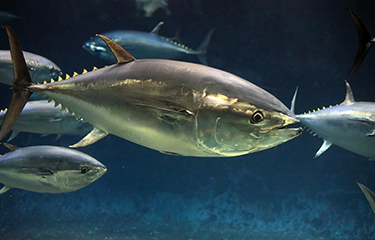
Juvenile Pacific bluefin tuna are plentiful in Japanese coastal waters, but the country’s fishermen aren’t celebrating as a low total allowable catch (TAC) is forcing them to release target fish to avoid catching too many bluefin, losing out on lucrative mackerel and yellowtail in the process.
Juvenile bluefin – defined as bluefin under 30 kilograms – is considered a choke species, or a species with a small quota often caught as bycatch that prevents the efficient utilization of quota for target species. The high presence of juvenile bluefin and its relatively low quota hampers fishing for other species.
Some fisheries in the U.S. have tackled the problem of choke species by pooling TAC among vessels, but Japanese fishermen typically want to possess as much bluefin quota for themselves as possible until the end of the year, when holiday spending on the species can cause prices to rise by as much as 50 percent.
Complicating the matter further, set-nets are a common and traditional fishing method in Japan, but give fishermen little control over what species they catch. When bluefin are mixed in with target catch, fishermen release them by sagging or opening a part of the net, leading to the inevitable escapement of target species as well.
“Such releases are becoming more frequent all over Japan due to the significant gap between growing stock levels and fixed catch limits,” the Japanese delegation at the meeting of the Joint Working Group on Pacific Bluefin Tuna said in Fukuoka, Japan, over the summer.
The delegation wanted the two regional fishery management organizations (RFMOs) that set rules for tuna fishing in the Pacific Ocean – the Western and Central Pacific Fisheries Commission (WCPFC) and the Inter-American Tropical Tuna Commission (IATTC) – to increase catch quota in light of the species’ faster-than-expected stock recovery. That request was denied, but is sure to be a prevalent theme at future meetings.
Besides set-net fishing, purse-seiners also have to deal with bluefin compromising targeted mackerel catch. The penalty for exceeding quota is typically a reduction in the following year, but it can also cause a chain reaction that results in a quota reduction for other vessel operators in the same prefecture.
A November report on Japan’s state-supported TV broadcaster NHK revealed the crew of an undisclosed seine vessel discarding juvenile bluefin at sea while fishing for mackerel to avoid exceeding TAC levels. A set-net operator interviewed said that he was compelled to discard tuna in order to land mackerel, though such discards are against the rules.
“Our livelihood is at stake, so we have to land the fish even at the expense of bluefin tuna; that's the reality," he said.
Similar problems may also arise in other mixed fisheries throughout the country. Bottom-trawl fisheries in particular are usually mixed fisheries that suffer from the high presence of choke species.
In light of the difficulties caused by the juvenile bluefin TAC, the Japanese government has begun implementing measures to help affected fishermen, signaling a continuation of governmental efforts to accomplish just that.
In the fiscal year 2020 budget, the government planned to spend JPY 40 million (USD 267,360, EU 244,760) to devise and test new set-net designs that would separate tuna and yellowtail, allowing the former species to escape without compromising target catch. One design focused on the average depth that each species prefers, and some of the allocated money went toward preparing and disseminating instructions on the use of such nets.
In 2019, the government spent JPY 4.9 billion (USD 32.7 million, EUR 30 million) to compensate fishermen who had to suspend fishing for their target species when too many juvenile bluefin were taken as bycatch, and a year before that, it budgeted JPY 21 billion (USD 140.3 million, EUR 128.5 million) to pay fishermen a fixed amount for the extra labor involved in releasing bluefin, as well as for half the cost of changing their gear to updated versions.
Such measures may soften the blow for now, but Japanese fishermen may lobby for similar measures and expenditures for additional choke species that the creation of new TACs, aligning with a 2018 reform of the country’s fisheries law – titled the Fisheries Reform Act – will generate.
Photo courtesy of feathercollector/Shutterstock
