



Norway’s salmon industry posted a 30 percent increase in export earnings last year despite a smaller harvest, with sales to overseas markets totaling a record NOK 105.6 billion (USD 9.6 billion, EUR 9 billion), according to Norwegian seafood data firm Kontali.
The data highlighting this increase, compiled by Kontali Analyst Filip Szczesny in a recent report titled “The Salmon Farming Industry in Norway 2023,” found that the E.U. and U.K. market was the biggest purchaser of Norwegian salmon in 2022, buying a 71 percent share of exports.
Notably, the U.S. increased its share of Norwegian salmon exports more than any other market, rising from 5.4 percent to 6.6 percent, while Japan’s share of Norwegian salmon exports fell from 3.2 percent to 2.7 percent.
The industry realized higher sales even as average sea temperatures were lower in 2022 than in the preceding year, impairing growth conditions for Norway’s producers. Average salmon harvest weight fell 1 percent to 4.84 kilograms whole-fish equivalent (WFE) during the period, and in total, the country harvested just over 1.5 million metric tons (MT) WFE.
The total global harvest of salmonids in 2022 reached 3.43 million MT – a 1.2 percent increase compared to 2021, but with Norway’s harvest volume decreasing in 2022, its share of global volume fell from 47.4 percent to 46.4 percent. Chile was the second-largest producer in volume terms with an output of just over 1.05 million MT.
Nevertheless, total income for Norway’s 38 large salmon-farming companies – those that possess six or more licenses – increased 27 percent, and prices increased 43 percent to an average of NOK 82 (USD 7.48, EUR 6.95) per kilogram. The weighted average earnings before interest and taxes (EBIT) margin for these companies increased from 20.8 percent in 2021 to 28.5 percent in 2022.
For the remaining 40 small and mid-sized companies – those that possess five or fewer licenses – net sales increased by 23 percent in 2022, and the weighted average EBIT margin was 26.1 percent, jumping from 18.4 percent posted the year before.
Alongside increased earnings, production costs also rose in 2022, Szczesny told SeafoodSource.
“Looking back over the past five to 10 years, cost developments can be largely attributed to mitigating biological challenges but not particularly in 2022 alone. The main cost driver is increased feed cost per kilogram. We anticipate further increases in feed cost in 2023,” he said. “Between 2017 and 2020, the feed cost increase accounted for roughly 50 percent of total cost increments, However, from 2020 to 2023, this proportion has surged to 70 percent.”
Besides high production costs, the additional 25 percent resource tax levied by the Norwegian government on the grow-out phase of salmon production led to capital expenditures among larger companies falling by an average of 36 percent in 2022. While the resource tax on salmonid producers was not finalized until May 2023, anticipation of the tax led to changes in company structures and a pause or complete cancellation of many investments.
Additionally, the resource tax heavily affected the 2022 auction of maximum allowed biomass (MAB), with auction prices significantly lower than in previous years and approximately 25 percent of offered volume – equivalent to 8,243 MT out of 32,887 MT – going unsold.
None of the publicly listed aquaculture companies purchased capacity in the auction, which impacted various regions, such as production in Finnmark, which was only able to sell 200 MT out of the 6,443 MT MAB available. The unsold capacity ended up being sold in October 2023 after more of the tax’s implications became clear to companies.
However, though investments have begun to pick up again, Szczesny said that elements of the tax remain unclear, particularly how the Norm Price Council determining salmon prices will determine actual price, or income subject to ground rent taxation.
“We have observed that a few large investments have picked up after a complete halt, such as through participation in the October auction of remaining capacity,” he said. “We are monitoring the development in this area closely.”
Alongside its Atlantic salmon harvest, Norway produced 75,500 MT WFE of ocean-farmed trout in 2022, some 7 percent, or 8,700 MT, less than in the previous year. Similar to salmon, the volume of trout exports fell 11 percent year over year, but higher prices led to a 24 percent, or NOK 900 million (USD 82.1 million, EUR 76.3 million), increase in value to almost NOK 5 billion (USD 456.2 million, EUR 423.9 million).
Kontali expects similar trends to play out once 2023 finalizes, predicting another decline in Norwegian salmon volume in 2023 but for total export earnings to increase again. For 2023 year-to-date, export earnings have increased 17 percent in NOK compared to last year, Szczesny said.
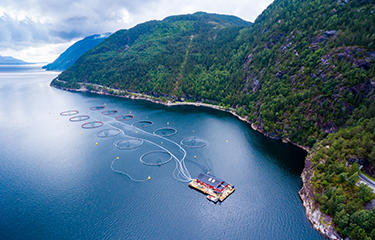
Photo courtesy of Andrei Armiagov/Shutterstock
