





This year’s quota for Alaska’s Bristol Bay commercial red king crab season was smaller than usual, but fishermen are reaping the reward of high demand in the lead-up to the holidays.
More than 99 percent of the 2.1-milllion-pound quota has already been caught by 31 vessels, according to KUCB. Alaska Department of Fish and Game Area Management Biologist Ethan Nichols said while the total allowable catch was less than half of the 2018-2019 season, it was still welcomed by the region’s fishermen. Bristol Bay struggled with a financially difficult salmon season this past summer, the Bering Sea snow crab fishery remains closed for a second straight year, and Southeast Alaska’s red and blue king crab fisheries have been closed since 2017.
“The red king crab and tanner fisheries are obviously small this year, but I think they're really important for helping the industry stay afloat through these years where we haven't had a snow crab fishery, which is really the bread and butter for the crab fleet in the Bering Sea,” Nichols said.
Nichols said called the fishing season “average,” with pot sizes and crab weight around previous norms.
“It varied a lot amongst the fleet, but I got a lot of positive feedback from captains,” he said. “They were seeing good numbers in their pots and a good mix of smaller males, and also females, they say, were working further to the east.”
Nichols said processors are paying around USD 8.00 (EUR 7.28) per pound for king crab, which doesn’t include retros, or bonuses, which could bring the total price up to USD 15.00 (EUR 13.65).
With a resilient U.S. economy and a ban on Russian king crab imports, the Bristol Bay red king crab fishery is commanding a premium in the market, according to crab expert Les Hodges. He reported U. S. king crab imports are down 87 percent through October to 3.4 million pounds. Even with Norwegian exports of live king crab to the U.S. rising 74 percent to 3.5 million pounds and frozen king crab exports hit 1.5 million pounds year-to-date through November, the total won’t come close to meeting the gap left by the exclusion of Russian crab from the market, Hodges said. Fresh Norwegian king crab was receiving USD 41.90 (EUR 38.14) per kilogram and frozen crab was pulling in USD 55.04 (EUR 50.10) per kilogram.
Meanwhile, Russian king crab exports to China are up 61 percent year-to-date through October 2023 to 58.7 million pounds for live crab alone. And the Norwegian king crab quota is expected to drop by 60 percent in 2024, meaning there is likely to be a shortage of king crab in the U.S. market for the foreseeable future, according to Hodges.
“Alaska red king crab is expected to be in high demand and dominate versus other sources of king crab for the holiday season,” Hodges said.
Alaskan fishermen are also bringing Bering Sea golden king crab in, with the season’s total allowable catch set at 5.5 million pounds. The 2023-2024 Bering Sea tanner crab is also underway, and the 2024 commercial tanner crab fishery quotas were released for in Kodiak and South Peninsula districts, at 3 million pounds for Kodiak – down 49 percent – and 480,000 pounds, respectively. Chignik will remain closed in 2024, as well the snow crab St. Matthew Island blue crab fisheries.
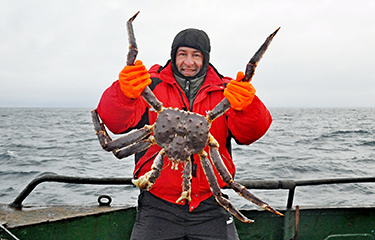
Photo courtesy of Don Serhio/Shutterstock
