


SeafoodSource Price Aggregation, Reporting, and Analysis Methodology
Products Covered: Shrimp, Whitefishes (cod, haddock, hake, pollock, saithe), Salmon, Tuna, Lobster
Updated 14 September 2026
SeafoodSource is committed to promoting transparency and understanding across global seafood markets. Our price reporting and analysis reflect this mission by providing consistent, objective, and evidence-based insight into seafood trading conditions. This methodology explains how we gather, verify, and evaluate market information, as well as how our proprietary price aggregation tool produces prices. It is updated frequently, including whenever we update our Premium+ seafood intelligence offerings.
ETHICAL STANDARDS
SeafoodSource adheres to strict ethical principles to safeguard independence and transparency. Beyond standard journalistic ethics, we practice the following principles:
- Reporters do not accept gifts, favors, or compensation from participants.
- Source identities are kept strictly confidential.
- Internal systems secure all submitted data.
- SeafoodSource does not enter into formal confidentiality agreements for the purpose of price reporting; instead, we rely on established newsroom standards of confidentiality and data protection.
PURPOSE AND SCOPE
SeafoodSource's price aggregation, reporting, and analysis aims to represent prevailing market conditions for key seafood commodities.
We report on prices in two general ways:
- Through our proprietary price aggregation tool, the SeafoodSource Pricing Portal, and through editorial reporting on the prices generated by that tool.
- Through editorial reporting on prices offered or sales reported to our Price Reporter from verified sources, whose accounts are contextualized within their sector and market.
We also offer analysis of pricing conditions, which aims to:
- Give readers an account of market participants' sentiments about the current market.
- Prepare readers for potential market fluctuations, when possible, by analysis of seasonal patterns, global factors, and historical precedence.
- Share expert opinions, in context, on market conditions with readers.
- Share the price reporter's analysis of these factors when appropriate.
Our process adheres to accepted seafood industry norms concerning:
- Units of measure
- Delivery terms
- Currency
- Product specifications, grades, and forms
- Regional market distinctions
SEAFOODSOURCE PRICING PORTAL METHODOLOGY
Prices reported by the SeafoodSource Pricing Portal are weighted averages, based on the price reported by a given source (whether a trade organization, physical marketplace, or benchmarking firm). Weighted averages are determined by considering how each value contributes to the total in proportion to an assigned weight.
In plain language, this means that we weight our averages to ensure that the large quantities of fish reported by larger nations, ports, and markets, bear more heavily on a given average price than those of their smaller counterparts. Another way to understand this is to say that we ensure that prices for very small quantities of fish do not skew our overall averages.
This system allows the SeafoodSource Pricing Portal to determine per-unit prices for most seafood commodities it tracks. If a given data source does not publish weights for its seafood commodities, however, we cannot produce a weighted average. These data sets are marked accordingly.
A visual representation of the weighted average method is below:

Figure: Illustrative weighted average price calculation.
EDITORIAL PRICE REPORTING METHODOLOGY
Prices reported editorially by the price reporter represent the best available indications of market value based on the perceptions of market participants and SeafoodSource analysts; they may not always be based on completed transactions.
Most prices are reported per kilogram, but the price reporter also offers per pound and per metric ton values when appropriate.
Incoterms relevant to the seafood trade
FOB (Free On Board): FOB prices reflect product at the point of loading, whether at the dockside, processing facility, cold storage, or distributor.
FCA (Free Carrier): Prices include export clearance fees, assumed by the seller. Risk transfer happens either at the seller's premises, when the seller loads the goods onto the buyer's collecting vehicle, or another named place (such as a warehouse), once the goods are placed at the carrier's disposal, ready to be unloaded.
INFORMATION COLLECTION AND REPORTING SCHEDULE
By the SeafoodSource Pricing Portal:
The SeafoodSource Pricing Portal collects data twice daily from all published data sources. If new data is available, the Portal updates its prices. The date and time of the last data collection attempt, as well as the last new data import, is recorded at the bottom of the screen.
Pricing Portal Data Source Coverage by Species:
Trade data and physical market/auction sources currently available in the SeafoodSource Pricing Portal, by species.
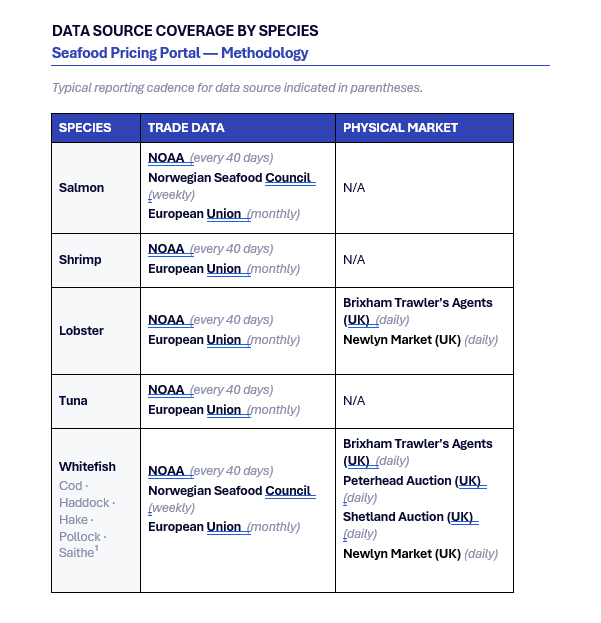
Cadence shown in parentheses reflects how often each source publishes new data. Physical market/auction sources are shown as daily based on typical trading-day reporting.
Through direct collection of data by Price Reporter:
SeafoodSource's Price Reporting Specialist collects information continually through:
- In-person meetings
- Industry-standard digital communication tools
We encourage participation across the seafood value chain, including harvesters, processors, traders, distributors, wholesalers, buyers, importers, exporters, and retailers.
Participants are asked to share all data relevant to price formation, including any contextual information that may clarify market conditions. Data gathered may include:
- Transaction timing and specifics
- Product form, species, size, grade, and certification
- Quantities and order sizes
- Delivery and shipment schedules
- Packaging details
- Firm bids and offers
- General market sentiment, supply/demand updates, and observed trends
Price Conversions
Prices are listed first in the currency of the market from which the reported data is being drawn. For instance, if a data point comes from a market in the UK, the price will first be reported in GBP, followed by the appropriate conversions in parenthesis.
Price conversions reflect the most recent conversions rates at the time of article publication. For this reason, readers desiring historical prices are encouraged to draw updated data from the Pricing Portal itself, which will always reflect updated currency rates and YoY changes accurately.
Reporting Schedule
SeafoodSource currently publishes to standard editorial weekly reports on seafood commodities.
Weekly Whitefish Report: published Tuesday AM (Eastern Time)[ES1]
- Includes weighted average prices for each tracked market during the reporting period, by cadence of week. (Users can always find daily prices, for these markets, in the Pricing Portal.)
- Includes market sentiment, seasonal and/or historical comparisons, and price reporter analysis, when appropriate.
- Reporting periods are aligned to standard business weeks, and data is collected by the SeafoodSource Pricing Portal from 12 AM on Sunday of a given week to 11:59 PM on Saturday of that week.
- Includes average prices from the most recent complete business week. The SeafoodSource Pricing Portal has daily or multi-weekly prices for whitefish from the UK markets we track, but we report on weekly averages in our reports.
Weekly Salmon Report: published Thursday AM (Eastern Time)
- Includes weighted average benchmark assessments produced by the Sitagri Salmon Index weekly.
- Includes market sentiment, seasonal and/or historical comparisons, and price reporter analysis, when appropriate.
- Reporting periods are aligned to standard business weeks, and data is collected by the SeafoodSource Pricing Portal from 12 AM on Sunday of a given week to 11:59 PM on Saturday of that week.
SOURCE NETWORK AND VERIFICATION FOR EDITORIAL PRICE REPORTING
SeafoodSource maintains a broad and diverse network of industry participants. Source credibility is assessed based on:
- Reliability and consistency
- Responsiveness and transparency
- Accuracy of previously provided information
Sources found to provide knowingly inaccurate information are removed from the network.
Participants may submit data via:
- In-person discussion
- Standard digital messaging platforms (with prior notice)
Indicative prices must be clearly identified as indicative. All relevant data submitted prior to the reporting cutoff is considered.
PRICE REPORTING WORKFLOW
SeafoodSource's pricing dashboard both aggregates publicly available data from national and regional reporting agencies, important seafood markets globally, and benchmarking firms.
The data aggregator will be updated continually to reflect the rolling price publication schedules of various national and regional reporting agencies and markets. Proprietary data is added to the Portal as it becomes available.
The price reporter reports on data from the SeafoodSource Pricing Portal twice weekly, in the whitefish and salmon reports, as well as whenever interesting data stories that will be of use to our readers appear or in connection to current events.
CORRECTIONS
SeafoodSource corrects material errors promptly. Corrections apply only to information available at the time of the original reporting. Post-publication insights do not retroactively alter reported prices.
SPECIES-SPECIFIC METHODOLOGY
SeafoodSource price reporting covers the following products: Shrimp, Whitefishes (cod, haddock, hake, pollock, and saithe), Salmon, Tuna, and Lobster. Each species (and in some cases, certain species from certain geographical regions) requires a tailored methodology which reflects market conditions and local customs. Species-specific methodologies will be shared as SeafoodSource brings this reporting online.
Salmon (Norway)
SeafoodSource aggregates and reports on prices for fresh, gutted, farmed Atlantic salmon from Norway exported globally. Prices are listed in FCA Oslo and reflect the point of sale at which the seller transfers the product to the buyer. Prices are listed in NOK/kg, in keeping with local industry practices.
The hierarchy of data collection for price reporting of fresh, gutted, farmed Atlantic salmon from Norway follows SeafoodSource's standard hierarchy of data collection (listed above).
Because Norwegian reporting agencies release prices each Wednesday, the SeafoodSource pricing dashboard will be updated to reflect official export prices and volumes by end of day (EST) Thursday.
Actual transactions in the Norwegian market often take place late in the week, however, so additional data points and price reporting may be published on Fridays or Mondays.
SeafoodSource gathers data from 7 a.m. to 3:30 p.m. Eastern Standard Time each weekday and enters data into the pricing dashboard on a continuous basis.
Whitefishes (U.K. and Norway)
SeafoodSource aggregates and reports on prices for a variety of whitefishes from both the U.K. and Norway. Prices are listed FOB in GBP/kg in the U.K. context and NOK/kg in the Norwegian context.
Data from the U.K. whitefish market currently comes from three physical marketplaces:
Peterhead Market in Aberdeenshire, Scotland:
The largest U.K. seafood port by landing volume, selling large quantities of whitefish on most weekdays. SeafoodSource treats data out of Peterhead as the most important regional signal available on whitefish prices, because prices at Peterhead are affected by the same forces (such as Northern Atlantic quotas and scarcity) which shape global whitefish markets.
Peterhead recently moved from a “shout” auction to a modern online auction and does not publish landing volume data yet; for this reason, weighted averages are not yet available from this market.
Peterhead trades in higher quantities of fish and deals with many more buyers than the other two U.K. markets the SeafoodSource Pricing Portal current tracks, and its prices tend to trend in the middle of those produced by smaller markets. The buying pool at Peterhead is more diverse and more reliably liquid than those of the two other markets tracked here; its buyers are less dependent on particular vessels, and its vessels less dependent on particular buyers, than those of the other tracked U.K. markets. Additionally, Peterhead does not produce data on export prices for the fish landed at the port; all prices are ex-vessel. The auction was one of the few remaining live “shout” auctions until earlier this year, when the Peterhead Port Authority switched to an electronic auction system.
Shetland Market, in Lerwick, on Scotland's Shetland Island Archipelago:
Prices out of Shetland should be understood as a regional check on the Peterhead signal; Brixham prices are offered for comparison.
Shetland Market auction data is produced by two physical markets on either side of the Shetland Island archipelago, which is to the far north of the Scottish mainland, between the Faroe Islands and Norway. Despite its distance from mainland Scotland, its fisheries fall under the same North Sea and West of Scotland stock quotas that determine U.K. whitefish market prices more broadly. This means that data from the location trends similarly to that produced by Peterhead, but with some important differences. There is no pelagic market in the area, and local buyers are made up of a much smaller pool. Within the course of the week, landing data is often highly variable, because the dual ports mean vessels land at one or the other location on given days, not both. These factors mean that single large landings at Shetland often affect prices more dramatically than they would at a major auction like Peterhead. For this reason, looking at week over week prices at Shetland (for example, each week on Mondays) is not a useful measure of the Market’s overall weekly activity. Users interested in a weekly totals at Shetland Market will find this information by searching for weekly averages in the Pricing Portal.
Brixham Market, in Devon, on the southern mainland of England:
This historic market does not move huge quantities of whitefish; pricing data on whitefish offers a counterperspective to the other markets tracked. Its geographical location means that it is not subject to the same quota pressures as the other two markets, and its main value driver is not whitefish. Often there is no whitefish catch at all at Brixham, but periodically very large whitefish landings are reported.
STYLISTIC CONVENTIONS
- Prices are listed first in the currency of the market from which the reported data is drawn; conversions reflect the most recent conversion rates at the time of publication. See above for more information on currency conversions.
- Monetary conversions are *not* included in data visualizations or informational charts for ease of visual accessibility.
- Percentage change is reported at a specificity of two decimal places unless otherwise noted.
- “Week over week” and “year over year” are stylized as “WoW” and “YoY” after their first appearance in the text.
- When there are multiple common names for a species, we list its scientific name in parentheses after the common name. Find more information about the regional name variants for tracked species in our glossary.
QUESTIONS, FEEDBACK, AND TRANSPARENCY
SeafoodSource welcomes questions, clarifications, and feedback regarding this methodology. We encourage open dialogue with all market participants to support improved transparency and accuracy in seafood price reporting. Please submit all inquiries to [email protected].
ONGOING REVIEW
This methodology is reviewed annually and updated as needed to reflect evolving market practices and uphold SeafoodSource's commitment to independent, transparent reporting.
Last Updated: 14 September 2026