


Seafood2030 Issue Brief: Financing Small-Scale Fishers’ Transition to Sustainability
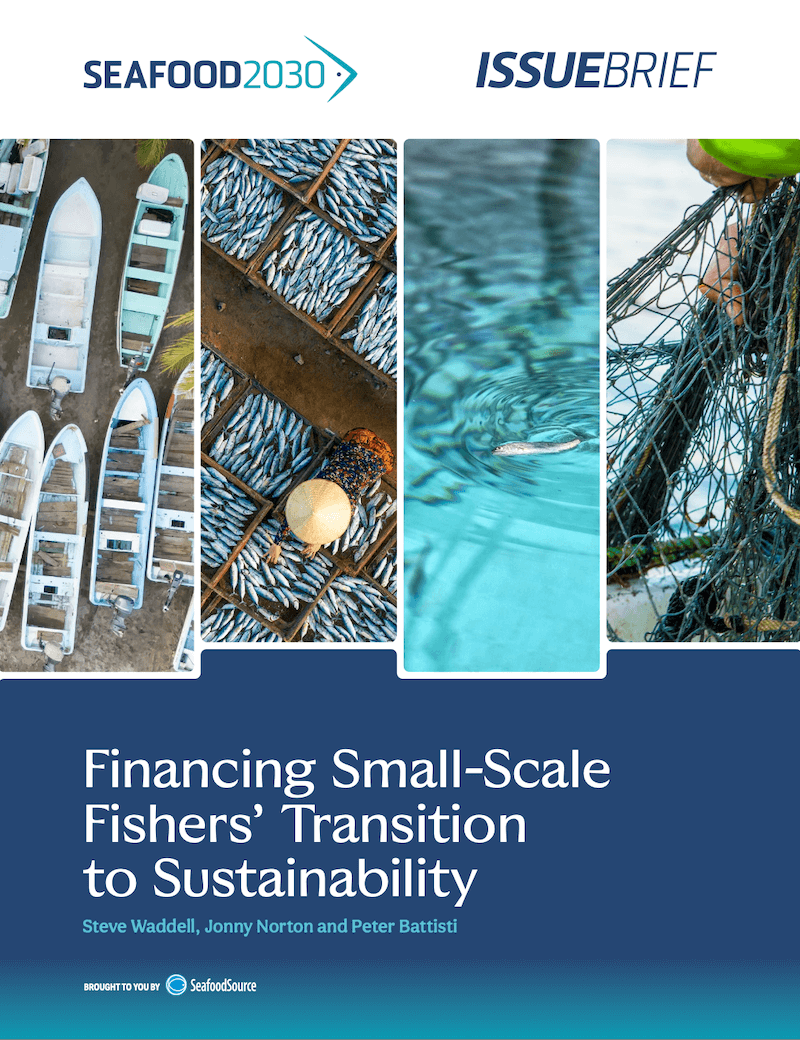
Authors: Steve Waddell, Jonny Norton and Peter Battisti
Seafood companies are very familiar with complicated systems (their supply chains) and the difficulty of cutting through the complexity of these systems to drive improvement and create efficiencies. The purpose of this paper is to help seafood companies understand how to cut through the complexity to drive change and create effective financing mechanisms and systems that support thriving communities, good fisheries management, and assured supply for fishers and supply chains.
Along with providing an understanding of the barriers and opportunities to developing effective financing mechanisms, the maps and guidance in this brief provide small-scale fishery interventions, their implementers, and their supply chain partners with a way to assess or rationalize the system they are working in. What stage of development are we in – experimentation, redesign, optimization? Do we have all of the enabling elements for and system roles in an effective finance system? If not, is that o.k.?
Seeing the system also helps explain why solutions that may seem obvious are insufficient or even counter-productive. Pressing upon one point of a system without being aware of the change needs of the whole system can be futile. The maps provide a critical window into the complexity of the issues that make responses actionable. The power of a systems perspective is that it allows identification of high leverage points to focus action, while understanding the ramifications for action on other points.