

Japan’s Kinki University, commonly known as “Kindai”, has become well known for developing closed-cycle breeding of bluefin tuna, but there is a lot of other aquaculture research going on at its many laboratories.
The unversity has four main locations in Wakayama Prefecture (six, if branch locations are counted): Shirahama (the main research site), Uragami, Kushimoto and Shingu-shi. The latter is the only one dealing with freshwater fish such as sweetfish, “satsukimasu salmon” (Oncorhynchus masou macrostomus) and sturgeon raised for caviar.
Additionally, there are two research sites outside of Wakayama Prefecture. The site at Toyama, on the Sea of Japan, deals with cold-water fish species. For example, cherry salmon (Oncorhynchus masou) are raised in tanks, using cold seawater pumped from 100 meters below sea level.
Prof. Hiromi Ohta, of the Department of Fisheries, Faculty of Agriculture said that salt water eel and cherry salmon numbers are declining because of warmer water due to climate change.
The site in Kagoshima, in southernmost Kyushu Island, deals with warm water species. This is where they currently do spawning of bluefin tuna.
“Within the department, there are about 14 or 15 sections dealing with different themes,” Ohta said. “In each of the locations, there are multiple projects going on, each with its own project team. There are about 110 aquaculture engineers, about 10 to 20 in each location. There are more projects going on than we can count.”
He said that the university’s aquaculture research originally dealt with sea bream other bream species, yellowtail and other popular farmed species.
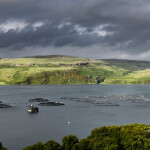
Aquaculture research into raising juvenile yellowtail in net pens was started in 1954 at the Shirahama Station. Previously yellowtail had been raised in a larger area – a part of a bay that had been enclosed by a levee. This was the start of the net pen method that has since been applied to red sea bream, great amberjack, hardtail, parrotfish, Japanese flounder and other species, and that has spread around the world. After developing the net-pen method, closed-cycle breeding allowed improvement of various traits of saltwater fish through selection and crossbreeding.
In 1965, the university was the first in the world to produce farm-hatched Japanese flounder fry. To date, they have succeeded in closed-cycle breeding of 18 species in all. These efforts are help to prevent depletion of natural fish stocks from overfishing, and have brought down prices of prized game fish by enabling mass-production of rare species; enabling a transition from fishing to farming.
The university’s Fisheries Laboratory has successfully brought down the market price of red sea bream and yellowtail by providing nurseries with farm-hatched fry. Supply rates have also climbed significantly.
Some notable crossbreeding experiments are the “burihira,” yellowtail cross-bred with higher-value goldstriped amberjack in 1970; and the “machidai,” the offspring of a fast growing female red sea bream and a male crimson sea bream, which retains its red color better when exposed to UV rays near the surface, as net-pen raised fish are. This crossbred fish however had delicate scales that were easily damaged, so a back-cross to red sea bream was made, called the “machimodoshi” to reach a suitable compromise between color and scale appearance.
In addition to raising fish, the university’s aquaculture research focuses on nutrition, breeding, morphology, physiology, biochemistry and fish diseases.
Since 1989, the Aquaculture Research has made academic agreements with Chulalongkorn University in Thailand, University Malaysia Sabah, and Chonnam National University in Korea, by which researchers and students travel back and forth for research and training.
