






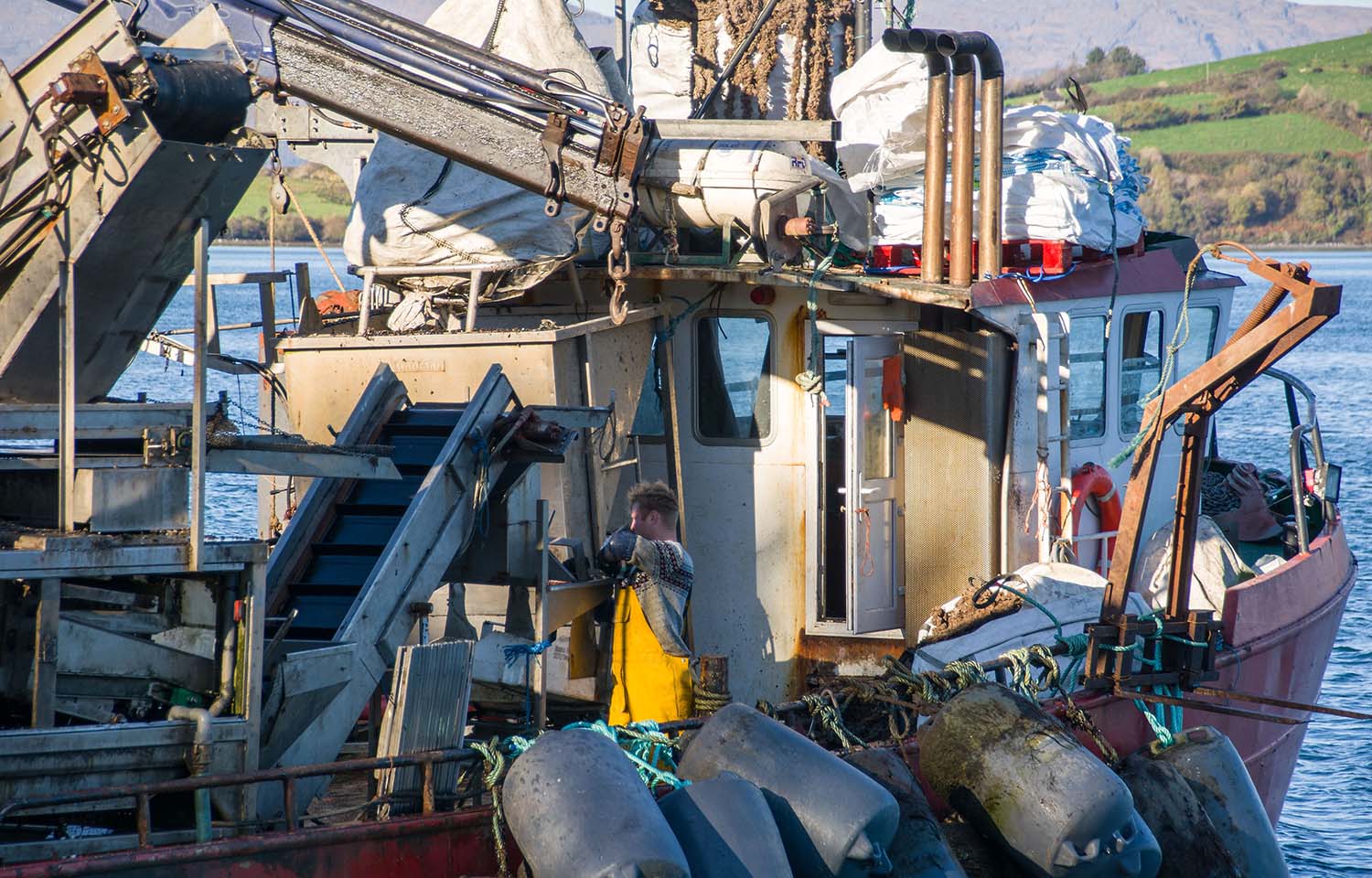
The Irish government recently announced a quota of 150 work permits as part of a new work permit scheme for immigrant fishery workers.
The plan is a “significant improvement” on the scheme it replaces, according to Michael O’Brien, head of the Fisheries Section at the Dublin offices of the International Transport Workers’ Federation.
The plan allows Irish fishing companies to hire workers from outside the European Union and the European Economic Area for a minimum salary of EUR 34,000 (USD 37,060) per year.
“Key improvements are the minimum salary of EUR 34,000 based on 1,872 hours per year [39 hours for 48 weeks], with the remaining four weeks being minimum statutory holidays,” O’Brien told SeafoodSource. “This compares well to the scrapped Atypical [Work Permit] scheme, which set a weekly working week of 39 hours paid at the national minimum wage.”
The Atypical Work Permit scheme was blamed by Irish unions and human rights groups for migrant labor exploitation and was also criticized by fishing companies for creating unwieldy layers of bureaucracy. It was scrapped in 2022.
The new permit scheme permits workers to change to another employer within the sector after nine months of labor and provides for a reactivation permit should a fisher feel compelled to leave the job because of abuses. The scheme also provides for a path to permanent residency in Ireland after five years of work.
O’Brien said he remains concerned about the “risks of abuse that come with all permit schemes that for a period tie the migrant worker exclusively to an employer” and said the new scheme won’t necessarily eliminate labor abuse in the industry.
“What needs to be understood is that the initiative rests with the vessel owner to seek approval from the [Irish] Department of Enterprise to engage a fisher under this scheme. The question is: Are vessel owners going to take up this legal route? That remains to be seen,” he said. “It is possible that given the minimum salary threshold they might go the extra mile in trying to recruit crew on the share from within the E.U. There is also the reality that some vessel owners prefer to recruit and exploit undocumented fishers.”
Dozens of undocumented fishers have been recruited into the fleet in the last 18 months, according to O’Brien, who said he has asked Ireland’s Department of Justice if these workers can be regularized into this new permit system without having to first go home.
“I did not get a straight answer but, rather, an answer to the effect that each application will be dealt with on its merits,” he said. “The reality is that if these fishers are to be regularized, it will likely require the vessel owner significantly increasing the fisher's income.”
Two state agencies – the Workplace Relations Commission and Marine Survey Office – will be responsible for enforcing the new scheme. O’Brien said he wants to see “significant dissuasive fines” levied on abusive vessel owners.
O’Brien said immigrant fishermen in Ireland need better organization, adding that the Unite union has indicated it will accept migrant fishers from Ireland and the U.K. into its membership.
The Irish Fish Producers OrganiZation, which represents many of Ireland’s fishing companies, did not respond to a request from SeafoodSource for comment on the new scheme.
