






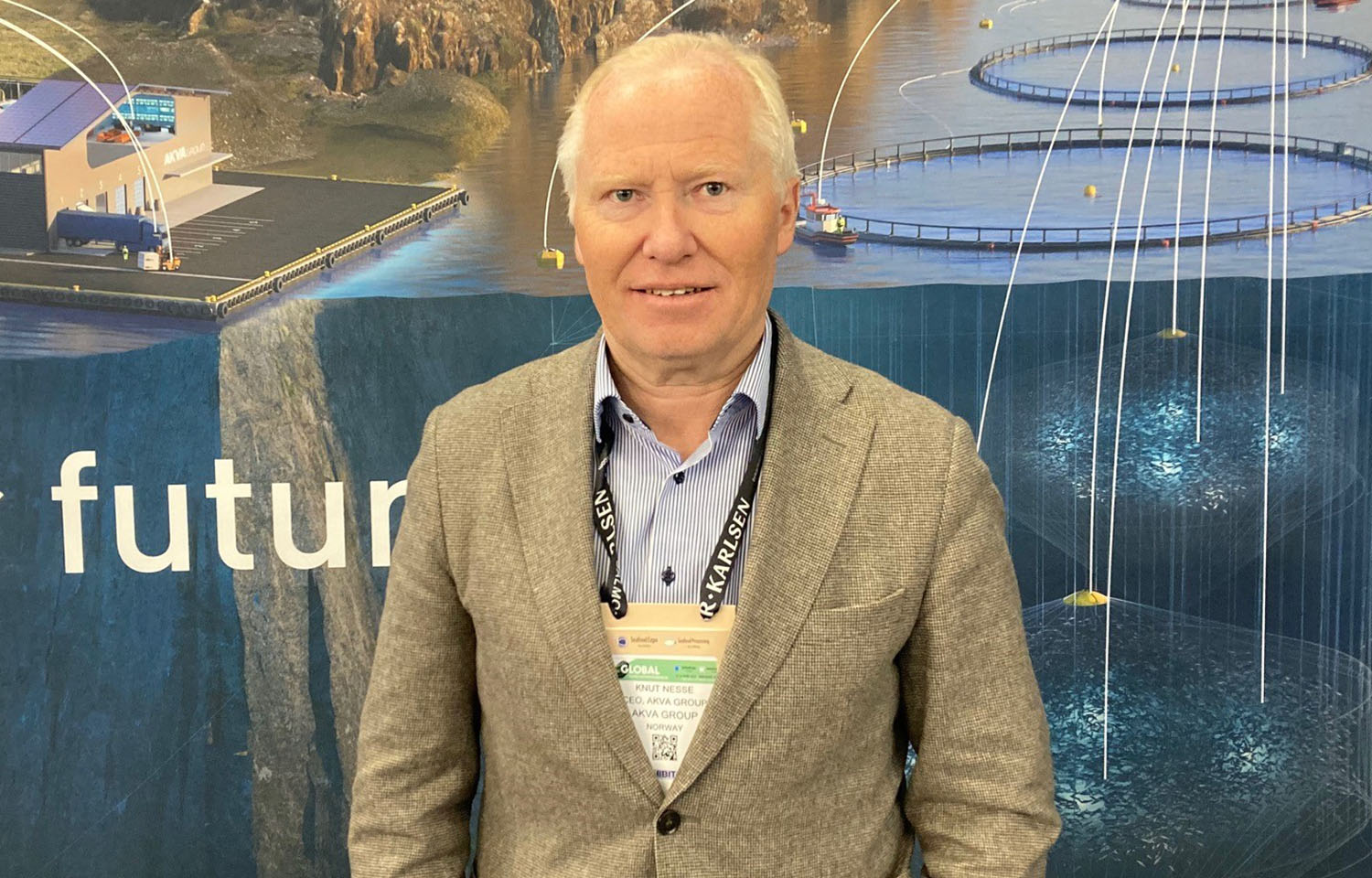
Knut Nesse is CEO of AKVA Group, an aquaculture technology firm based in Klepp, Norway.
SeafoodSource: What is AKVA Group’s long-term vision for the future of land-based fish farming?
Nesse: If you look at our vision statement, it says "Pioneering a better future." So, we have more than 40 years of history in pioneering aquaculture. We were first with automated feeding. We were first with a plastic pen, and we have been a pioneer in many other spaces and products.
But, you don't get a great future if you just look in the back mirror, so our aspiration is also to be pioneers for the future. Basically, we are running three innovation agendas: one within land-based, one within digital, and one within sea-based.
In land-based, I think we have proof of concept. We are delivering all the technology for Nordic Aquafarms’ project in China. I believe in the 10- to 20-year perspective, it will be challenged if and when you can send a salmon airborne to an overseas market.
Is that the future model? I'm not entirely sure about that. Demand and growth will also be required. In that sense, in our 10- to 20-year perspective, I think overseas production on land is going to be a supplement to what we are doing today.
We have invested quite a lot in the last five years in order to improve the technology platform we have in land-based, and now we are about to decide at a strategy meeting in June about a five-year plan we’re calling “Land-Based Version 4.0.” We consider we are on the land-based technology Version 2.0 today, meaning that we have functional, good technology with data science and documentation behind it. But, we need to have better automation and better support by digital technology.
If we are to deliver the visionary perspective we have for the future, in which we are going to produce some 100,000 [metric] tons of salmon in in the overseas markets, that needs to be on the basis of Land-Based Version 4.0 because we need more automation in order to scale up this technology. If you need too many people with specialist competencies to run it, first of all, that's not scalable because they don't exist, and it's not future-oriented.
For that reason, we’re looking to scale up the technology and have more salmon factories around the world, with a higher level of automation and digitalization. That's what we are busy on. Of course, this will take time for technology development and also because of market and financing constraints, but it will come.
SeafoodSource: Does the technology you are touching on exist now to be implemented in a way that would be transformative to the aquaculture sector, or is the technology still being developed?
Nesse: I will say the old-school aquaculture guys and the Silicon Valley culture still need to meet in a more solid way. With smart farming in a land-based facility, you need more data collection, you need more sensors in order to collect data, and you need to have this data transformed onto supporting tools. You need big dashboards with all kinds of alert systems and monitoring systems so the operator will have more support in running a more complex recirculating aquaculture system [RAS] technology plant. I think that needs to be developed, and that brings me to the digital agenda.
We have around 110 people dealing with basically four product areas. One is Fish Talk, which is for biological control and planning. That's the ERP [enterprise resource planning] system. So, producers responsible for six out of 10 farmed salmon in the world will be on our ERP platform. Then you have AKVA Connect, which is about bringing the hardware and the software together; in the old days, it was called the PLS system, but that's about the functioning of the feeding cameras and the feed pouches. We have spent some resources on modernizing that as well.
We are also looking into advancing automated feeding through a company based outside London that we own 32 percent of, and they have more than 100 installations at more than 100 sites around the world for observation. That is progressing pretty well, so I expect more from that area in the years to come.
The fourth area is making the cameras smarter so you can have automated sea lice counting, automated biomass estimation, and also a fish health dashboard. We just acquired some new technology called Submerge, and we are further developing that.
On the more traditional area, which is sea-based farming, there’s a lot of new technology development and alternative solutions. For now, though, we focus most on bringing the fish into the deep. That's the concept around deep farming. We believe that's a good supplement for some areas, but of course, it requires a minimum depth in order to apply this technology. We still think that is part of the solution we need in our toolbox.
SeafoodSource: Sea lice was recently found present in some of Lerøy Seafood Group’s submersible deep-sea cages in Gjengane, Norway. Does that concern you?
Nesse: There will always be some sea lice, but so far, we have more than 100 cages; so far, there have been zero sea lice treatments. With sea lice, when you are very much below the limit or the limit within the legislation, you don't need to treat. That's the point. So, yes, there are some sea lice that but at very little density levels, meaning there have been no requirement for treatments. The point being, we can run production deep without having treatments in place, and that brings a good improvement to fish health and comes with lower mortality.
SeafoodSource: What is the most underrated technology or advancement that's happening in aquatech right now?
Nesse: I'm surprised that we don't see more investments within the area of post-smolt because I think the benefits are really clear. If you can go from 17 to 18 months in the sea dome to eight or nine months starting with 700- to 800-gram post-smolt, that could be 10 months less than the sea. If you talk with people with good knowledge around fish health, everybody agrees that there is the concept of accumulation, meaning the more months in the sea, the more exposed the fish will be to viruses, bacteria, allergies, or sea lice.
Around 10 months less in the sea is a lot less pressure on the fish. Generally, you don't have sea lice in the first two months once fish are put in sea cages, and if you're only eight or nine months in the sea, you get away with either zero treatments or maybe one or two, as opposed to five or six.
I would have expected that since this is proven technology and since it comes with a lot of benefits, like bringing down the production cost and increasing volume capacity, more companies would commit to this technology. Of course, there is a cap-ex, but if you run the numbers, it's a highly profitable investment.
I understand there have been issues, such as the Norwegian resource tax, which came with a lot of headaches and made decision-making in the boardrooms more complicated. That's likely the key reason for why post-smolt investment has slowed down, but if you want a really good contribution to fish health, lower mortality, and an even volume growth, for me, that is the post-smolt strategy.
SeafoodSource: The resource tax was one factor slowing investments, but the global economy has also been hard to predict, though there are very high prices for salmon right now. What is your take on how macroeconomic factors are impacting investment in aquaculture technology?
Nesse: The resource tax and lack of permits for new smolt facilities is the factor most holding back investments. Of course, higher interest rates are not boosting investments either, but people see they are leveling out and will likely go down in the next year. So, I think that is a very manageable thing. It's more about the political dimension or agenda, which is not helpful these days.
SeafoodSource: In your conversations with the leaders of large aquaculture companies, how open are they to a future where aquaculture is done in a radically different manner than it is today?
Nesse: They are very good at monitoring emerging technology platforms and have a solid monitoring program in place, but they might not necessarily be the driver of new emerging technologies because they have a very solid business model. When success is there, new players will enter. In land-based, you will see some of that dynamic play out there. The dynamic will play out over the next five years, but I think a lot more projects will be financed and started in the next two to three years. Of course, then you still take several years before you harvest the first fish.
SeafoodSource: What are the lessons that have been learned over the last five years when it comes to land-based aquaculture?
Nesse: Of course, we have seen failures. I think technology has also been more mature, but the protocols it takes to run this technology are more solid today. The sum of everything is that the technology is more proven, it's well-documented, and there are more well-developed protocols – things like standard operating procedures.
There are also more people who understand that you need to have the basics extremely under control – things like water temperature and cooling capacity being regimented in a very rigid way – so you don't run any risk on the fundamentals. In our own situation, we have a team of five very skilled people, most of them with a Ph.D. within RAS, to support customers when they start to run a new facility. A couple of years ago, we did not have this kind of support function. All that will give more and better production backup.
SeafoodSource: Do you feel like land-based aquaculture and deep-water farming are at an inflection point, where the industry at large absorbs this as an accepted element of the industry.
Nesse: I agree. When I say a lot of projects will be financed in the next two to three years, that's an inflection point. That timeline is relatively dynamic considering the size and cost of these projects.
SeafoodSource: Will other species ever gain as much popularity for RAS projects?
Nesse: Right now, there are a couple of kingfish projects that are working very well, but it remains very salmon-focused. I think more species will be added, but that will take more time. I always thought personally that RAS for shrimp could work in Europe, bringing shrimp farming closer to the consumer. I still think that idea has some merit.
