


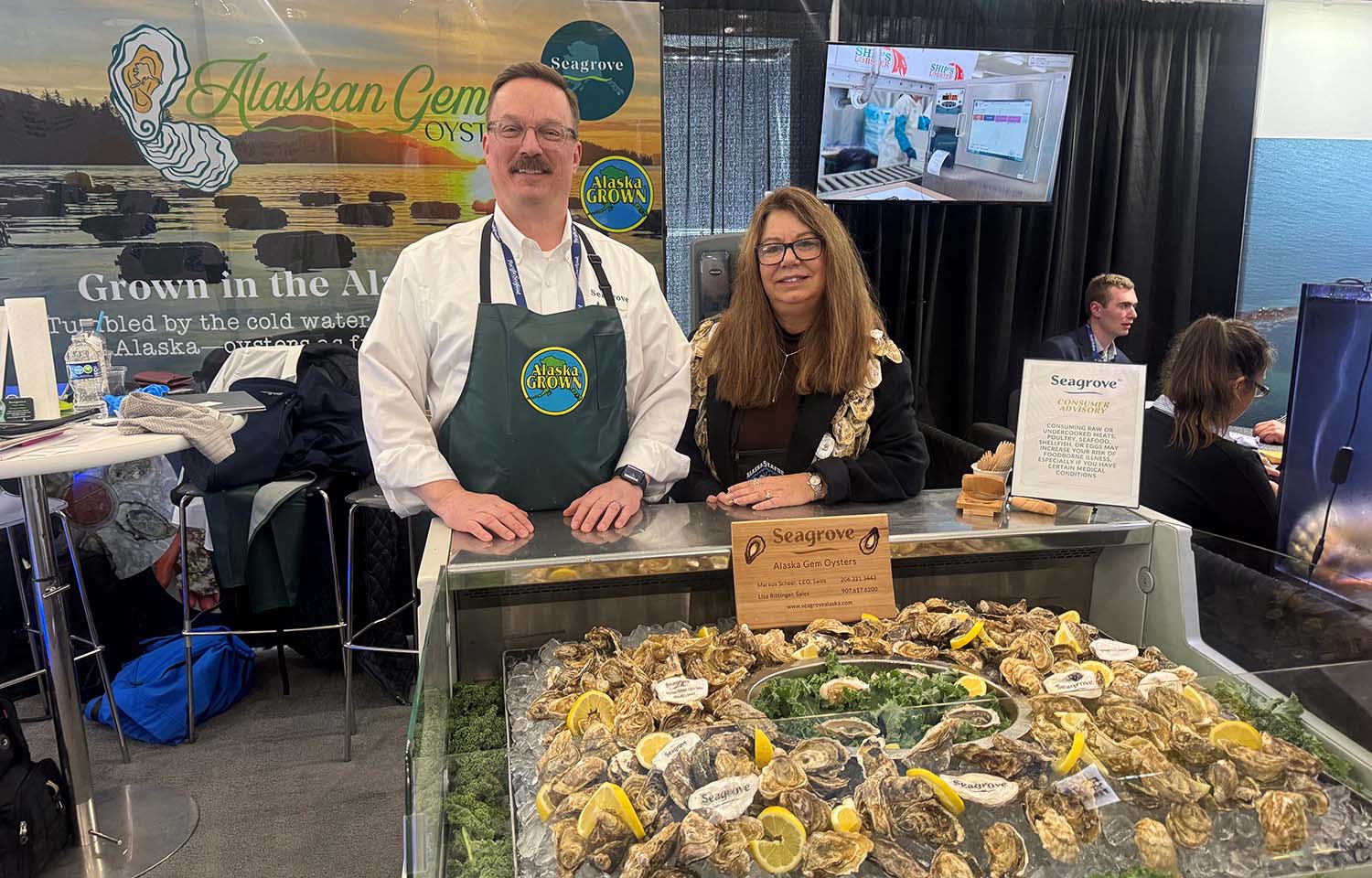
Markos Scheer said he knew starting Ketchikan, Alaska, U.S.A.-based Seagrove right in his hometown would be vital to the small town’s economy.
Speaking to SeafoodSource at the 2026 Seafood Expo North America (SENA) – which took place from 15 to 17 March in Boston, Massachusetts, U.S.A. – Scheer said he’s proud to boost the local economy by doing something he loves.
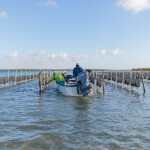
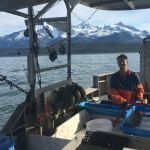
Seagrove is Alaska’s largest vertically integrated multi-species mariculture company producing both oysters and kelp in Southeast Alaska. Scheer founded the company in 2016 and said he’s proud to be self-sufficient from harvest to consumption, not relying on outsourcing any work to other manufacturers or processing plants.
“We have a unique story; not only is it within the Alaska brand but also the Alaska oyster is not something that is commonly experienced outside of Alaska,” Scheer said. “Even though people have been oyster farming over the past 100 years, getting the opportunity to come here and allow other people to experience it, it’s been terrific because we grow these in Alaska, where it’s cool and pristine and that comes through in the flavor of the oyster.”
He began operations officially in 2019, establishing year-round farms near Prince of Wales Island where he first moved to as a teenager.
The journey to where Seagrove is today wasn’t easy to get to, Scheer said.
The start of Seagrove was riddled with problems. The first kelp nursery burnt to the ground in Ketchikan a week before he was set to move in. A short while later, herring spawned on the kelp farm for the first time in history. In 2020, the Covid-19 pandemic further affected business.
However, he now owns and operates a shellfish handling and shipping facility in Ketchikan and has since expanded affiliated farm operations with Marble Seafoods and offers eco-culinary tours through the Bonfire Bay Tour Company.
Currently, Seagrove cultivates oysters and kelp across more than 300 acres of permitted farm sites.
According to Scheer, what makes an Alaskan oyster unique is the way it’s grown through an offshore cultivation system where oysters are naturally tumbled in the ocean’s waves. The flavor presents as crisp and briny upfront with a cucumber aftertaste.
“Alaska’s a violent place – the weather is. Because we do offshore cultivation, they’re tumbling in that weather … the oysters kind of get through that process, which makes a really nice cup shell and a very clean shell because they’re working all the time,” Scheer told SeafoodSource. “The water’s colder, so it [also] takes a little longer to grow out than I’d say a Virginica’s or a West Coast [oyster], but we think that adds to the flavor.”
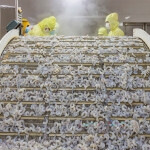
Scheer said Seagrove uses advanced Shellquip Engineered Design (SED) vision technology for handling harvested oysters, which helps streamline grading and test for quality control. The system washes, individually inspects, accurately sizes, and electronically counts each harvested oyster.
The company also uses BlueTrace technology for traceability purposes. Once accounted for and ready to ship, the oysters move quickly through processing into a continuously refreshed wet storage to improve performance on the half shell for chefs, elongate shelf life, and reduce mortality. Scheer said wet storage allows the company to ship fresh oysters on limited notice, arriving within 24 to 36 hours after leaving the water.
Prince of Wales Island is about the size of the U.S. state of Delaware, at about 3,500 in population, Scheer said. Having explored many of Alaska’s coastal regions like Thorne Bay, Hollis, Klawock, and Ketchikan, Scheer felt he could properly operate his business on Alaska’s coastline.
“We’ve spent the last six years really trying to build the infrastructure, the people, the operations, and get the shellfish up to scale,” Scheer said. “This is our third year selling the shellfish, and we’ve been selling seaweed since 2020. Wwe’re probably one of the largest seaweed operations in the country. Now that we have infrastructure in place, we built the processing facility, we have the wet storage, we have processing and packing lines, and people in place now. We have about 15 employees.”
Scheer shared that Seagrove ships to about eight states currently and hopes to expand to 30 states by the end of 2026. He sees the full-year harvesting schedule as an incentive for growth because people can move to Alaska for consistent work, instead of relying on a seasonal gig. Ketchikan’s geographical proximity to Seattle, Washington, U.S.A., helps Scheer easily ship oysters across the country.
“I started in the seafood company in 1985, and I spent 13 years working in processing and operations there,” Scheer said. “I went to law school; I worked as an attorney in the industry for 20 years, and I became involved in mariculture development in Alaska about 15 years ago. I kept looking at this thing [saying], 'This thing makes sense because we have this opportunity to create […] something that’s non-extractive.' It’s a real paradigm shift for local economics. I think the fact that we’ve created 15 jobs in a rural region that didn’t exist before, year-round jobs, that’s a huge win. The economic benefit of that is huge, and it’s just the beginning; the future is really right here.”
