

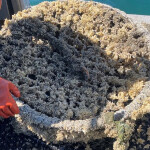




Chef José Andrés’ food security foundation, the Longer Tables Fund, has issued a grant to The Oceanographic Institute at Florida Atlantic University's (FAU) Harbor Branch campus aimed at conserving and restoring the Bahamian queen conch.
The FAU Harbor Branch already hosts the Queen Conch Lab, a facility which is working to establish community-based queen conch farms in every Caribbean country. Queen conches, which are native to the U.S. state of Florida as well as the Caribbean, have suffered from overfishing and habitat destruction, leading to a significant population decline. The animal is now listed as “threatened” under the Endangered Species Act.
The Longer Tables Fund invests in transformative solutions to food system challenges, aiming to rebuild communities and empower future leaders through such projects as queen conch restoration.
"I believe food has the incredible power to nourish communities, sustain livelihoods, and create a healthier planet," Andrés said. "That's why I am so excited for how this new partnership will restore healthy conch populations and improve sustainable fishing methods. The Queen Conch Lab is showing us what it looks like when science, community, and food come together to build a better future; this is what it means to build longer tables."
The Queen Conch Lab has raised nearly USD 6 million (EUR 5.1 million) over the past six years from cush sources as Builders Vision, the Moore Bahamas Foundation, NOAA Fisheries, the U.S. Department of Agriculture, the Agricultural Research Service, the Jamaica Conch Restoration Project, Bahamas National Trust, Blue Carbon Plus, and the McPike-Zima Foundation.
The lab has used that funding to establish 10 community-based farms across the Caribbean. The grant from the Longer Tables Fund will be used to expand the program’s reach and deepen its partnership with the Bahamas-based Island School’s Cape Eleuthera Institute, a campus which has been studying the Bahamian queen conch for two decades.
Queen Conch Lab Director Megan Davis said that the collaboration will protect an animal that “is significant to the local ecosystem and a vital resource and cultural touchstone for the island.”
"This collaboration supports working together as a community to ensure the queen conch is there for generations to come. There is much more work to be done,” she said.
The Queen Conch Lab also aims to develop a mobile lab at the Eleuthera Institute, which will grow 2,000 juvenile queen conch per year for conservation and restoration efforts, as well as train staff and the more than 1,000 students attending the school each year.
Additionally, over 10,000 Eleuthera residents are expected to participate in outreach programs led by the Mobile Lab and the school, which will provide workforce skill training.
Island School Head Chris Maxey said that he was delighted with the partnership, which will “address a critical concern in our local environment and the community – the conservation and restoration of the queen conch population.”
"The project fits squarely into our mission of conducting innovative, cutting-edge environmental research and sharing and applying what we learn to sustainable solutions within our community,” he said.
