






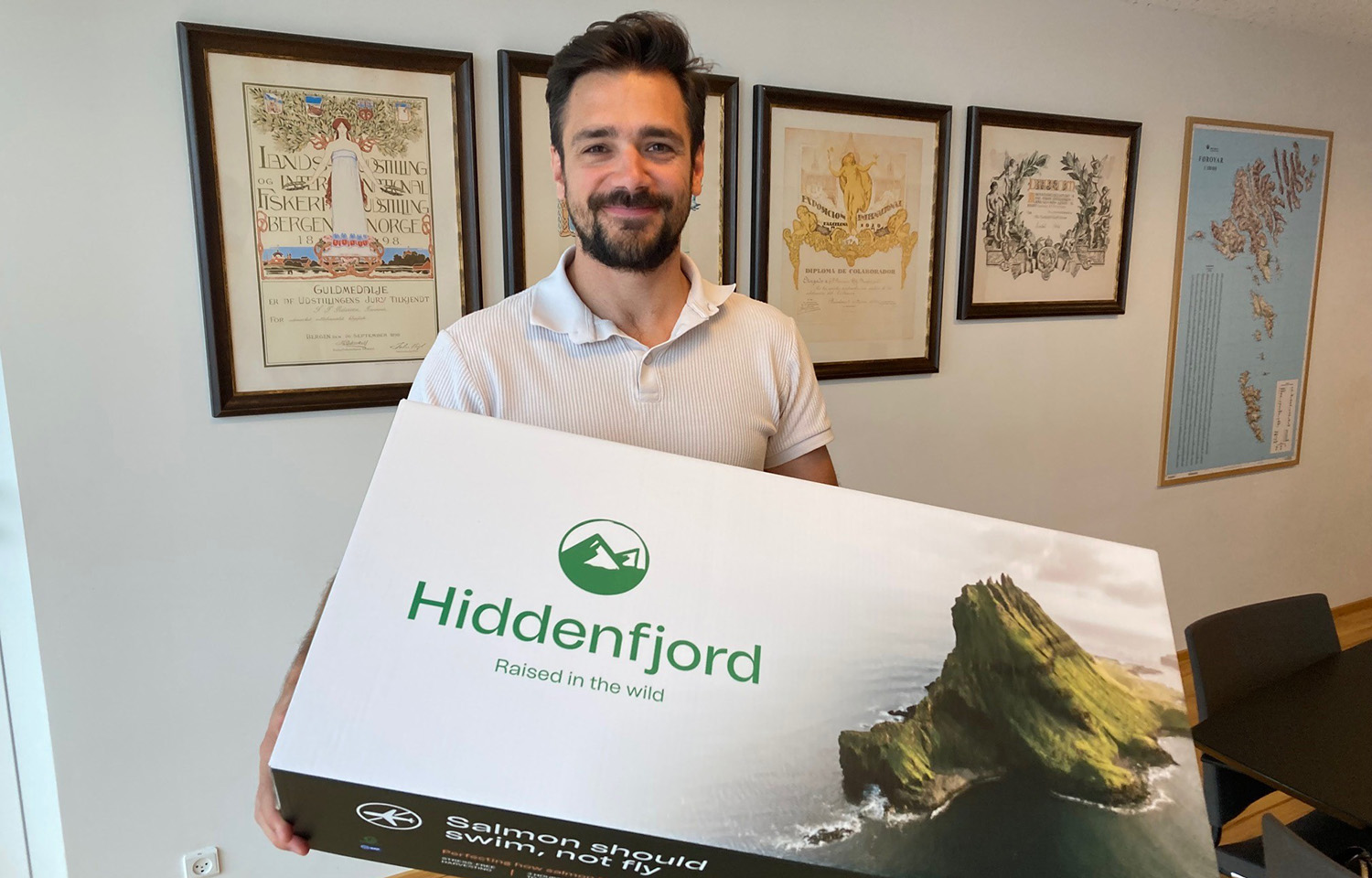
Levi Hanssen is the brand and marketing manager for Hiddenfjord, a salmon-farming firm based in Sørvágur, Faroe Islands.
SeafoodSource: Hiddenfjord is known as a family-owned company, which is rare among salmon-farming firms. Can you talk about the company’s history, its size, and its family ties?
Hanssen: Hiddenfjord is a family-owned company founded in 1929. It started as a whitefish-processing company with the purpose of creating jobs in the Faroe Islands. The company began raising salmon in the early 1980s. Today, two brothers, Atli and Regin, own the company, which was founded by their grandfather. They both have children who work in the company. Being privately owned gives us the liberty to have an idealistic focus on sustainability without pressure from shareholders for short-term profits. This liberty is manifested in many of our decisions, such as when it comes to sustainable farming practices, innovation, research and development, and, most recently, our decision to stop all distribution by air freight.
We now have approximately 275 employees. Our farms are located on the west side of the Faroe Islands, which are generally known to have rougher weather conditions. We call the Faroe Islands the home of the Atlantic salmon. It’s a place where salmon have migrated for thousands of years to feed and grow. With steady year-round water temperatures and strong currents, we have the perfect conditions to raise salmon sustainably.
SeafoodSource: Hiddenfjord has become known for its commitment to sustainability. What is the origin of that commitment?
Hanssen: The origin of that commitment is the clear conviction of the owners that we must farm salmon in harmony with nature. Our actions today must ensure good farming conditions for future generations. This conviction is evidenced by how the company has consistently pioneered sustainable farming practices, starting in the 1980s, by locating our pens in more exposed locations. We were also the leading advocate for a critical aquaculture legislation after the ISA (infectious salmon anaemia) crisis in the early 2000s. A 2003 reform changed aquaculture in the Faroe Islands and had a tremendous impact on the industry, paving the way for it to be one of the leading salmon-farming nations in the world today.
SeafoodSource: How much of the company's image do you think is tied to the Faroe Islands?
Hanssen: Many know of salmon from the Faroe Islands. In some cases, people will be more familiar with salmon from the Faroe Islands than with particular brands. Faroese salmon has a very good reputation, so we welcome the fact that the Faroe Islands is tied to our brand. Hiddenfjord is, in fact, the only 100 percent Faroese salmon-farming company.
SeafoodSource: What are the company’s primary goals?
Hanssen: One of our primary goals is to do our very best so that salmon farming in the Faroe Islands can thrive and reach its full potential. Salmon farming accounts for almost half of the country’s exports, making it a very important part of our economy. We have a responsibility and duty to make sure that we fully utilize the opportunities in aquaculture, not just for our own benefit but for the entire country. Another primary goal of ours is to reduce our CO2 emissions. Regardless of how small we are on a global scale, we have a responsibility to play our role in fighting climate change. A third goal of ours is the very modest aim of continuing to produce the world’s best salmon!
SeafoodSource: Hiddenfjord has carved a name out for itself by phasing out the shipment of its salmon via air transport in 2020. How and why was that decision made?
Hanssen: The decision was solely motivated by a desire to reduce our CO2 emissions. In 2019, an independent research organization from Norway analyzed our company’s CO2 emissions and found that transportation accounted for the largest part of our emissions – more than feed production or electricity.
So, transportation was tackled first. When the decision was made to eliminate air freight, we did not know that we would end up finding a solution to send fresh salmon to the U.S. market by boat. At the time, we were cutting access to the U.S. and Asian markets for fresh salmon, which are two of the most lucrative markets. It was a huge risk. But, the thinking was that if we truly wanted to play our small part in fighting climate change for a more sustainable future, we had to think big and actually do it!
After the decision was made, we figured out a way to send fresh salmon to the U.S. by boat. We see that the quality and shelf life of our fresh salmon to the U.S. is just as good as salmon transported by air, if not better. Also, it’s a much more environmentally friendly way of transporting salmon. We’ve reduced our CO2 emissions for overseas transportation by 94 percent since switching to sea freight only.
SeafoodSource: How did your customers react to these changes?
Hanssen: At first, many were skeptical and advised us not to eliminate air freight, warning us that we would ruin our brand. We’re very pleased that we’ve found a solution that makes it possible to send fresh salmon all over the U.S. Customers have embraced our decision and are very pleased with our salmon’s quality and shelf life.
SeafoodSource: How did the move change the company’s sales?
Hanssen: The Asian market for fresh salmon remains unattainable, as it takes too long to transport by boat from the Faroe Islands to Asia. We do, however, sell frozen salmon to the Asian market, and we see great potential there.
SeafoodSource: Hiddenfjord was also one of the first salmon-farming companies that experimented with growing smolt to larger sizes in land-based facilities, which has become standard practice in the industry. Why does the company take it upon itself to try and pioneer new technologies and farming methods?
Hanssen: Ultimately, being innovative is in the DNA of our owners. The philosophy is fully engrained in the company values and has spread throughout the organization, where innovation is prioritized and celebrated. There are countless examples of this pioneering philosophy at work throughout our history, dating back to the early '80s. I can mention our stress-free harvesting method, our stun-and-bleed system, our freshwater facility where we grow large smolt, our current dampeners that make it possible to farm in strong currents, our decision to eliminate air freight, and so forth. This philosophy of innovation continues to play a huge role in our work.
