






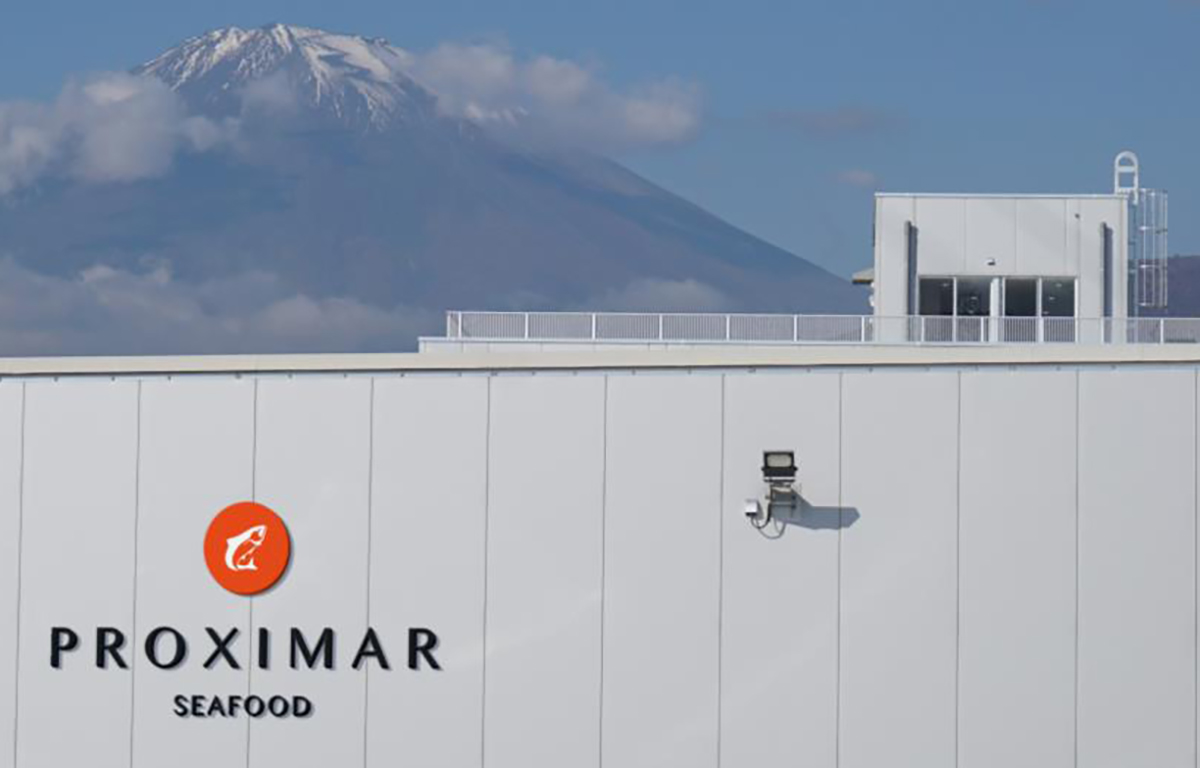
Proximar Seafood, a Norwegian company developing a land-based salmon recirculating aquaculture system (RAS) facility in Japan, said it remains on track to have its first harvest in Q3 2024.
The company began construction on its RAS facility – located in Yama, Shizuoka Prefecture, Japan near Mt. Fuji – in 2021, using equipment provided by Israeli aquauculture technology firm AquaMaof. It completed that facility in Q3 2023 and has since been building up biomass at its site.
The facility is targeting a production rate of 5,300 metric tons (MT) head-on gutted (HOG) salmon per year, and as of its 23 February update, it had reached 57 MT of standing biomass. So far, one of its four post-smolt grow-out facility modules is completed and in operation, and according to the company, the next module will be ready to receive its first fish in April.
“We are transitioning from construction to an operational phase with harvest of the first fish expected in Q3 this year,” Proximar Seafood CEO Joachim Nielsen said.
Proximar said biological performance at the facility has been “encouraging,” with stable conditions and growth in line with its production plan.
“We are pleased to see the standing biomass increase at pace, whilst the growth of the fish remains according to expectations,” Nielsen said. “Fish health and safety remain our key priority going forward, and we are very happy to have a highly skilled team in place to deliver on our plans.”
The company, however, experienced one hiccup; it reported 50,000 fish died due to a tank breach in its grow-out building on 3 February, which it said was caused by leakage between the floor panels and the “center module in the tank.”
That leak resulted in soil drainage in the tank’s foundation, causing a sudden breach. The company said it will prevent future breaches using foam injections around the center module to prevent any drainage damaging the foundation and to “secure extra support.”
“Although we’ve experienced issues with the tank breach following the quarter end, initiatives have been made to prevent similar incidents. This remains our number one priority,” Nielsen said.
In its latest Q4 2023 update, it said that the number of fish that died represents less than 5 percent of the individuals in production but will impact the Q4 2024 harvest by an estimated 250 MT.
Nielsen added that the upcoming year will be “pivotal” for the company as it begins harvesting and supplying Atlantic salmon to Japanese consumers and establishing a revenue stream there.
Revenue will be important given the higher-than-expected costs of the facility. In Q3 2023, the company announced its total capex had reached NOK 1.24 billion (then USD 114 million, EUR 105 million) – a 17-percent increase from the start of construction. That forced it to raise an additional NOK 165 million (then USD 15.3 million, EUR 14 million) to cover the costs.
The company ended Q4 2024 with a loss of NOK 52.9 million (USD 5.0 million, EUR 4.6 million) – up from NOK 9.2 million (USD 873,000, EUR 807,000) in Q4 2022 – befitting its status as a startup operation. For the year, it lost NOK 90.7 million (USD 8.6 million, EUR 7.9 million), compared to NOK 28.7 million (USD 2.7 million, EUR 2.5 million) in FY 2022.
Looking forward, the company said that current market prices and estimated costs of raising salmon paint a promising picture. It said with current pricing expectations, it expects to be profitable and achieve earnings before interest, taxes, depreciation, and amortization (EBITDA) of NOK 30 (USD 2.84, EUR 2.63) per kilogram “even with a production of 2,000 MT” of salmon. With its planned density and 5,300 MT production, it said it expects to reach an EBITDA per kilogram of NOK 59 (USD 5.59, EUR 5.17).
“The demand for high-quality Atlantic salmon is strong, and with the high cost of transportation and distribution of salmon imported from overseas, Proximar is attractively positioned to offer fresh and locally produced Atlantic salmon of the highest quality to the Japanese market,” Nielsen said. “Proximar is the first producer of Atlantic salmon in Japan – years ahead of competition.”
