

Andfjord Salmon CEO Martin Rasmussen confirmed High Liner Foods’ participation in a NOK 350 million (USD 32.9 million, EUR 30.3 million) private placement concluded 21 May.
“The net proceeds from the private placement will be used to expand our production capacity at Kvalnes, ramping up biomass, and for general corporate purposes,” Rasmussen told SeafoodSource.
Lunenberg, Nova Scotia, Canada-based High Liner Foods announced it contributed USD 10 million (EUR 9.2 million), paid from cash from its operations, in exchange for an approximately 4.5 percent share of ownership in Andfjord, which is building a flow-through land-based salmon farm on the island of Andøya in the Arctic archipelago of Vesterålen, Norway.
"Salmon is an important growth species for High Liner Foods, and we believe that land-based aquaculture will become an important component of the global salmon supply chain that will help bridge the gap between supply and demand," High Liner President and CEO Paul Jewer said. "[The] modest investment will give High Liner Foods a platform to gain operational insights and experience in land-based aquaculture as part of our ongoing efforts to meet the growing consumer demand for sustainably sourced and eco-friendly seafood products.”
Jewer said Andfjord’s ambitious expansion plans, targeting a production capacity of 40,000 metric tons by 2030, and its innovative approach to salmon farming drew High Liner into making the investment.
“We feel that Andfjord is an ideal partner that possesses the proven technology and experience High Liner Foods can work with and learn from as we focus our efforts on growing our Atlantic salmon business in North America,” he said.
Rasmussen said the private placement of over 10.6 million shares at NOK 33 (USD 3.09, EUR 2.86) per share was significantly oversubscribed, with additional participation from Jerónimo Martins Agro-Alimentar, which now holds 25.1 percent of the company’s outstanding shares and invested NOK 87 million (USD 8.2 million, EUR 7.5 million) to do so, and Eidsfjord Sjøfarm, which invested NOK 15.9 million (USD 1.5 million, EUR 1.4 million) and how holds 4.5 percent of the company’s outstanding shares.
Previous investors include Holmøy and Nutreco, through which it has developed a strategic feed supply agreement with Skretting on a proprietary feed called Calanus Plus by Andfjord Salmon, which uses the zooplankton Calanus finmarchicus.
On 23 May, it announced a subsequent offering of 796,530 new shares directed toward existing company shareholders. The company’s stock price Euronext Growth exchange on the Oslo Stock Exchange, listed under the symbol ANDF, closed at NOK 33.20 (USD 3.11, EUR 2.87) on Thursday, 23 May.
In February 2024, Andfjord announced plans to implement a post-smolt production strategy to capitalize on its unutilized pool capacity in the first half of each production cycle. The plan, which includes a strategic partnership with Eidsfjord Sjøfarm and Holmøy Havbruk, will give it an estimated 15 percent to 25 percent bump in its EBIT and will enable a 10 percent higher biomass turnover without the need for additional infrastructure capex, according to the company.
“Our Kvalnes build-out is on track and on budget, and the post-smolt opportunity we announced on 29 February has generated significant interest from industrial investors,” Rasmussen said. “We decided to utilize this positive momentum to our advantage and raise funds that provide us with added financial flexibility. We are delighted that strong, international industrial investors subscribed for substantial amounts in the private placement.”
Andfjord Salmon Group reported an operating loss of NOK 79.6 million (USD 7.5 million, EUR 6.9 million) in its 2023 fiscal year, up from a loss of NOK 56.1 million (USD 5.3 million, EUR 4.9 million) in 2022, according to its annual report. Its pre-tax loss was NOK 69.8 million (USD 6.6 million, EUR 6.1 million), up from NOK 56.7 million (USD 5.3 million, EUR 4.9 million) in 2022, which the company said was in line with its board’s expectation for its current phase of development. Its net interest-bearing debt was down to NOK 67.6 million (USD 6.3 million, EUR 5.9 million) from NOK 123.5 million (USD 11.6 million, EUR 10.7 million) in 2022, while its equity rose to NOK 993.7 million (USD 93.3 million, EUR 86.1 million) from NOK 475.7 million (USD 44.7 million, EUR 41.2 million), giving it an equity ratio of 81.9 percent.
Andfjord generated its first sales revenue in 2023, with total income of NOK 37.3 million (USD 3.5 million, EUR 3.2 million) from its first production cycle of 540 MT. The 97.5 percent survival rate was “significantly better than the industry average” of 83.3 percent, it said.
In June 2023, Andfjord secured commitment for bank financing of NOK 825 million (USD 77.4 million, EUR 71.5 million), plus refinancing existing debt of NOK 75 million (USD 7 million, EUR 6.5 million), to fund its Kvalnes expansion. Subsequent private placements raised gross proceeds of approximately NOK 615 million (USD 57.7 million, EUR 53.3 million), it said.
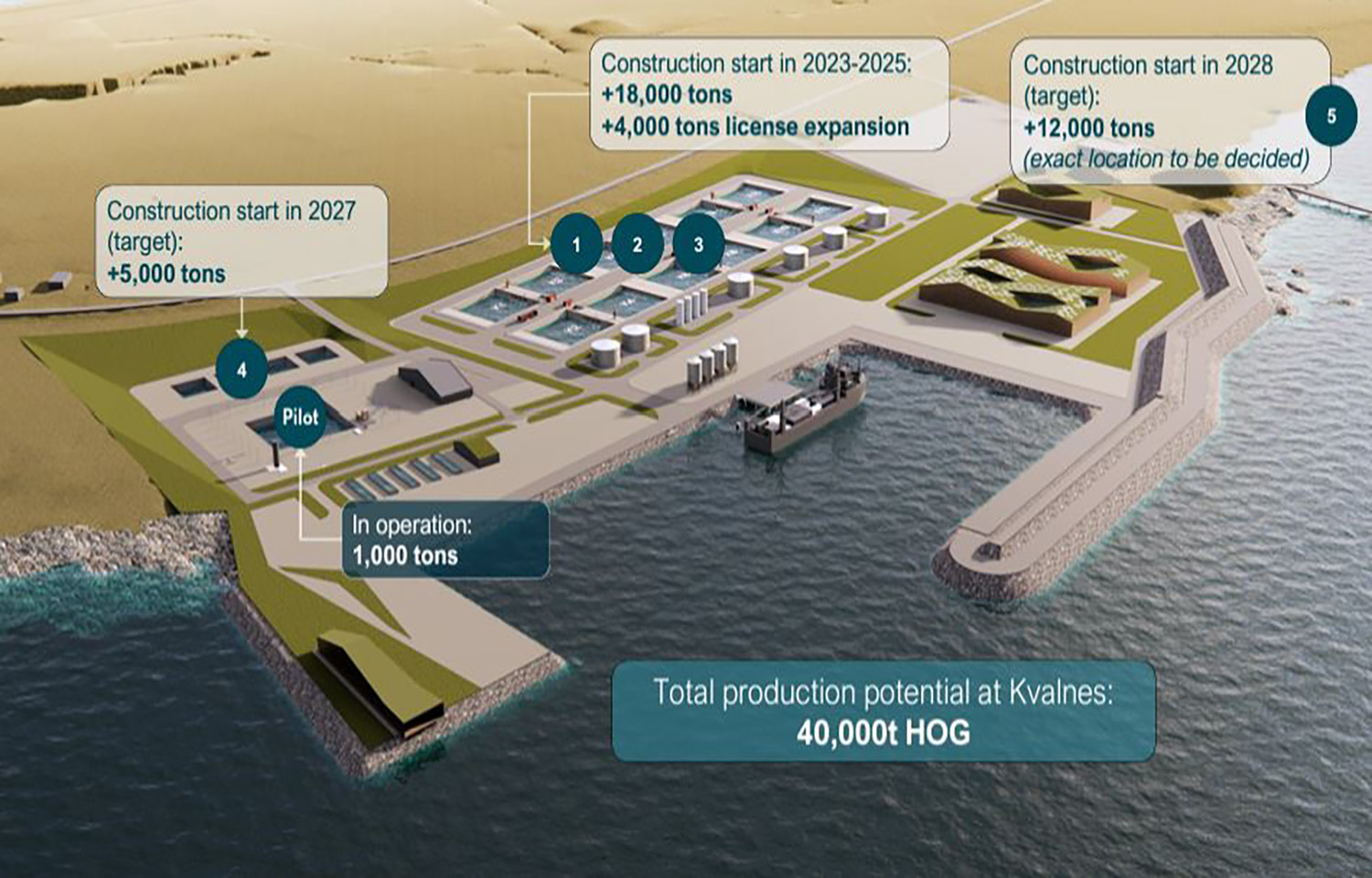
Andfjord said in its current build-out phase it is completing four new pools that will bring its total production capacity to 8,000 MT head-on gutted (HOG) at its Kvalnes site in 2025.
Andfjord is targeting a total production capacity of 40,000 MT HOG at Kvalnes “through a gradual increase in volume between 2025 and 2030,” it said. Andfjord Salmon has production licenses in place for 10,000 MT maximum allowable biomass, giving it a potential production level of 19,000 MT HOG annually in its 13 pools.
North of the Kvalnes location, Andfjord Salmon is hoping to expand into additional sites in Breivik and Fiskenes, which together could produce an additional 50,000 MT of salmon at maximum capacity. Preparatory work on these sites is already underway, with construction slated for 2026 into the following year.
“We are within our budget and our timelines; really, we're actually in front of our schedule. The concept is largely about creating enough space so we're not so impacted by inflationary impacts on the raw material in global trends. When it comes to the financing, I think it's extremely important to find a good shareholder base early in the stage. Now, we have industrial shareholders with us; for example, our largest shareholder is Jeronimo Martins, a company from Portugal and one of the largest retailers in Europe,” Rasmussen said. “We have proven that we have been able to be in a very good financial position, and our financing is in order now for the phase we are within. We also have very good dialogues with the banks, which also seem convinced this is a very beneficial method to produce good salmon in Norway.”
Rasmussen also stressed the sustainability bona fides of his project, which has achieved a fish-in, fish-out (FIFO) ratio of 1.05 in its first batch of salmon and uses 1 kWh of energy for every one kilo of salmon produced.
