



A fishery representing 60 percent of the Argentine red shrimp catch has officially entered the assessment process for Marine Stewardship Council certification after more than a decade of work.
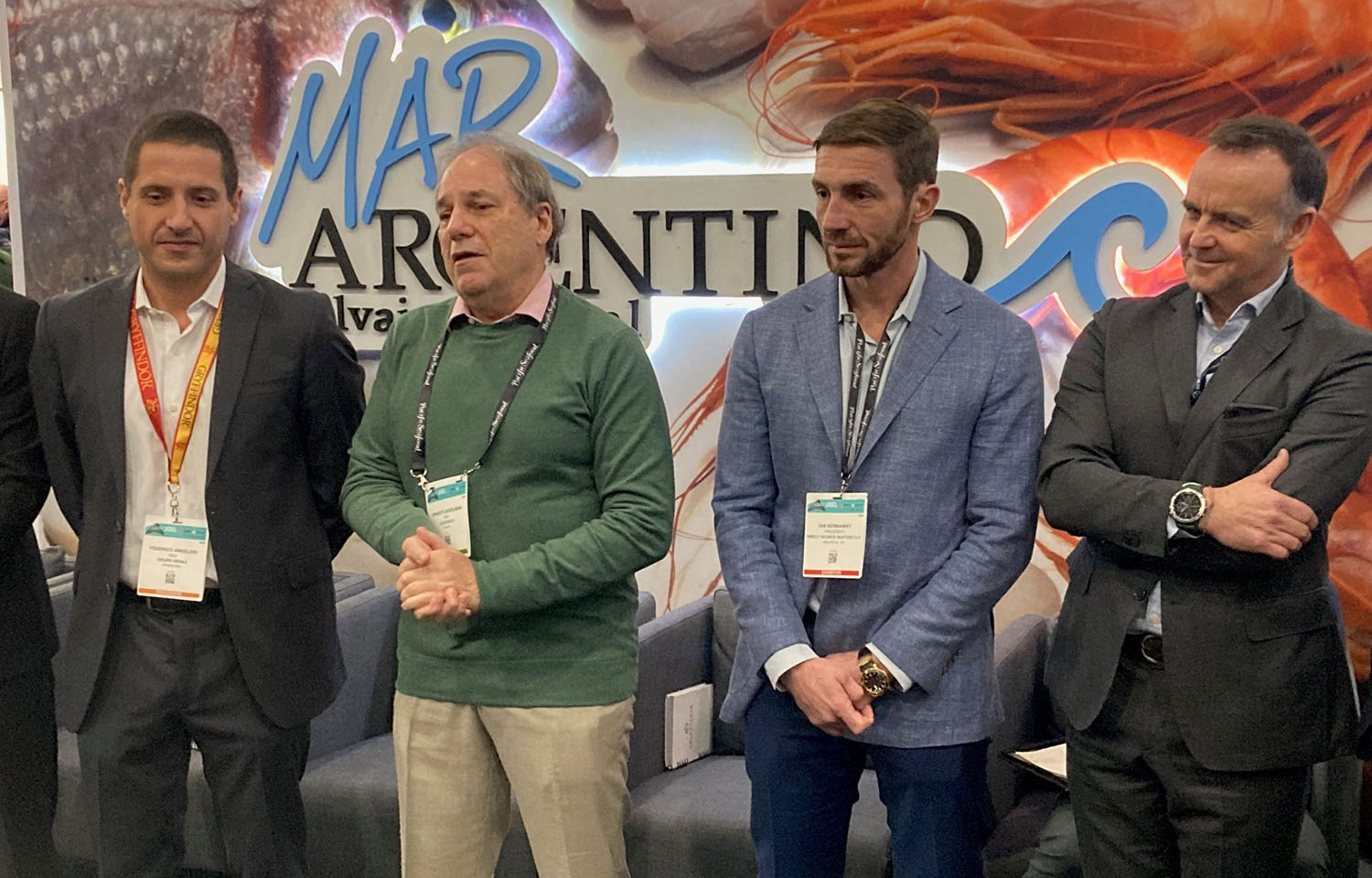
“This has been a very, very challenging project, to be honest,” Federico Angeleri, the commercial director at Mar del Plata, Argentina-based Grupo Veraz, a major participant in the fishery, said at an announcement at the 2024 Seafood Expo North America. “We started working on this in 2014 and we faced many challenges, including three different government changes, three different undersecretaries of fisheries [to whom] we had to explain what we were doing.”
The near-shore fishery, based out of the port of Chubut, developed a fishery improvement project (FIP) in 2014, with the offshore fishery following in 2016. At the 2018 Seafood Expo Global, government officials and nonprofit leaders from Argentina said they hoped to obtain MSC certification for both fisheries in 2019. But the South American country's institute of fisheries, INIDEP, did not develop a limit reference point for shrimp stock – a point at which fishing is no longer considered sustainable – until 2022, and other updates and rulemaking moves necessary for certification took longer than expected, according to Angeleri.
“There are still further steps – we have six to eight months of work ahead that is going to be challenging as well, but we hope to have [certification] by next season,” he said.
MSC Chief Program Officer Nicolas Guichoux said retailers around the globe now demand MSC certification in order to even consider carrying wild-caught seafood products. He praised the members of the FIP for their perseverance and wished them luck with the assessment.
“There are a lot of retail partners in America, Japan, and elsewhere who are very eager to demonstrate they are sourcing from a sustainable source,” Guichoux said. “We will do everything we can to support you when hopefully you get that certification [to make those connections].”
Argentine red shrimp has been one of the fastest-growing sub-categories of seafood in terms of sales over the past 15 years. The total catch surpassed 200,000 metric tons (MT) in 2023, with the near-shore fishery accounting for 89,871 MT of the total. The U.S. imported just 211 MT of Argentine red shrimp in 2010, but direct imports from Argentina to the United States grew to 5,071 MT in 2015, and a high of 17,339 MT in 2020. In 2023, the U.S. imported 14,300 MT worth USD 181.5 million (EUR 166.7 million), down from 200.6 million (EUR 184.2 million) on 16,433 MT in 2022.
In recent years, the product has seen increased uptake in the U.S., China, and Japan. Maritime Products International President Matthew Fass previously predicted Argentine red shrimp has even greater potential as buyers and consumers continue to become more familiar with its unique characteristics.
Though the overall stock abundance has decreased since its peak in 2017, it has not reached concerning levels yet, according to Argentina’s National Fisheries Research and Development Institute (INIDEP). More than 99 percent of shrimp landings were covered with inspections, demonstrating the effective management of the fishery, according to CeDePesca, an NGO with the mission of helping Latin American fisheries work toward more sustainable practices.
CeDePesca Executive Director Ernesto Godelman told SeafoodSource the main holdup in the certification has been a lack of data from the fishery.
“There have been many things to resolve, particularly a lack of information about the impacts [the fishery has] on the ecosystem, [and] the management system at the local level needed improvements. So there were new rules introduced that are covering these gaps,” he said. “The status of the stock has never been a problem, but also we needed demonstration of that through working with researchers from INIDEP.”
Godelman said research showed bycatch is under 5 percent, comprised nearly entirely of hake, and that the total abundance of Argentine red shrimp has actually increased in recent years, even with greater fishing effort.
“Since 2010, there has been an amazing increase of the stock that has not been explained by the science yet. But our management practices are concerted on maintaining the stock at that good level,” he said. “The fishery has become the most important in terms of value in Argentina, and its social importance also been increasing along with that.”
Its growing significance – the fishery accounts for roughly 30 percent of the province of Chubut’s gross income, according to Godelman – has caught the eye of Argentina’s past three successive governments, including the current administration of Argentina President Javier Milei, who was elected in November 2023. Milei’s recently appointed subsecretary of fisheries was on hand for the announcement at SENA.
Godelman said CeDePesca tries to stay politically neutral while working with the government to advance fisheries sustainability. The delay in the MSC certification process for the red shrimp fishery was more due to the time required to bring governmental fisheries representatives of sequential administrations over the past decade up to speed on the project and what was needed to advance it.
“We always find the way to open doors – first windows, maybe, then doors. And at this moment, with a new [subsecretary], we have a good dialogue,” Godelman said. “Over the course of the project, we never got opposition – we could construct a good dialogue with all the successive authorities. We have an approach regarding government in general that is very constructive, collaborative, and independent of politics. Our work is beyond any political fight, because it’s in the best interests of the country and state policy to make things more sustainable and support jobs in rural areas. Politicians have learned that certifications are very important. It is something that is needed to export seafood, which is very important, with the local market representing maybe 10 percent of the total catch.”
Godelman said Argentine red shrimp is gaining popularity in the United States, and that MSC certification will open even more opportunities for the product.
“MSC certification is required by many buyers now,” Godelman said. “In the past, the most valuable product was the two-kilo frozen-on-board shrimp going mainly to Spain, but there has recently been a switch to headed, peeled shrimp mostly to the American market."
Godelman said he’s optimistic the near-shore fishery will gain MSC certification in time for the beginning of the next season, which runs from December through April. And he said Argentina’s other red shrimp fishery, the offshore fishery, which takes place in federal waters between 12 and 50 miles off the country’s central coastline, is also taking steps toward MSC certification.
“This [MSC] process is maybe something that does not go exactly [according to plan]. But we are hoping soon,” he said.
CeDePesca is now working on around 20 projects in 10 countries in Latin American and the Caribbean. But as an Argentine organization based in Buenos Aires, and as a Argentinean himself, Godelman said emotions were running high at the advancement of the fishery to MSC assessment.
“We are very happy,” he said. “For some time, we didn't have any project in Argentina. Then, at a certain moment, FIPs started to be considered an important tool in Argentina, and we now have six projects there. Hake was an original focus for CeDePesca, and we are also working with that fishery toward getting [MSC] certification in maybe two or three years. But [the Chubut red shrimp fishery] is a big one for us because it is so important to the country and the first to go into assessment.”
