






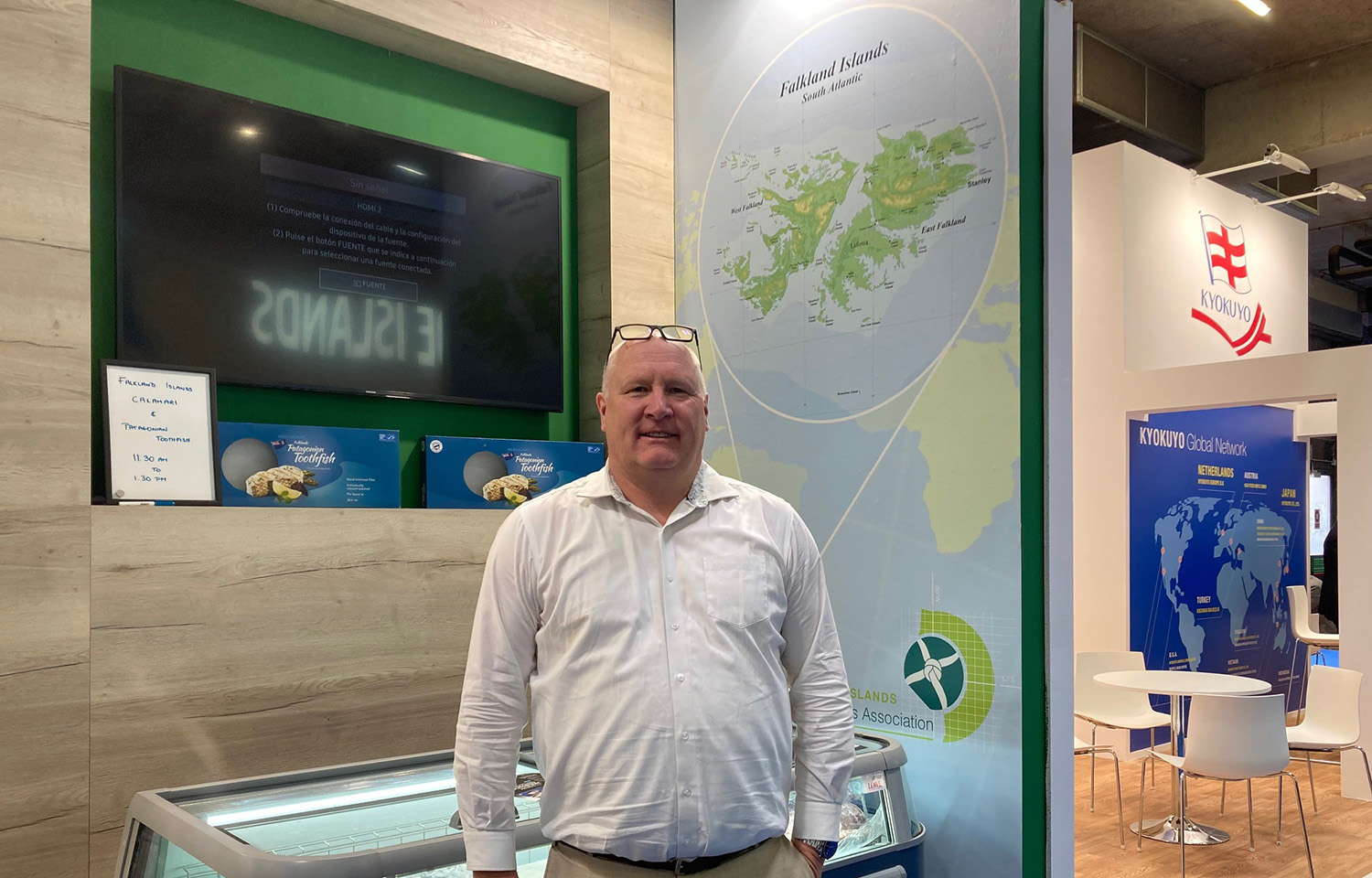
The vast oil reserves buried around the Falkland Islands may represent the future of its economy, but fishing remains its biggest economic driver, accounting for 65 percent of the islands’ gross domestic product in 2023.
“It remains a massive deal,” Falkland Islands Fishing Companies Association Executive Secretary James Bates told SeafoodSource at the 2024 Seafood Expo Global in Barcelona, Spain on 23 April.
The islands, which lie 300 miles east of Argentina in the Southern Atlantic Ocean, and control of which was contested in a war between Argentina and the United Kingdom in 1982, are self-governing, though they remain a part of the U.K. They play host to a fleet of vessels fishing year-round for a diverse range of species, including loligo and illex squid, southern blue whiting, hake, king clip, red cod, rock cod, and Patagonian toothfish.
“We're responsible about our fisheries. For us, it’s fair to say that everybody's life in the Falklands is impacted by the fishing industry in one way, shape, or form. Obviously, the government receives license fees and corporation taxes, and that goes on to fund our government and life on the islands,” Bates said. “The government of course is keen and enthusiastic to explore other sort of revenue streams, because obviously you can't have all your eggs in one basket. But at the moment, and probably for the next few years, at least, fishing will remain the number-one industry of importance to the Falklands.”
While the Falklands’ government maintains control over its exclusive economic zone, which stretches 200 miles out from the islands except where it bumps up against Argentina’s EEZ, the area is a popular destination for distant-water vessels from other nations, particularly China.
Argentina estimates annual losses of ARS 2.6 billion (USD 25.5 million, EUR 22.5 million) tied to illegal, unreported, and unregulated (IUU) fishing in its waters, and has invested in expanding the surveillance and control capacity of maritime resources in a move to stop those losses. In an April 2020 incident, about 100 mostly Chinese-flagged squid jiggers were allegedly caught fishing illegally in Argentina’s national waters with their automatic tracking devices turned off, leading to a Argentine Coast Guard opening fire on one of the vessels.
“The Southwest Atlantic is the largest body of water in the in the world without a RFMO [regional fisheries management organization] and that’s something the Falkland Islands are very keen to see put in place,” Bates said. “There's no getting around the fact that you can see the Chinese long-distant fishing fleet from space even, and so we are crying out for cooperation, for an RFMO for the region that will include the likes Great Britain, Argentina, and the Falklands that puts politics aside and focuses on the bigger the larger good.”
Bates acknowledged the historical tensions between the parties could complicate the process.
“The process will have to proceed cautiously, but everyone needs to recognize the situation has come to a point where the politics have to be put aside to get this done,” he said. “It's difficult, it's challenging. But I think people are capable of recognizing there are bigger things in play.”
In January 2024, the Argentine Naval Prefecture launched Operation Griffon XVII, led by the patrol vessel Rear Admiral Cordero, to combat IUU fishing by Chinese squid-jiggers along the 200-mile line of its EEZ. The operation was joined by the U.S. Coast Guard Cutter James, which has previously performed anti-IUU patrols in the Pacific and Caribbean.
Argentina Defense Minister Luis Petri said between 450 and 500 vessels, primarily Chinese had passed through the Strait of Magellan and had positioned at the border of the country’s EEZ.
“As of today, there are 344 that we have perfectly identified,” Petri told La Derecha Diario. “IUU fishing causes the greatest losses to local economies, especially in Latin America, in addition to great environmental damage as a result of the destruction of natural maritime resources.”
Petri said the Chinese vessels intentionally disable their automatic identification system (AIS) devices to avoid detection while engaged in IUU practices.
“Aerial control must be done. Satellite control must be done,” Petri said. “But we also have to modify the entire legal system, particularly that which applies to administrative sanctions when incursions into our EEZ occur.”
Petri did not address whether Argentina’s new president, Javier Milei, supported the creation of an RFMO, but Bates said there seems to be a growing consensus that more urgent and extensive action should be taken to address Chinese IUU.
“There’s no formal effort underway yet, but with the new president, there’s hope Argentina might be amenable to a dialogue. We’re giving that administration time to settle in and there's hope that there might be a conversation that takes place behind the scenes to get things started,” Bates said. “There was an agreement a number of years ago on the sharing of data on trans-boundary species, but that stopped under the previous administration and hasn't yet restarted on the new administration. We remain confident that something can be achieved to push our joint efforts further.”
Bates acknowledged how the shared history between the Falkland Islands, referred to as the Malvinas by Argentina, has likely impeded previous progress on creating an RFMO for the South Atlantic. And he said any talks on the subject are predicated on the fact that the Falkland Islands “have their own sovereign identity.”
“We want to be involved in any negotiations. This is right and proper, but obviously it could be a problem for [Milei] administration. That might be politically challenging, but hopefully the magnitude of the problem and the need to address means we can do what's right for the bigger good, and hopefully those conversations will progress at some point," Bates said. "I don't know how we go about it, but diplomacy must come into play, and a recognition that we need to work collaboratively together on this.”
