




The negative effects of bottom trawling on not only marine environments but local economies and societies have been the focus of several recent studies, with certain NGOs calling for a stop to the practice altogether.
Despite supplying a quarter of the world’s seafood, fishing via bottom trawling has sparked a longstanding debate on its impacts, including its potential harmful effects on deepwater ecosystems and the levels of carbon emissions it generates. In addition to NGOs requesting a complete elimination of the practice, there were calls in 2022 for bottom trawling to be replaced in the E.U. with less impactful fishing gear.
A Canadian startup is trying to find a middle ground, in which bottom trawling can continue while limiting the practice’s negative impacts on critical seabed environments.
“I don't think it should be [viewed] as negative as it is. Fishers in general are very concerned about the sustainability of their industry, but they just don't have the tools that allow them to fish it differently,” Angie Greene, the CFO of Halifax, Nova Scotia, Canada-based startup Katchi, said. “They just get tighter and tighter regulations without anything to help do it differently. Our solution, I feel, bridges the gap between both initiatives [ensuring environmental sustainability while protecting fishers’ livelihoods] and helps them to work together.”
Katchi's solution is bottom-trawling equipment it pioneered that is designed to reduce fuel consumption, minimize equipment damage, and preserve sensitive seafloor environments.
The idea for such a project started with Katchi Founder and CEO Marc d’Entremont, who envisioned a fish-harvesting system that eliminates or at least minimizes disturbance to the ocean floor while enhancing commercial catch efficiency, thereby cutting costs for fishermen.
With support from Halifax-based Dalhousie University, funding from Canada’s Ocean Supercluster, and collaboration with other partners, the system is set for commercial release in 2024.
“[On traditional vessels], there are currently two huge trawl doors situated in the trawl system that frequently have to be brought to the welding shop for repairs, and then, thousands of dollars later, they get reinstalled on the vessel, and you can go out again. It delays your trip. It’s expensive, and sometimes, trawlers can lose most of their net system due to snagging the bottom [of the ocean],” Greene said. “[Katchi’s system] is going to reduce the impact of expenses like maintenance and fuel consumption because you are no longer touching the seafloor, and on the environmental side, it reduces bycatch.”
The novel bottom-trawling gear incorporates sensors and data technology to precisely position nets near the seabed without making physical contact. This innovation also involved replacing traditional heavy trawl doors with a streamlined option to minimize drag. Additionally, a major goal of the company was to ensure the gear could be integrated into existing vessels, requiring minimal modifications to reduce the cost of transitioning to the new system.
“It was a simple concept, but it’s a very hard engineering feat.” Greene said. “We’ve really tried to adhere to the standard that it's easy for fishers to use this new gear because it's so integrated into what they already use now. The method of fishing is something to get used to, but actually taking it out to sea and putting it in the water should be quite quick to learn and assimilate to.”
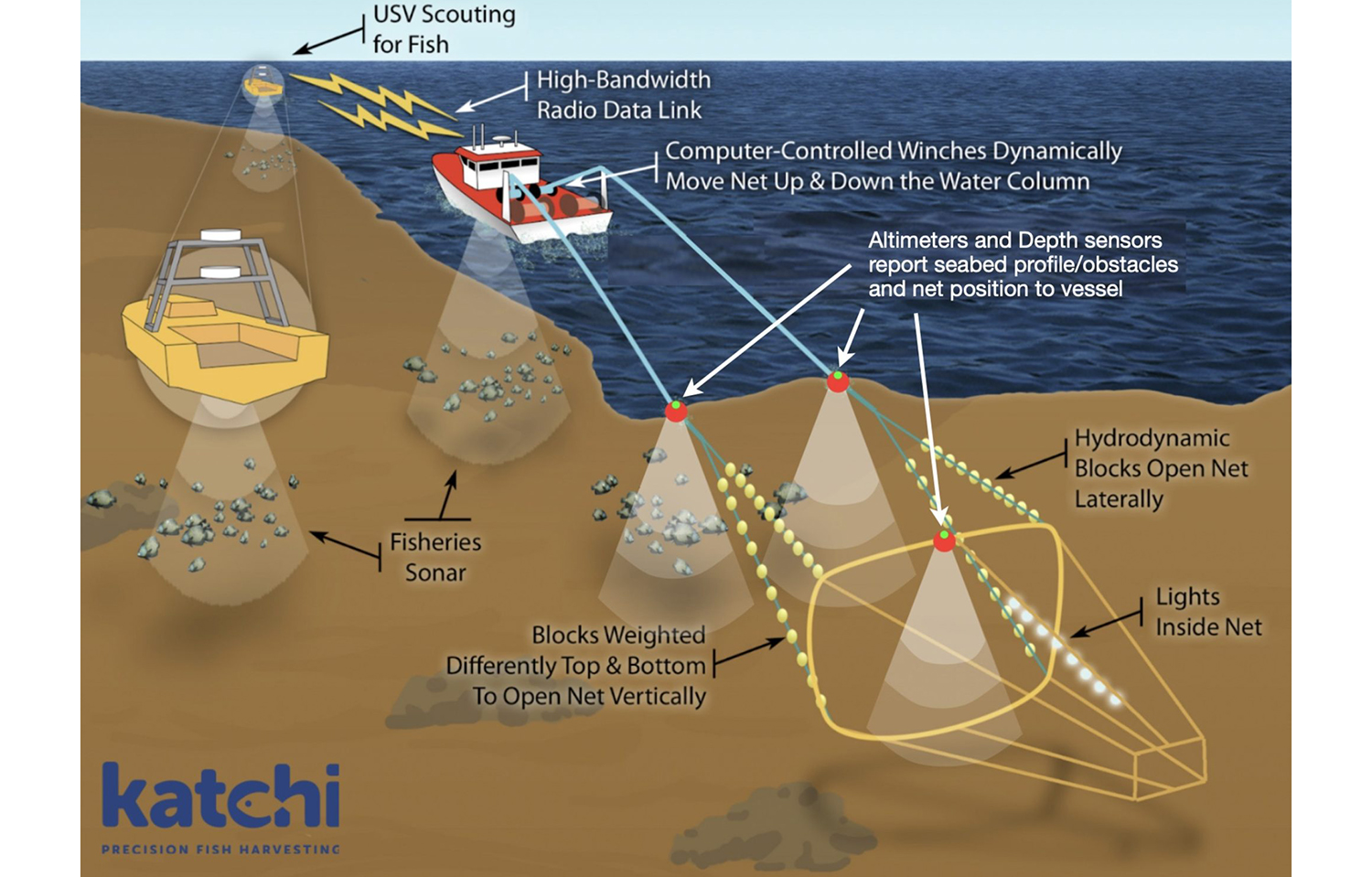
The new trawling systems consists of an uncrewed service vessel (USV), computer-controlled winches, altimeters and depth sensors on the ropes, hydrodynamic weighted blocks, and lights and bioacoustics on the net.
The USV scouts for fish and delivers hydroacoustic data to the vessels, allowing for more efficient trips. The winches allow for net movement up and down – eliminating the need for extra gear to accomplish that task – and track the movement of targeted species in the water column, as well as changes in depth on the ocean floor.
This innovation may have far-reaching impacts, according to Greene.
“If [fishers can] fly above all these ecosystems without any impact, then it’s going to help them possibly be able to fish in different areas in the future that are not open to them right now,” Greene said.
Katchi is also exploring the use of lights and bioacoustics inside the net to attract targeted species, reducing bycatch and deterring unwanted species.
“With the ocean environment, it’s not just one area that fish congregate in all the time, and maybe this technology will give fishers the ability to take a break on a school of biomass and fish out of a different biomass for a while,” Greene said.
Greene also explained the removal of the doors increases fisher safety thanks to the weight reduction the system offers. The only new additions onto an existing vessel are electronic and software components.
Through academic, nonprofit, and governmental collaboration, Katchi believes it has built a system that will allow fishers to maintain their livelihoods while ensuring the marine environment stays healthy for years to come.
“Projects such as the one led by Katchi are taking innovation further, making lasting contributions and helping develop sustainable fishing solutions,” Canadian Minister of Innovation, Science, and Industry François-Philippe Champagne said.
