



NOAA Fisheries recently held what it is describing as its first-ever international cooperative research knowledge exchange with Scotland.
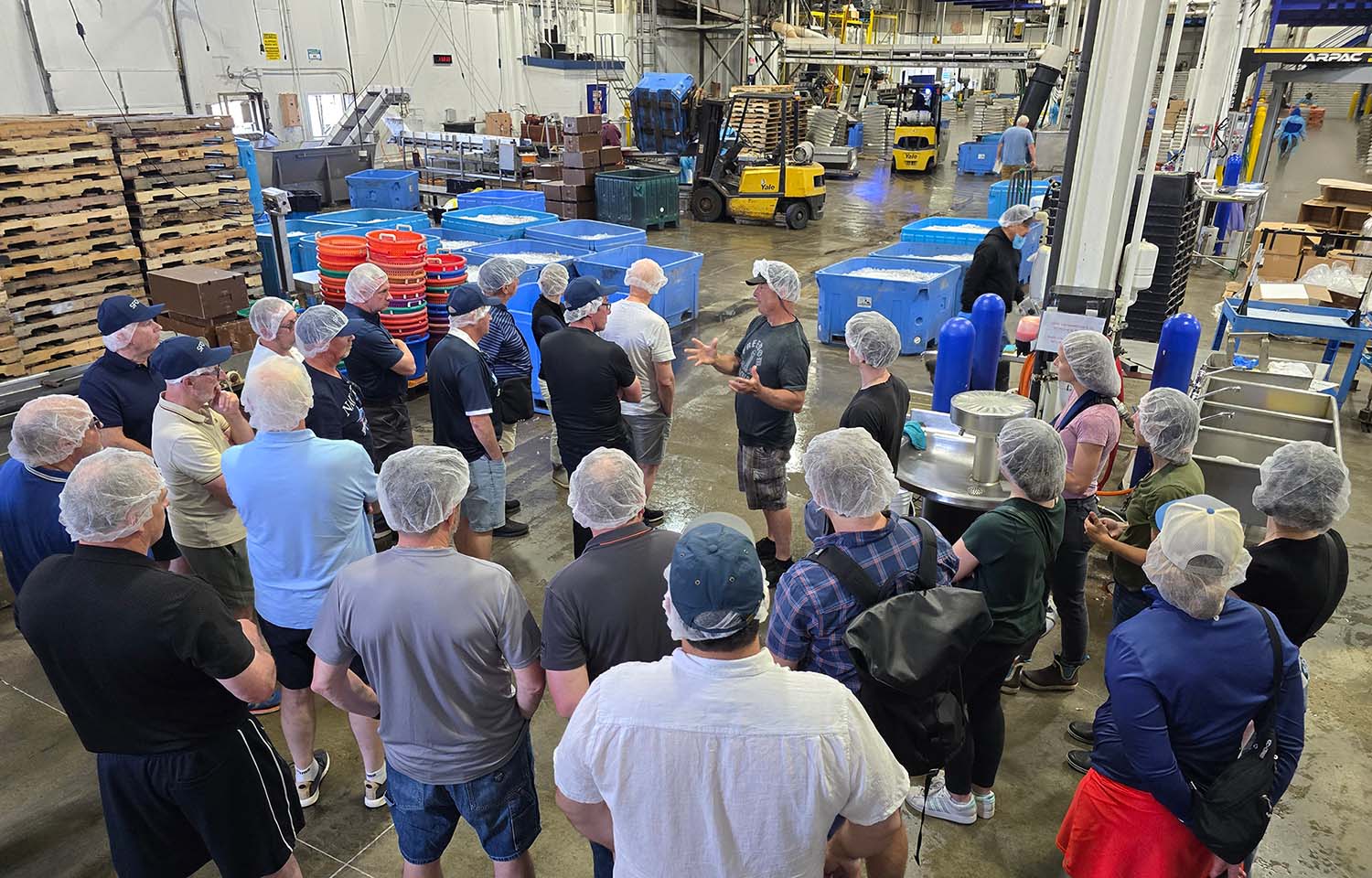
NOAA hosted 16 members of the Scottish Fishermen’s Association in a three-day event which involved tours of multiple ports, fishing vessels, and seafood processing facilities. The goal of the exchange was to share fisheries knowledge between the two organizations, which share management of multiple fisheries species in the Atlanic including Atlantic cod, Atlantic pollock, haddock, Atlantic mackerel, and Atlantic herring.
“Our organization understands the value of cooperative research and has always been an advocate for a structured approach to dealing with scientific and management challenges in Scottish fisheries,” Scottish Fishermen’s Association CEO John Anderson said. “While we do engage in some cooperative research in Scotland, there are real opportunities to develop a more cohesive and strategic approach to dealing with knowledge gaps and challenges in our fisheries – similar to the model being used in the Northeast.”
The Scottish Fishermen’s Association is one of the largest fish producing organizations in Europe, and the largest in the U.K. It has roughly 140 members, which are responsible for a collective landings of roughly 150,000 metric tons (MT) of fish and shellfish.
NOAA said the trip was useful to the attendees as a frame of reference, especially considering Scotland is currently revising some of its national fisheries policies. Scotland’s Fisheries Management Strategy was published in December 2020, and the plan has been updated multiple times since then, according to the Scottish Government.
NOAA Cooperative Research Branch Chief Anna Mercer said the administration coordinated vessel tours to show the visitors a range of different gear types, with a focus on the fisheries shared by the two countries.
"It was interesting to see how some vessels also own processing plants. They catch and process fish, and either export it or supply it to local restaurants. That was really impressive. That [vertical integration] doesn’t happen in Scotland,” Peter Lovie, the captain of the fishing vessel Endeavor and one of the directors of the Scottish Fishermen’s Association, said.
NOAA Fisheries said members of the Scottish Fishermen’s Association met with scientists, fishery managers, academics, and nonprofits to learn more about collaborative research and how it can support fisheries management and the fishers. NOAA Fisheries shared efforts like a new Atlantic mackerel research initiative, which is a two-year cooperative effort to address uncertainty in population dynamics of Atlantic mackerel.
NOAA Fisheries said the exchange also benefited the association by showcasing many challenges shared in both regions, including issues of trust between fishermen and scientists, the graying of the fleet, fleet consolidations, and spatial squeezes as multiple uses try to coexist on the water, like fishing and wind energy.
“We fishermen want to contribute more towards science for the future," Lovie said. "Funding fisheries research is really important for our future."
Scottish Fishermen’s Association Vice Chair George West said the exchange was encouraging for the group, as it showed that there can be enhanced cooperation between fisheries managers and researchers and the fishermen who depend on those fisheries for their livelihoods.
“We’re encouraged to see the level of cooperation between fishermen and scientists during our visit. That seems to be something that’s growing … That gives us heart because although we’re doing some, we feel we could be doing much more,” West said. “We see that as the way forward because fishermen have so much knowledge and time at sea. Scientists of course have their own expertise that can help fisheries and fishermen. There’s just so much mileage in cooperative research.”
