





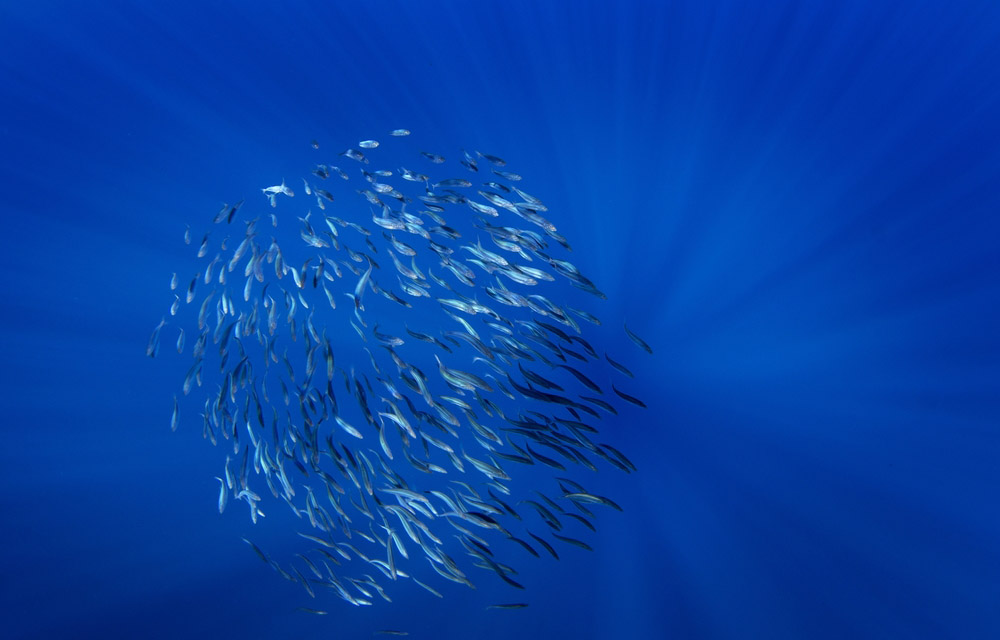
The Pacific Fishery Management Council (PFMC) has proposed merging two Pacific sardine subpopulations into a single stock, eliminating a rebuilding plan adopted and set in motion last year.
Currently, the federal government considers there to be two Pacific sardine stocks along the U.S. West Coast – a northern subpopulation and a southern subpopulation. NOAA Fisheries first listed the northern subpopulation as overfished in 2019.
After a 2021 rebuilding plan was deemed unsatisfactory, conservation NGO Oceana sued the government to force regulators to adopt stronger measures to help rebuild the populations. In April 2024, a federal judge ruled in favor of Oceana, and in 2025, NOAA Fisheries unveiled its new rebuilding plan, limiting the annual catch of sardines to 2,200 metric tons. Satisfied, Oceana praised the new plan, calling it a big step forward.
Now, the PFMC is moving away from that rebuilding plan by removing subpopulation designations and considering Pacific sardines as one stock.
“Newly available scientific literature on Pacific sardine, including genetic studies and a review of all preceding research on Pacific sardine population biology, reveals a lack of scientific evidence to support any population structure, including the long-held hypothesis that [the northern and southern subpopulations] are distinct subpopulations that underlies current management of sardine,” the PFMC stated in its action. “This new information and thorough reviews of past hypotheses and population biology show Pacific sardine comprise a single, panmictic population without regional differences in demographics or other life history traits (e.g., growth) ranging from the Gulf of California, Mexico, to Canada.”
As such, the rebuilding plan for the northern subpopulation would effectively be moot.
In a statement, Oceana criticized the council for bypassing conservation measures and suggested the action threatens Pacific sardines and the wildlife that depends on them.
“Today’s action is incredibly shortsighted and further threatens whales, salmon, sea lions, pelicans, and other animals already under duress from a massive Super El Niño and other stresses,” Oceana Senior Scientist Geoff Shester said in a release. “Pacific sardines are the energy bars of the ocean, and while they may be small, they play a huge role in the ocean food web. Yet, rather than giving a newly created rebuilding plan a chance to work, fishery managers are instead playing games with the numbers to hide the ball from the public and further push sardines and the animals that rely on them further toward catastrophe.”
