






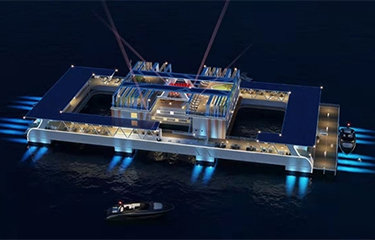
Sweeping sea views from a hotel window, with a steaming cup of coffee on a glass table, are not images one typically associated with a deepwater fish farming facility, but that’s exactly how Chinese news outlets have advertised the new Min Tou Number 1 fish farm, billing the facility as the future of Chinese mariculture.
The footage from the Min Tou Number 1 platform, shown on provincial and national broadcast news recently, depicts the facility as a combined “deepwater mariculture” fish farm and hotel on a platform off the Fujian coast in southeastern China. Located in Dinghai Bay near the city of Fuzhou, the facility aims to be a “smart automated” platform that has potential revenue streams in fish farming, tourism, and research.
The facility – with annual production estimated at 600 metric tons (MT) – uses solar and hydropower generated from tidal waves as its electricity sources.
As another sustainability measure, four facility vessels transport sewage water ashore for purification, facility manager Xu Hang told a Fujian broadcast network.
Continuing a trend of Chinese aquaculture facilities doubling as tourist draws, Hang advertised the Min Tou Number 1 platform as a fun place to visit.
“You can feed fish, you can catch fish, and you can stay overnight looking at the ocean,” Hang said.
The facility epitomizes the country’s push toward developing innovative technology in sectors it believes are on the rise – two of which are mariculture and renewable energy.
Chinese government policies have actively encouraged the expansion of deepwater mariculture in the country as a way to remove near-shore aquaculture facilities often blamed for pollution, while also establishing China as a world leader in a future-forward field.
Speaking at a mariculture conference in the southern city of Sanya on 19 June, Ceng Hao, the head of aquaculture regulation at the Chinese agriculture ministry, said he wants to see China develop a “whole value chain” in deepwater mariculture equipment and seafood production.
This would build upon the 40 platform facilities, 20,000 “modern” deepwater cages, and four vessels that already exist in the country, according to China Vice Minister for Agriculture Zhang Ma, who also spoke at the Sanya conference.
Investors in mariculture, meanwhile, have been keen to tap demand for expensive seafood species like grouper, pomfret, and croaker that these deepwater facilities aim to farm.
Specifically highlighting golden pomfret, a species farmed at Min Tou Number 1 and a favorite staple of many Chinese banquets, Chen Dan, the head of Guangdong Evergreen, a corporation specializing in feed production and marketing, believes the species’ potential could rival that of Norway’s salmon sector, and that deepwater facilities would be key to that process.
Chen said that his company wants to employ a major marketing campaign to launch a range of consumer-facing packaged meals featuring golden pomfret – the current production of which suffers from weak pricing power due to “low awareness” among consumers.
The heads of major aquafeed firms Guangdong Haid, Da Bei Nong, and Tongwei Group were all in attendance when Chen spoke and confirmed that they’re on board to supply feed to farmers of high-value species in new offshore mariculture facilities.
The industry does not want to just limit itself to domestic investors, however.
Looking toward other markets, China views its participation in the Asia-wide Regional Comprehensive Economic Partnership (RCEP) free-trade deal as opening the doors to valuable Japanese buyers.
China is also seeking to join the Comprehensive and Progressive Agreement for Trans-Pacific Partnership (CPTPP), which would open up low-tariff access to numerous other developed economy markets.
Though doors seem to be opening for the industry, production of species like golden pomfret is still far from the mainstream. To rival more popular global species, the Chinese mariculture industry needs to take further action, such as pursuing eco-certifications that global buyers look for when purchasing seafood products, Chen said.
One firm is setting the stage for what that would look like: Hainan Xiangtai Fishery Co., a firm better known as a tilapia exporter, has received Aquaculture Stewardship Council (ASC) certification for a golden pomfret marine cage farm. Hainan Xiangtai publicized the certification – under the ASC Tropical Marine Finfish category – at a recent conference in Guangzhou attended by some key players in the Chinese mariculture industry.
Speaking at the Guangzhou conference, Fang Qing, head of the ASC’s office in China, said certification would become increasingly important to reassure investors and regulators that deepwater mariculture is sustainable in China, such as at the Min Tou facility and others.
Photo courtesy of Mintou Deep Sea Aquaculture Equipment Leasing Company
