



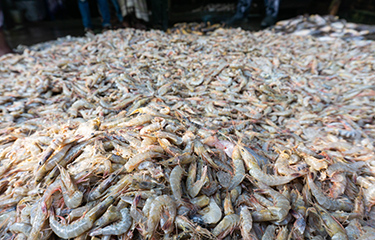
Shrimp farming in Khulna, Bangladesh, the Asian country's shrimp-producing hub, has become harder due to climate change, worrying local producers and exporters.
The lower production has resulted in Khulna's shrimp production declining by 21.7 percent year-on-year to 33,271 metric tons (MT) in fiscal year 2021-2022.
Local producers are blaming climate change, with fluctuations in salinity levels caused by changes in natural high tides playing a major role in the decline, the United News of Bangladesh reported on 6 October.
Bangladesh began developing its domestic shrimp industry in the 1960s, and grew it into an export-oriented industry in the 1980s. However, its peak production period is possibly over, according to Bangladesh Frozen Food Exporters Association Vice President Humayun Kabir.
“But it seems like the heyday of the shrimp business is coming to an end. Production is getting lowered, while demand and prices are also falling. All in all, the situation is really dire for those associated with the shrimp industry,” he said.
Kabir said high temperatures and mounting issues with disease have resulted in lower production.
Khulna Division (Shrimp) Fry Trading Association General Secretary Golam Kibria Ripon also said the change in salinity levels in local rivers has also resulted in a decline in production.
“Usually the water in the rivers of Khulna region becomes saline in January. Last year, salinity of the rivers was delayed to February. Lack of saline water during the harvesting period is affecting shrimp farming badly,” he said.
The rate of salinity nowadays falls to 8 to 10 percent, from 16 to 18 percent previously. Consequently, local farmers aim for a fry survival rate of between 15 and 20 percent, much lower than the 60 to 70 percent achieved in the past. And given the water shortage due to climate change, Ripon said there is now an emerging need for dredging rivers to supply sufficient water for shrimp farming.
Mostafa Sarwar, a climate expert and Head of Urban and Regional Planning Department of Khulna University of Science and Technology, said normally farmers start seeding in January or February, when the water temperature is around 25 degrees Celsius. A large quantity of the fry die each March, when the temperature increases to 27 degrees, as they are sensitive to the rising temperatures. Higher water temperature also leads to the spread of viral infections.
Khulna District Fisheries Officer Joydeb Kumar said the government has carried out various measures to protect the local shrimp-farming sector, including asking farmers to maintain normal water temperaturse by increasing the depth of their enclosures and by building protective barriers to shield farms from the entrance of harmful substances into their farming areas.
Photo courtesy of munimbinsalim/Shutterstock
