





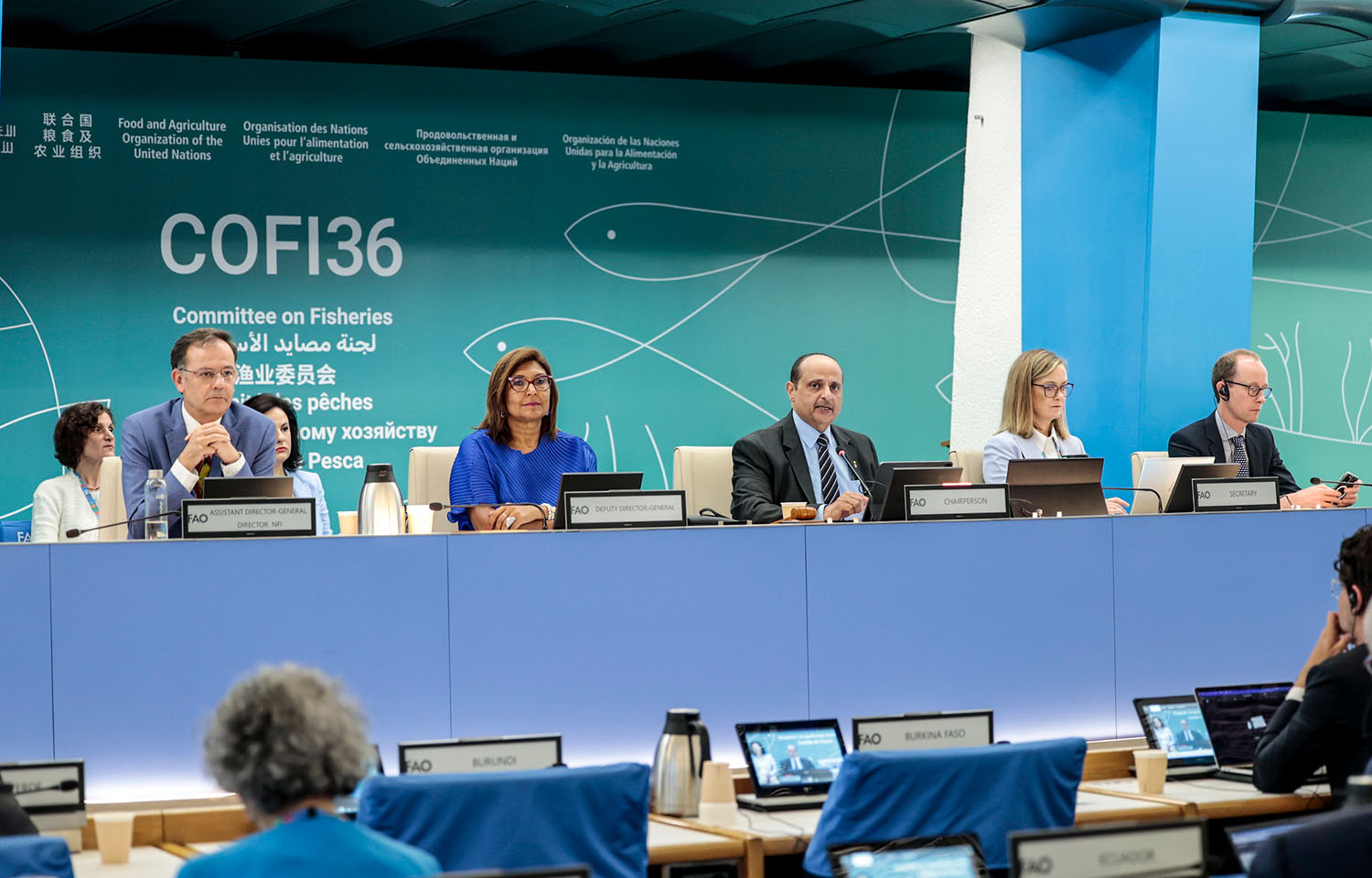
The Food and Agriculture Organization (FAO) of the United Nations' Committee on Fisheries (COFI) has endorsed a new set of guidelines for aquaculture designed to develop a set of best practices for the industry worldwide.
The Guidelines for Sustainable Aquaculture (GSA) was designed with the aid of NOAA and other stakeholders and officially endorsed by COFI at the committee’s 36th session in Rome, Italy. The new guidelines come after the FAO’s State of World Fisheries and Aquaculture report showed that fisheries and aquaculture production hit a new high of 223.2 million metric tons (MT) in 2022 – with aquaculture contributing over 57 percent of aquatic animal products for direct human consumption.
"An increasingly expanding global aquaculture sector is driving the supply of fish and fishery products to new records. In 2022, aquaculture overtook capture fisheries as the main supplier of aquatic animals,” FAO Director-General Qu Dongyu said at the opening of the COFI session. “Ensuring the expansion of sustainable aquaculture is of fundamental importance for consumers.”
The new guidelines came with three sections, with the first covering its objective and scope, the second covering the guidelines for promoting sustainable aquaculture, and the third section covering how to implement and monitor guidelines.
“In line with FAO’s Blue Transformation, which has a major pillar dedicated to the sustainable intensification and expansion of aquaculture, the GSA envision an aquaculture sector that contributes significantly to a world free from hunger and to equitable improvement of the living standards of all actors in its value chain, including the poorest,” the GSA states.
The vision of the GSA, it said, is to create more productive and resilient agrifood systems to meet the demand for aquatic foods while also contributing to poverty alleviation and hunger. While seeking those goals, the GSA established a set of guiding principles to adhere to covering sustainability, cultural sensitivity, transparency, and more.
With that baseline, the GSA offers a set of administrative, legal, and policy frameworks that can be used to guide governments on creating successful aquaculture policies.
“Having and enforcing implementation of good aquaculture governance frameworks is one of the necessary conditions for the sector to fully realize its potential for growth and prosper over time,” the GSA states.
In a press release, NOAA said it helped inform the new guidelines and that it specifically worked to ensure that North American aquaculture sectors were represented in the new document.
“Aquaculture is the fastest-growing food production sector globally, driven by technological innovations and growing demand for seafood. As with all forms of agriculture, this rapid growth has exposed challenges for environmental, social, and economic sustainability,” NOAA said. “Guidelines are needed to ensure aquaculture grows sustainably.”
The GSA was endorsed on the 10th anniversary of COFI’s endorsement of the Voluntary Guidelines for Securing Sustainable Small-Scale Fisheries in the Context of Food Security and Poverty Eradication (SSF Guidelines) – which highlighted the importance of small-scale fisheries and offered a guide on ensuring their sustainability.
“The SSF Guidelines are the world's first and only global normative instrument entirely dedicated to small-scale fisheries,” Dongyu said. “The needs and aspirations of more than 500 million people around the world are reflected in those guidelines.”
As COFI’s 36th session came to a close, Accountability.Fish renewed its calls for reforms to regional fisheries management organizations (RFMOs), which are in charge of managing fisheries.
“With fish populations increasingly at risk and climate impacts worsening, fundamental reforms are urgently needed,” Accountability.Fish Global Director Ryan Orgera said in a release.
RFMOs are treaty-based management bodies, and Accountability.Fish said they are not following through on sets of guidelines adopted by FAO and COFI – such as the biodiversity beyond national jurisdiction agreement, also known as the High Seas Treaty.
The result of 20 years of UN-facilitated talks that culminated in a deal in March 2023, the treaty needs 53 more ratifications to come into effect globally.
Orgera said that as the UN and nations make progress, RFMOs are ill-equipped to follow through on the guidelines.
“The main reason why RFMOs are wholly unsuitable for a greater role in marine sustainability at this time is that the RFMOs are dominated by industrial fishing interests and, generally, lack transparency and inclusiveness of non-extracting stakeholders,” Orgera said. “They are also severely hampered in their effectiveness by consensus-based voting rules that often give their worst actors veto power over any substantive changes.”
Orgera said RFMOs need to be modernized as the FAO, COFI, and UN continue to make progress on international fisheries and aquaculture governance guidelines.
“The future of our oceans depends on modernizing RFMOs. That means making them accountable to the full range of stakeholders beyond their current focus on satisfying the demands of industrial fishers,” he said. “This transformation is an opportunity we cannot afford to miss.”
