






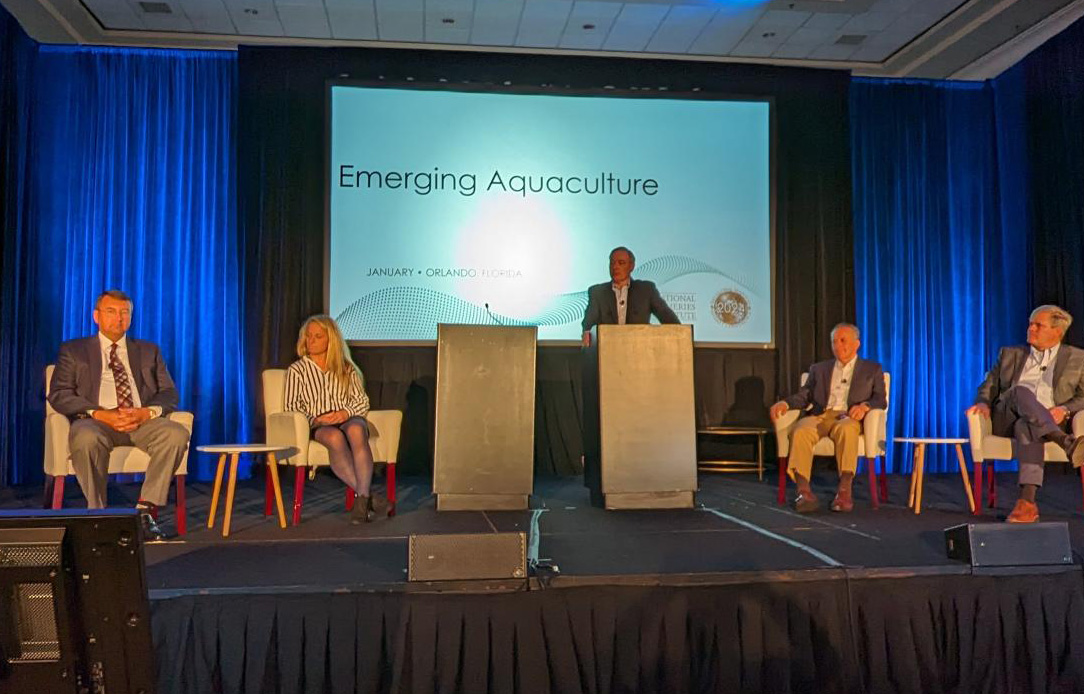
As aquaculture operations raising novel species in unique ways begin to establish themselves in the market, one of the most important resources to have is patience, a panel of experts said.
During the Global Seafood Market Conference – running from 23 to 25 January in Orlando, Florida, U.S.A. – a group of emerging aquaculture industry executives gave an overview of the trials and tribulations of debuting either a new species, a new farming method, or both. While those speaking on the panel raise different species in various markets, the one thing they all agreed on is a need for persistence and patience.
“You have to have patient capital,” Blue Ocean Mariculture CEO Dick Jones said.
Blue Ocean Mariculture farms kampachi off the coast of Kona, Hawaii, U.S.A. and is currently the only open-ocean aquaculture finfish farm in the U.S. While its farms are located relatively close to shore, the farms are located in 200 feet of water and in water conditions that mimic that of water up to 40 miles off the coast.
Farms like Blue Ocean, Jones said, are pioneering new technologies and new species in ways that often won’t bring returns for years – hence the need for patience.
“In those early days where you’re only growing a few hundred tons offshore, the economics are more than upside-down, and it’s really difficult,” Jones said.
Finding the right species is also a challenge. Jones said in the early iterations of farming, the company’s founder, Neil Sims, experimented with a number of different species, with mixed results.
Mahi, it turns out, was a bad choice for the type of aquaculture operation Blue Ocean was aiming to establish.
“He started with 100 … and then ended with one because they just ate each other,” Jones said. “You have to learn those things as you’re continuing to evolve and learn the species that you want to grow, seeing what works best for your market.”
Considering the right market is another factor in establishing a successful new aquaculture operation. Jones said it’s important to make sure you can establish a market presence for the species that you’re trying to raise.
Australis Aquaculture President Jason Paine said for his company, which farms barramundi in Vietnam, awareness is still a big challenge.
“Identifying that target audience [is key]; we’ve done three consecutive years of Hanover research, and we just recently brought in a data analyst who has distilled that information to help us find who our target audience is and what messages really resonate with that target audience,” he said. “So, we’re beta-testing those messages in the marketplace so we can really hone in and make sure we’re hitting that right audience, building awareness, and [ensuring] the sales and growth of our products.”
Searenity Seafoods Founder Lauren Enz said establishing a market requires a multi-pronged approach so that consumers can be taught what the fish is and why they should eat it. Tapping in to the regionality of seafood and understanding where you can establish a “safe” place for consumers to try a new species out is essential.
Leveraging social media is also something the seafood industry needs to do more and is what Kingfish – the company she’s helped market its products – has done well, Enz said.
“We’re really leveraging the social media platforms and taking advantage,” Enz said. “ I think that that’s something that our seafood industry is a little lacking on, [and] I think that Kingfish has been kind of cutting-edge on that.”
The company has created a "sizzle reel" for social media platforms like TikTok, using influencers to introduce new audiences to its products.
Another way to make sure the species is familiar to a target consumer is to choose one that’s already on the market. Pine Island Redfish Founder Megan Sorby chose redfish specifically because it has long been a regional favorite in Florida, where her new company is based.
Pine Island Redfish is working to establish a recirculating aquaculture system (RAS) for redfish in Florida and is going through the process of gaining approval and meeting with the local community. Historically, redfish was – for a long time – a commercially caught species before overfishing led to a collapse in its populations, but the species is still well-known in the area.
“It used to be domestically sourced; we used to fish it right out of our local waters, and we did it so well that we about fished it out,” she said. “It leaves an opportunity for a farm like ours to come in and say, ‘Hey, we can actually be a supplier of a domestic product again.’”
After going through the long process of establishing a new species, the next big step is consistently making sure that the supply is there, Mar Andino Founder and President Eduardo Kipreos said.
Mar Andino farms steelhead trout high in the Peruvian Andes and has been an established operation for over a decade. Over the past nine years, the company has delivered fresh products every single week all 52 weeks of the year.
“I think it’s a quite challenging achievement,” he said.
Being able to deliver a consistent supply of a species, Paine said, is the final piece of the puzzle.
“Consistency is the word that you want – consistency in supply, consistency in quality, consistency in price," he said. "That’s what these new emergent species really offer.”
Photo courtesy of Chris Chase/SeafoodSource
