






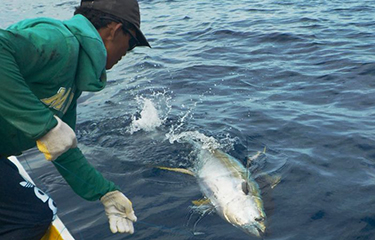
Indonesia’s fishing industry is looking to raise tuna in its numerous bays to enhance its domestic aquaculture sector and alleviate the overexploitation of the world's largest tuna fishery.
Indonesia was the third largest-aquaculture producer in the world by volume in 2020, even though it has only thus far used 7.38 percent of its potential area for aquaculture production, according to a 2016 Ipsos report. With 18,000 islands and islets, the Indonesian archipelago possesses the third-most coastline in the world.
The Southeast Asian nation is the top tuna-producing country in the world, accounting for about 16 percent of the global tuna supply. In 2021, the country produced 791,000 metric tons (MT) of tuna worth IDR 22 trillion (USD 1.46 billion, EUR 1.34 billion). Of that, 174,764 MT worth IDR 10.6 trillion (USD 705.7 million, EUR 645.6 million) was exported, with the U.S., Japan, Thailand, Saudi Arabia, the E.U., Australia, Vietnam, the U.K., and the Philippines serving as Indonesia’s top markets.
Indonesia is among the top global producers in the aquaculture sector, undergoing 527 percent growth from 1990 to 2018. However, its production has declined from a high of 16.1 million MT in 2017 to 14.6 million MT in 2021, according to FAO statistics.
Indonesia earned approximately USD 6.2 billion (EUR 5.67 billion) from its exports of fishery and marine products in 2022, with shrimp accounting for USD 2.2 billion (EUR 2 billion) in exports in 2021, making it Indonesia’s most valuable seafood export. Farming tuna in bays around the country would align with the national goal of reaching USD 7.6 billion (EUR 6.9 billion) in seafood exports in 2023. Indonesian President Joko Widodo has become a more vocal proponent of enlarging Indonesia’s aquaculture production. In 2019, at the beginning of his second term in office, he directed the country’s fisheries ministry to prioritize aquaculture productivity efforts.
Expanding on these efforts, the ministry is now considering establishing tuna farms in several of the country’s bays, conservation news web portal Mongabay reported.
“This can be a good thing if we can develop it in Indonesia," Indonesian Fisheries Minister Sakti Wahyu Trenggono said at a press conference in Bali recently. “No more massive tuna catching but, instead, an option is to catch them and then grow them for a certain period and give them high economic added value while also [satisfying] protein demands.”
Indonesia's numerous bays, particularly in eastern regions such as Kupang in the East Nusa Tenggara Province and Morotai in the Maluku Province, offer favorable locations for tuna farming, he said. These areas, along with other spots scattered throughout the country’s archipelago, serve as essential fishing and spawning grounds for tuna species including albacore, yellowfin, bigeye, and southern bluefin tuna.
Catching wild tuna for farming requires different skills and techniques compared to traditional methods of fishing, Trenggono said. He said he plans to discuss tuna-farming techniques with global experts in countries like Turkey and Australia, where the practice has been successfully implemented.
The effort is also designed to mitigate unsustainable fishing practices in Indonesia’s tuna fisheries, which have led to the overexploitation of the country’s fishing grounds in the Pacific and Indian oceans, resulting in the depletion of many tuna species due to overfishing.
In response, Indonesia’s Ministry of Marine Affairs and Fisheries has implemented a number of measures to ensure sustainable production by introducing harvest control rules, monitoring species in at-risk fisheries, regulating the use of fish-aggregating devices, and encouraging fishers to obtain internationally recognized sustainability certifications. This is in addition to nongovernmental measures in other fisheries that aim to promote sustainable practices, such as the Environmental Defense Fund instituting an innovative camera system at three major crab landing sites in Sumatra.
The tuna-ranching project would expand on these efforts, according to Trenggono, resulting in a tightly controlled process that has been impossible to achieve in open waters.
The Indonesian government has already laid groundwork promoting sustainable certification and eco-labeling for its tuna fisheries to ensure sustainable fish stocks, minimize environmental impacts, uphold labor rights, establish transparent and traceable supply chains, and enforce best practices in management.
The fisheries ministry and the Marine Stewardship Council (MSC) signed a memorandum of understanding in 2019 to promote sustainable fishing in Indonesia, which was renewed in 2022. In May 2020, the Indonesian handline yellowfin tuna fishery, monitored by the North Buru and Maluku Fair Trade Fishing associations, received MSC certification, indicating the success of their joint efforts, according to MSC.
Additionally, in January 2021, the International Pole and Line Foundation (IPNLF), in partnership with IPNLF member Asosiasi Perikanan Pole and Line dan Handline Indonesia (AP2HI), announced that eight Indonesian one-by-one tuna fisheries earned MSC certification. The certification of the eight fisheries, located throughout the Indonesian archipelago, will add nearly 11,000 MT of responsibly sourced skipjack and yellowfin tuna to Indonesia’s production.
Photo courtesy of Yayasan Masyarakat dan Perikanan Indonesia
