



Two of Japan’s biggest trading companies, Marubeni and Sumitomo, have separately begun partnerships with insect protein companies, aiming to both use and sell the alternative protein for aquaculture feed purposes in Japan.
Japan is the second-largest user of fishmeal in the world, with much of it imported from Peru for its yellowtail and sea bream aquaculture operations. But recently, prices for fishmeal have been rising, leading to interest in alternatives. The Indexmundi website, based on World Bank data for Peru fishmeal pellets with 65 percent protein, shows a rise from USD 376 (EUR 341) per metric ton (MT) in November 2000 to USD 1,760 (EUR 1,642) in February 2023.
Marubeni, which owns a wide range of businesses, including food and agribusiness ventures such as Teaneck, New Jersey, U.S.A.-based shrimp importer Eastern Fish, announced on 7 March that it signed a letter of intent to collaborate with Paris, France-based Ÿnsect, a producer of insect protein and fertilizers. Marubeni said its eventual goal is to make insect feed readily available in the Japanese market.
"There are concerns about a supply-demand crunch of fishmeal such as anchovy, which is an indispensable feed ingredient for the aquaculture industry ... due to long years of harvesting and increased global demand for aquaculture," Marubeni said. "There is a growing need for solutions to develop alternatives to imported fishmeal, the price of which is expected to continue to rise in the future."
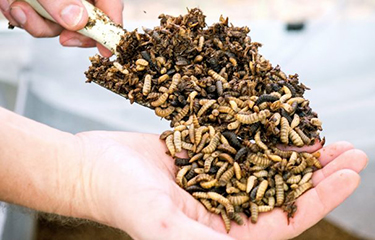
Ÿnsect, founded in 2011, produces lesser mealworms (Alphitobius diaperinus, sometimes marketed as “buffalo mealworms”) and yellow mealworms (Tenebrio molitor) in fully automated vertical farms. The larvae mature in stacked containers inside climate-controlled buildings, and the company operates three production sites in Dole, France; Ermelo, the Netherlands; and the U.S. state of Nebraska. An additional site, which will be the world's largest vertical insect farm, is under construction in Amiens, France, and the company has announced plans for another U.S. site.
Ÿnsect has raised around USD 500 million (EUR 466.3 million) from investment funds, banks, and public bodies and exports its products around the world. It also promotes its mealworms for human consumption, but so far, the main uses are for bird and fish feed.
A 2020 study published in the journal Fisheries and Aquatic Sciences reported that in an eight-week feeding trial of aquafeed incorporating various levels of full-fat mealworms – at 0, 7, 14, 21, and 28 percent – growth performance of rainbow trout increased up to 14 percent, but decreased at 28 percent. The study also showed insect feed positively stimulated the immune system of fish that ate it.
Marubeni's rival trading house, Sumitomo, announced on 23 April it had signed a memorandum of understanding with Singapore-based Nutrition Technologies to start sales in Japan of protein powder derived from black soldier flies for use in pet food and animal feed. The agreement is valued at about USD 100 million (EUR 93.4 million), according to Aquaculture Asia Pacific.
"Going forward, we will promote collaboration with Nutrition Technologies to expand the market for their products and develop high value-added products, thereby contributing to stable and sustainable food production across the world," Sumitomo stated in a press release.
Through the deal, Sumitomo will begin selling insect-derived feed in Japan in 2023. The company invested in Nutrition Technologies and acquired exclusive sales rights in Japan. Sumitomo, which invested in Nutrition Technologies in September 2022, claims that it will be the first major trading company to initiate full-scale domestic sales of insect powder.
It plans to import and sell 30,000 MT by 2030, which would be equivalent to about 7.5 percent of Japan’s current imports of fishmeal. The price is likely to be about the same as fishmeal at around JPY 200,000 (USD 1,493, EUR 1,355) per MT.
Nutrition Technologies uses the larvae of black soldier flies (Hermetia illucens), native to tropical regions of the Americas. The company processes the larvae into powder to make animal feed and pet food, and its current annual production volume is about 3,000 MT, which ranks second in the world behind Innovafeed.
In Singapore, Nutrition Technologies markets its products by emphasizing how it can reduce carbon emissions in the feed industry. The company purchases food waste from food processors and other sources as feed for black soldier flies, claiming that using waste that would otherwise be incinerated helps to reduce carbon dioxide emissions.
Nutrition Technologies also touts the fact that its two-hectare production facility in Johor, Malaysia requires no heating equipment, an additional energy savings. European insect meal producers Protix Innovafeed, which have larger black soldier fly production volume, have factories in Europe where the temperature varies more, so they use electricity for climate control. This results in lower comparative energy costs in Southeast Asia and, as Nutrition advertises, greater sustainability metrics in its production processes.
Other recent deals involving insect feed include Innovafeed partnering with feed producer Skretting and processor Truite Service to introduce an insect-fed trout to Auchan supermarkets in France; and In Puerto Montt, Chile-based F4F Food For The Future marketing trout raised on feed partially composed of insect protein.
Photo courtesy of Marubeni/Ÿnsect
