

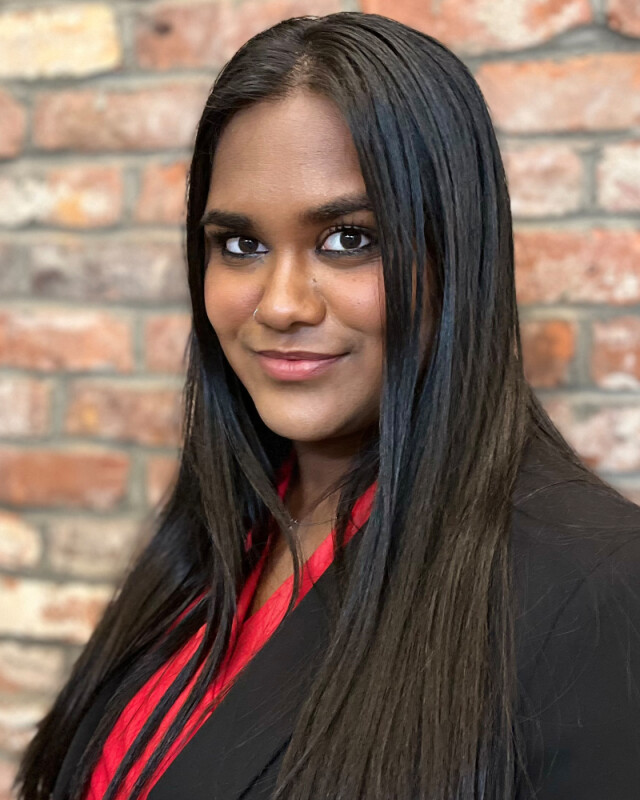
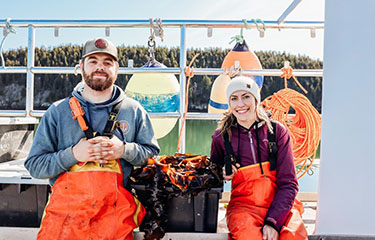
Morgan-Lea Fogg and Jake Patryn are the co-founders of Machias, Maine-based Nautical Farms. Their company grows organic Maine seaweed, and produces an array of products including sugar kelp flakes, kelp and sea salt body scrubs, and whole leaf sugar kelp.
SeafoodSource sat down with Fogg to discuss the origins of the business, and the company's future goals.
SeafoodSource: What was the original inspiration behind Nautical Farms?
Fogg: We started the official company in early 2018, in January. It really started out of a few different things. Jake and I were living in Colorado. We are from Maine, both of us. Jake grew up on the water, so, he had extensive experience lobster fishing, scallop dragging, clam digging, kind of doing all the things you do when you live in a coastal town and grew up with a family of fishermen. And we moved to Colorado in our early 20s, kind of just to switch it up, not really knowing what to expect.
We got out there, and started diving into our own personal health journeys. We got really into the type of food that we're eating, where that food was coming from, and we were hiking a lot, working out a lot, doing all that stuff. We slowly started into the journey of learning about where our food comes from and all of that, hearing about seaweed quite a bit, and there was seaweed circulating with other people I worked with in different industries. And so, it was becoming like a buzzword, so to speak at the time, and becoming a trend that people were talking about. Because we’re from Maine originally, it really piqued our interest, and then we started learning about not only the health benefits of seaweed, but also just the environmental impacts of seaweed and actually that Maine is an amazing place to grow seaweeds because we have such, clean water and cold water. And so, we started learning about all that stuff. I found it really, interesting.
Initially we were just trying to convince other people that we knew that were still living back here in Maine to start a farm, just because we thought it was a cool idea. And most people thought we were crazy. They were kind of like "no, we're not going to do that." After talking about it a lot, we decided that we’d move back – because we initially didn't want to move back. We really loved Colorado, but we just loved this idea so much and nobody else was really willing to take the leap and do it. At least in our immediate friend group down here. We officially moved back in 2018, and then started the business in 2018. And we were farming by October and November of that year.
SeafoodSource: Did you do all the research by yourself, independently?
Fogg: Yeah, for the most part, we read a lot online, as much as we could find. I think there's like more podcasts and things now which are really interesting where you could just learn about seaweed, and unseeded farming in general. But at the time, there really wasn't a lot of that. We got in touch with a few different organizations, one of them being GreenWave, which is based out of Connecticut, a nonprofit. So, we got in touch with them early on, and they introduced us to a few key people that were super helpful and just willing to kind of teach us what they do.
We actually got these guys that own a company, there's only one of them now unfortunately, one of them has past but called Maine Fresh Sea Farms. But that was owned by Peter Fischer and Seth Barker, and they were two older guys that were really awesome, super, super helpful. And we would spend hours on the phone, interviewing them, and asking them question after question.
They were so amazing because they spent so much time with us answering all of those questions, and thankfully Jake growing up on the water already had experience, he knew a lot of the equipment that you need and all of that stuff already. So he was very familiar with those types of things. It definitely decreased the amount of time and research we had to do but we definitely did our due diligence through people that were kind of already doing it as much as we possibly could.
SeafoodSource: Are all your products harvested with your seaweed at your farm now, versus sourcing from other places?
Fogg: Right now everything that we sell on our website, any of our food products or bath products, we source all that seaweed ourselves from our farm. We really started nautical farms out of the love for the environment and sustainability, so our goal has never really been to grow to be the biggest farm. Which you know, we're still growing for sure, but we're also not really that big all things considered, compared to some of the farms that exist today.
We will continue to grow our farm, but we really are mindful in everything that we do, but also in the farm sustainability and what is sustainable for us not only environmentally but personally and professionally. What we want our lifestyle to look like, we really try to factor all of that in. So, our long term goal is really to like grow the farm to a size that is sustainable for us, then actually work with other people who are local there. Now that we've started our farm and people have kind of watched us over the years, we've actually had people come to us and say, “maybe I do want to do that” or “I'm kind of interested in that,” which is really fun. So we've helped people get started over the last few years down here. Long term, our goal would be to work with them, and be selling enough product that we can buy their seaweed as well and use theirs in our product. We're hopefully long-term lifting up the entire community versus just creating a business for ourselves.
SeafoodSource: Could you tell me a little bit about your products – what did you start with, what do you have now, and what are you anticipating growing to?
Fogg: We started before we even initially had a direct-to-consumer business, we were actually just selling the seaweed directly to another processor. It was several years before we decided to start our own direct consumer line of products. And we did that for several reasons, but one of them was Covid. We were selling to big processors, but also fresh seaweed to restaurants and things. When Covid hit, we couldn't do that as much anymore, and we weren't sure how long that was going to last, I'm sure like most of the world, and so we decided to just start drying and selling on our website.
We started with just sugar kelp. We now grow three different types of seaweed. We grow sugar kelp, alaria, and skinny kelp so three different types of brown kelps. We initially just started with sugar kelp, that's what we grew first as well. And we were just drying that and flaking it or selling it whole leaf. So we still offer those products today. But now on our website, you'll also see the flaked and whole-leaf alaria as well. Skinny kelp and sugar kelp are very similar in taste, so we don't sell the skinny kelp on our website, but it's essentially the same thing as sugar kelp. And then from there, we really got into experimenting with the bath products because seaweed can be used for so many different things and I really wanted to diversify what we're offering. I'm trying to think what we launched first, I believe it was the bath soaks that we had launched from there, which are amazing. They come with Maine sea salt, solar dried sea salt, sugar kelp, and then one of them comes with rose petals as well. It just gives a really nice aroma as you're using it. And then from there we went to the body scrub, then we've just recently launched the kelp capsules as well as supplements.
SeafoodSource: Which product do you find the most popular overall?
Fogg: In terms of all the products, people love the kelp flakes. I think because they are a great introductory to seaweed if you're someone who's not familiar with eating seaweed, you can kind of just sprinkle it on anything as a salt alternative sort of situation. A very close second is the kelp capsules. People love those as well just because they're easy. You get the vitamins and the minerals from them. You can pop one a day and if you are somebody who doesn't love the taste of seaweed, you don't have to worry about the taste of it. You can still get the benefits.
SeafoodSource: Is your retail demographic mostly Maine or is it primarily outsourced?
Fogg: Both, we have a great main customer base and I'd say that's growing, but we have a lot of customers in Florida. And I haven't totally figured out why. But we ship all across the country. We've shipped to Alaska, Hawaii, everywhere.
SeafoodSource: How many staff do you have?
Fogg: It's just Jake and I full-time and then we contract so we've contracted for everything from social media marketing, and purposes sales. We also hire a decent amount of people around our harvest sometimes, around seeding and depends on just weather and how quickly we need to get that done. It's a little bit easier with a few more people. The harvest is quite a process, especially just for two people, so we try to hire seasonal people around that time who can help us either go out on the farm and harvest on the boat, or even people who can just be waiting for the seaweed to dock and then dry it because that takes a few hours and we try to get it done early in the morning so it has most of the day to dry. It's a pretty timely process once you start harvesting. We've got to get it out so, we do hire a decent amount of people around that time.
SeafoodSource: And where did the name Nautical Farms originate?
Fogg: Jake came up with Nautical Farms. We like to call ourselves Nautical Farmers, since we aren't land-based farmers. We were trying to think of something different. At the time of our start, a lot of companies had kelp, sea, or seafarms in their names and we wanted to find something that set us apart.
Photo courtesy of Nautical Farms/ Leia Marasovich
