






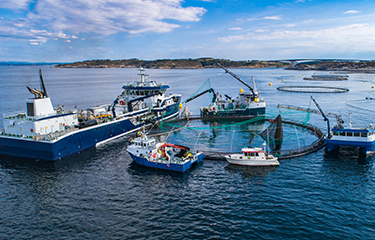
A higher than normal number infectious salmon anemia cases have been reported in Norway in the summer of 2023.
On 8 September, the Norwegian Food Safety Authority said it had confirmed an ISA outbreak in Åfjord municipality, Trøndelag county, affecting farms operated by Refsnes Laks that had previously been operated in a collaboration with SalMar until April 2023. The confirmation came after the government agency was first notified of a suspected case at the site on 25 August.
In late August, a suspected outbreak of infectious salmon anemia was discovered at a Mowi salmon farm in Volda municipality, in Møre og Romsdal county. Andin July, a case of ILA was confirmed at farms operated by SalMar and Norsk Sjømat Oppdrett in Heim municipality in Trøndelag county.
In all, there are six separate farming zones being monitored for or cleansed of ISA currently shown on the Barents Watch tracking page operated by the authority.
ISA is caused by a virus that is harmless to humans but which can cause mass mortalities at salmon farms as it spreads. Rainbow trout can become infected, but usually do not develop symptoms of the disease, according to the authority.
ISA outbreaks can be costly to Norwegian aquaculture companies, as they are forced to purge and fallow any impacted site and set up a protection and monitoring zone to ensure marine traffic is forbidden from entering the area. Much of the cost of government analysis and sampling also falls on the companies operating the impacted farms.
The high number of recent ISA cases in Norway comes on the heels of seven separate reported cases in both May and June 2023. That compares to 25 cases in all of 2021, and just 15 in 2022. In a report issued June 2023, the Norwegian Food Safety Authority acknowledged ISA cases were on the rise in the country’s aquaculture industry, calling it “a major challenge.”
“Outbreaks of ILA have serious consequences, and Norway aims to keep the disease at a low level,” it said.
In 2022, Norway implemented updated regulations for the handling of ISA outbreaks. In April 2022, the Norwegian Ministry of Trade and Fisheries called for the implementation of an eradication program to limit ISA outbreaks to fewer than 1 percent of the locations in Norway in active operation at any time, corresponding to 8 outbreaks annually. It said it would seek to establish incentives for ISA vaccination and general biosecurity measures to contribute to the achievement of that goal.
“The Ministry of Trade and Fisheries believes that the incidence of the disease in 2021 was far too high. The incidence of ILA must decrease if Norway in 12 years' time is to reach the target that fewer than 1 per cent of the locations in Norway that are in active operation at any time should have detected the disease per year,” it said. “The ministry is also of the opinion that an increase in the number of cases of ILA could weaken confidence in Norwegian salmon and thus have a negative impact on market access for Norwegian salmon.”
Earlier this year, Norway’s Veterinary Institute initiated a study of ISA outbreaks that have occurred across Norway over the past five years. Its work will include direct conversations with salmon-farming companies and other firms involved in the industry. Its goals is to improve biosecurity and monitoring efforts to limit the number of ISA outbreaks and prevent its spread to other geographies.
Photo courtesy of Marius Dobilas/Shutterstock
