



Egypt's tilapia sector is expected to post year-over-year growth in both 2023 and 2024, marking a positive shift from the stagnant output the North African country’s aquaculture sector has reported since 2020, according to a joint report from the Global Seafood Alliance (GSA) and Rabobank.
Specifically, the report, which references data from the GSA and Dutch banking and financial services provider Rabobank, estimates Egyptian tilapia production to grow 6.2 percent in 2023 and will grow 5.2 percent in 2024.
Meanwhile, five other African tilapia-producing countries – Ghana, Nigeria, Uganda, Zambia, and Zimbabwe – will post combined estimated production growth of 15.6 percent in 2023 and 17.6 percent in 2024, according to the report.
This brighter outlook is largely due to “additional culturing capacity put in place in recent years” by African governments, “as well as national policies promoting aquaculture fueled by rising local demand,” according to the Food and Agriculture Organization (FAO).
For Egypt in particular, the predicted growth in tilapia production is partly thanks to the country’s strategy of implementing market-friendly policies such as pursuing “private-sector investments and enabling public-sector interventions such as access to state land.”
The nation has attempted to woo private investment in aquaculture by emphasizing the low cost of producing seafood-derived protein compared to other products such as milk and meat.
“The investment cost of producing the required per capita supply of protein is about USD 145.2 million [EUR 134.6 million] for tilapia, compared to about USD 416.3 million [EUR 380.2 million] for milk and USD 466.6 million [EUR 432.2 million] for red meat. That is, the cost of producing fish protein is equivalent to one-third of the cost of producing milk or red meat alike,” a recent African Union report stated.
What attracts investors even more toward Egyptian-farmed tilapia is that the species is the most common fish consumed in the country.
Highlighting these benefits has helped the country secure funding, but the investments are threatened by the inherent risks that come along with Egypt’s economy, which has suffered from “soaring inflation, a shortage of foreign currency and a subsequent increase in feed costs,” the African Union stated.
“The economic crisis has greatly impacted Egypt’s seafood sector, causing instability and uncertainty within the country’s tilapia industry,” the FAO added.
The impact of national economic performance on the tilapia sector is not confined to Egypt alone, as reports indicate the emergence of similar trends in other key tilapia-producing nations and regions, such as China and Latin America.
Although global tilapia trade volumes remained stable in the first half of 2023, the FAO stated that “producers have struggled with high costs, limited availability of inputs, and demand instability,” adding that global export prices to major markets were significantly lower in the first half of the year compared to the same period of 2022.
Nevertheless, Egypt’s tilapia sector has maintained its goal of reaching 3 million metric tons (MT) of output by 2025, which would see the country maintain its top spot in African tilapia production and the third spot globally.
In its “State of World Fisheries and Aquaculture 2022” report, the FAO was a bit more conservative in its estimates, saying that Egypt’s overall aquaculture output would increase from 1.6 million MT in 2020 to 1.9 million MT in 2030 – an equivalent of nearly 68 percent of Africa’s total aquaculture production, which is estimated at 2.8 million MT.
However, Egypt’s Ministry of Agriculture and Land Reclamation recently said that these statistics lowball the country’s actual output, claiming that aquaculture production has already grown to 2 million MT, which is slightly below the country’s annual consumption demand of 2.4 million MT.
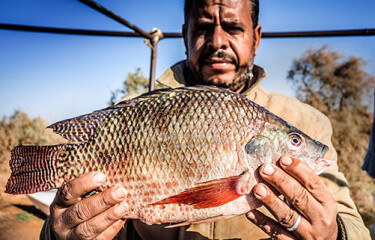
Photo courtesy of International Institute of Tropical Agriculture
