



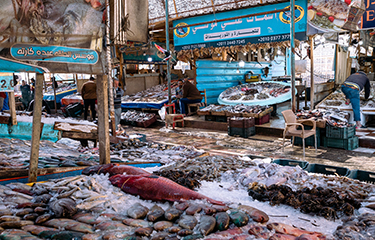
An ongoing economic crisis in Egypt is shaking the country's seafood sector, as it faces historic currency devaluation, rising inflation levels, and foreign currency shortages.
The country's inflation rate spiked 8.5 percent in 2022 due to the global crisis triggered by the Russia-Ukraine conflict and to the devaluation of the Egyptian pound, which lost half of its value compared to pre-conflict, according to an analysis by Stanbic Bank. Egypt is heavily reliant on wheat exported from Ukraine and Russia, and that trade has been disrupted as a result of the war. The significant drop in imports of grains is a negative sign for the health of Egypt’s economy, as it was the world’s largest importer of wheat before China took that spot.
Egypt is facing a deepening economic crisis, with the Egyptian pound falling 50 percent compared to the U.S. dollar in 2022, and food price inflation has reaching 60 percent.
“Economic fallout from the war in Ukraine spiked international prices higher and generated a foreign currency crunch in Egypt, coupled with the Egyptian pound losing almost half of its value against the U.S. dollar since March 2022,” a U.S. Department of Agriculture (USDA) report said.
Egypt's aquaculture industry, a robust sector focused on tilapia, has been hit by higher grain prices. The country is the top aquaculture producer in Africa and the sixth-largest by volume worldwide, producing third-highest volume of tilapia globally. Egypt's government has set a target of increasing its fish production to more than 3 million MT by 2025. The country fast-tracked government plans to expand and improve the protection of several of its inland fisheries, particularly lakes, as part of a fisheries and aquaculture development scheme.
That plan is under duress, however, as the 105 privately-owned feed mills in Egypt, which account for 95 percent of the country’s fish feed production, have had to grapple with a major slowdown in corn and soybean imports. World Grain reported the country’s imports declined 62 percent year-over-year to 880,000 MT between October 2022 and February 2023.
And Egypt's seafood imports have also plunged, according to the Central Bank of Egypt, declining from USD 203.9 million (EUR 189.5 million) in Q2 2022 to USD 173.5 million (EUR 161.2 million) in Q3 2022, to USD 137.8 million (EUR 128 million) in Q4 2022.
Initially, it looked like Egypt's tuna exports might be an exception to that trend. Thailand, the top exporter of tuna to Egypt, reported a 15.5 percent increase in its tuna exports to Egypt for the January-June 2022 period, reaching 38,950 MT – up 33,700 MT from the same period in 2021. And Vietnam exported 44 percent more tuna, worth USD 8.4 million (EUR 7.8 million), to Egypt in the first five months of 2022, up 44 percent compared.
However, that positive trend was reversed in the latter half of the year. Egypt's tuna imports from Thailand decreased 19 percent in 2022, declining from 71,380 MT worth USD 199 million (EUR 185.6 million) in 2021 to 57,839 MT worth USD 174 million (EUR 162 million) in 2022.
Egypt's tuna imports from Vietnam also dropped in the latter half of 2022, with Haiquan reporting the country’s tuna exports to Egypt dropped by 41 percent. Vietnam Customs predicted the country's exports to Egypt would continue to decline as inflation and depreciation reduced the North African country's purchasing power.
Photo courtesy of Curioso.Photography/Shutterstock
