

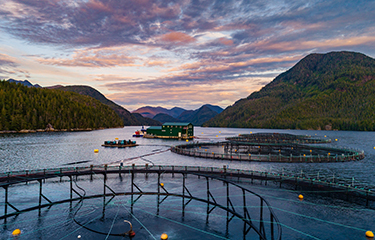
Grieg Seafood harvested more fish than planned from its Norwegian operations in Q1 2023 after both its Rogaland and Finnmark salmon-farming sites contended with biological challenges.
According to Grieg’s first-quarter 2023 report, its Rogaland operations harvested 7,502 metric tons (MT) of salmon in the quarter, compared with 9,645 MT in Q1 2022,2,200 MT above guidance due to earlier-than-expected harvesting to reduce biological risk related to presence of infectious salmon anemia (ISA) at one site and winter ulcers.
Finnmark’s volume for the quarter was 7,856 MT, versus 5,175 MT a year previously. Grieg’s confirmed this was 2,100 MT above guidance due to advance harvesting related to the Spiro parasite (Spironucleus salmonicida) and winter ulcers.
Grieg said no new incidents of Spiro were detected at the freshwater facility during the first quarter, and to compensate for the advance harvesting, the smolt release for the remainder of the year will be ramped up to rebuild biomass. But the company said this initiative is not expected to fully compensate for the lost fish, and it subsequently reduced its 2023 harvest target for Finnmark from 28,000 to 26,000 MT.
Largely due to these challenges, the firm’s farming costs per kilogram increased to NOK 58.40 (USD 5.53, EUR 5.05) at Rogaland and NOK 62.80 (USD 5.94, EUR 5.43) at Finnmark.
Grieg harvested no fish in British Columbia, Canada, in Q1 2023 in order to grow biomass, it said. In Q1 2022, the region’s harvest volume was 2,096 MT. Grieg reported stable growing conditions at its BC farms in the quarter.
Grieg also reported it plans to conduct its first harvest from its new Newfoundland (NL) operations by the end of 2023. It reported its fish in Newfoundland have experienced good growth and health, with high survival and no sea lice issues, and that its production plan is on schedule.
Overall, the group's farming cost for Q1 2023 was NOK 61.50 (USD 5.83, EUR 5.31) per kilo versus NOK 43.40 (USD 4.11, EUR 3.75) a year prior, and up NOK 3.90 (USD 0.37, EUR 0.34) per kilo compared on Q4 2022’s NOK 57.60 (USD 5.46, EUR 4.98).
Grieg, based in Bergen, Norway, supplied close to 3 percent of the global volume of Atlantic salmon harvested in Q1 2023, with 75 percent of its exported volume going to Europe, 17 percent to Asia, and 8 percent to North America.
Its harvest volume for the Q2 2023 is expected to total 21,300 MT, with its operations in Rogaland providing 10,500 MT, Finnmark 5,500 MT, and BC 5,300 MT. For the full-year 2023, it has forecast a total harvest of 80,000 MT, down from its previous guidance of 82,000 MT. Of this, it expects Rogaland to produce 29,000 MT, Finnmark 26,000 MT, BC 20,000 MT, and NL: 5,000 MT.
Grieg posted operational earnings before interest and taxes (EBIT) of NOK 385 million (USD 36.5 million, EUR 33.3 million) before fair-value adjustment of biomass in Q1 2023 – a decrease of NOK 68 million (USD 6.4 million, EUR 5.9 million) on the corresponding period of 2022.
At the same time, its sales revenue increased by NOK 81 million (USD 7.7 million, EUR 7 million) to more than NOK 1.5 billion (USD 142.1 million, EUR 129.6 million), while the total volume of salmon harvested in the quarter slipped by 1,559 MT to 15,357 MT gutted-weight.
It achieved an EBIT per kilogram of NOK 25.10 (USD 2.38, EUR 2.17), versus NOK 26.80 (USD 2.54, EUR 2.32) a year previously.
Grieg CEO Andreas Kvame confirmed that growth investments for Gthe company's Norwegian operations have been put on hold while it awaits the final version of the government’s proposed aquaculture resource tax, which is expected by the end of June. The company’s stalled investments are currently valued at approximately NOK 2.3 billion (USD 217.9 million, EUR 198.7 million).
“The tax would significantly impact sustainable development of the industry in Norway should it be adopted in its present form, and we hope the parliament will make the necessary changes to secure continued innovation, investments and sustainable development throughout our production cycle, which is necessary to improve biology and sustainability,” Kvame said.
Looking forward, the company expects a “good market” as a result of very limited global supply growth of Atlantic salmon in combination with the outlook for continued high demand both in retail and the hotel, restaurant, and catering (HORECA) market.
Separately, Grieg has confirmed the appointment of Nina Stangeland as chief strategy officer. She will also be a member of Grieg’s executive management team. Stangeland has nearly two decades of experience in business development, corporate finance, and mergers and acquisitions within in the seafood, maritime, and finance industries. Since 2019, she has been managing director of the NCE Seafood Innovation cluster, a 130-member initiative aimed at promoting innovation and sustainability in the Norwegian seafood industry. Strangeland will begin at Grieg on 1 September 2023.
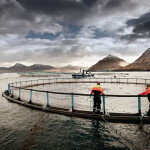
Photo courtesy of Grieg Seafood
